
For switching between model families, OpenRouter is a useful starting point; for an individual using included open models frequently, NanoGPT’s subscription deserves a closer look. Vercel AI Gateway is attractive when avoiding token markup matters, Chutes suits open-model inference, and Requesty packages routing with team controls. The best value depends on the models you actually use and the restrictions your workload can accept.
A low price per million tokens is only part of the bill. Credit-purchase fees, paid fallback routes, reasoning tokens and subscription exclusions can change the result. These five recommendations are ordered by use case, rather than presented as a measured speed or universal cheapest-price ranking.
Pricing and terms checked on November 4, 2026. This is a documentation-based comparison with original cost calculations, not a paid API latency or output-quality benchmark. Prices below are USD before tax, currency conversion and payment-provider charges.
Choose by workload, not the headline price
| Provider | Best fit | Cost structure / main restriction |
|---|---|---|
| OpenRouter | Switching models and providers | Standard: 5.5% credit-purchase fee; minimum fee can matter |
| NanoGPT | Frequent personal use of included models | $12/month Pro; 60M input units/week; exclusions apply |
| Vercel AI Gateway | Developers wanting list-price routing | No token markup; optional features and fallback can cost extra |
| Chutes | Hosted open-model inference | Model-specific PAYGO; monthly plans no longer sold |
| Requesty | Teams needing routing and spend controls | PAYGO: model cost + 5% |
1. OpenRouter — the flexible starting point
OpenRouter combines a model catalog, a unified API key and provider routing. Its practical advantage is avoiding a separate integration and prepaid balance for every model family. Automatic fallback can keep a workflow going when a provider fails, while provider preferences help control who receives the request. It is especially useful for comparing models in an OpenAI-compatible chat client or coding workflow.
OpenRouter — Official pricing and product information
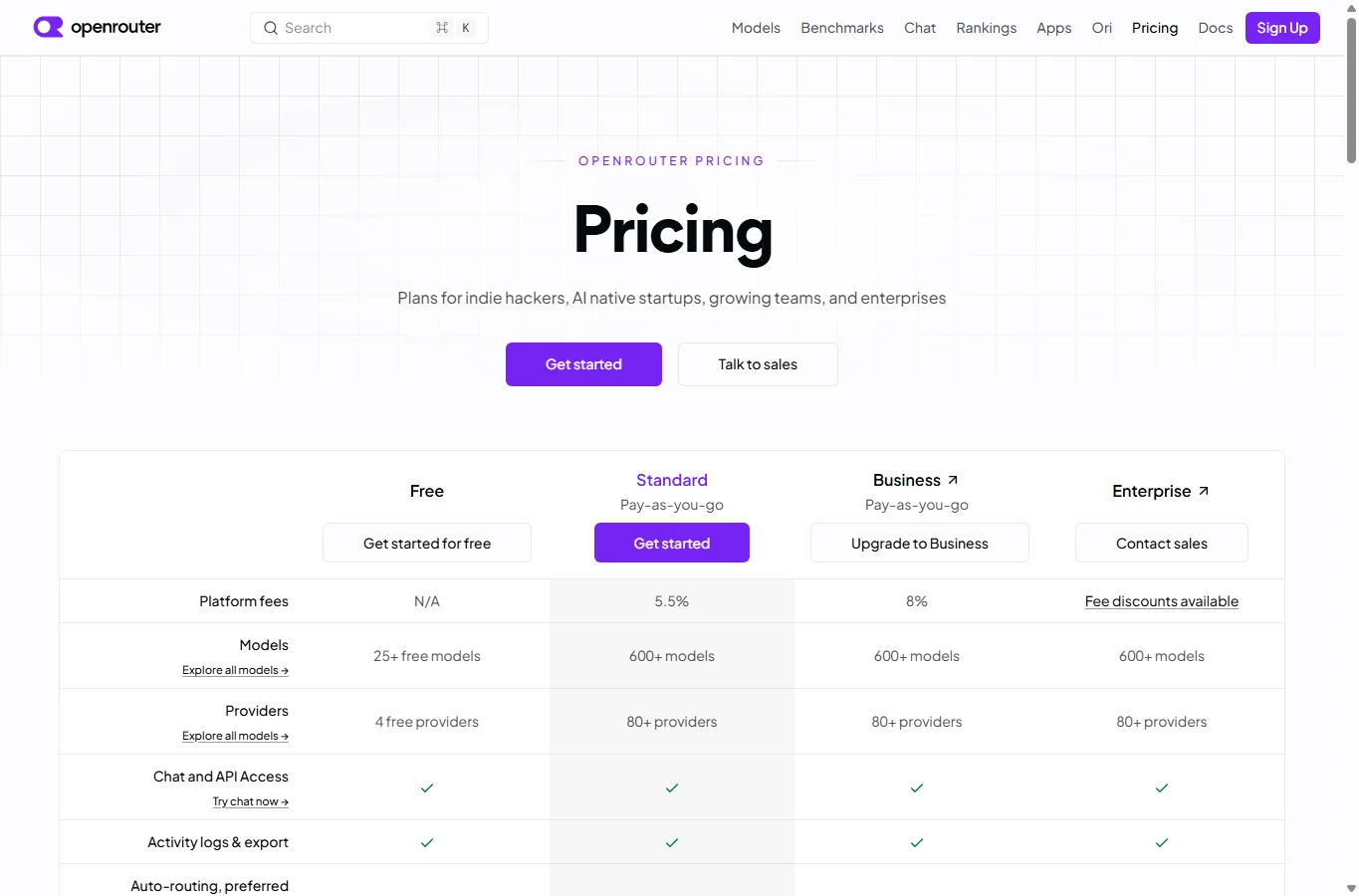
Standard passes through provider model prices but adds a 5.5% fee when credits are purchased; Business is 8%. The card-purchase minimum of $0.80 makes tiny top-ups relatively expensive. That is a funding fee, not an additional 5.5% added to every inference after the same credits are spent. Standard/Business BYOK currently includes $25,000 of monthly list-price inference, then charges 5% of equivalent model cost. BYOK also leaves you paying the upstream provider.
Start with one exact model ID and a narrow provider policy, then enable fallback deliberately. Different providers can differ in context support, caching, price and data handling even for the same model name. Free-model quotas are for exploration, not a production capacity promise. Choose OpenRouter for breadth and routing convenience; if you use only one model reliably, compare its direct API before paying for an extra layer.
2. NanoGPT — strong value for the right individual workload
NanoGPT offers web chat and an OpenAI-compatible API using the same account balance. Default text routing is advertised at model list prices with no deposit percentage fee. The important exceptions are manual provider pinning and BYOK: both add 5% of normal model cost. This makes it worth comparing the default route with a pinned route before treating “no markup” as an all-purpose rule.
NanoGPT — Official pricing and product information
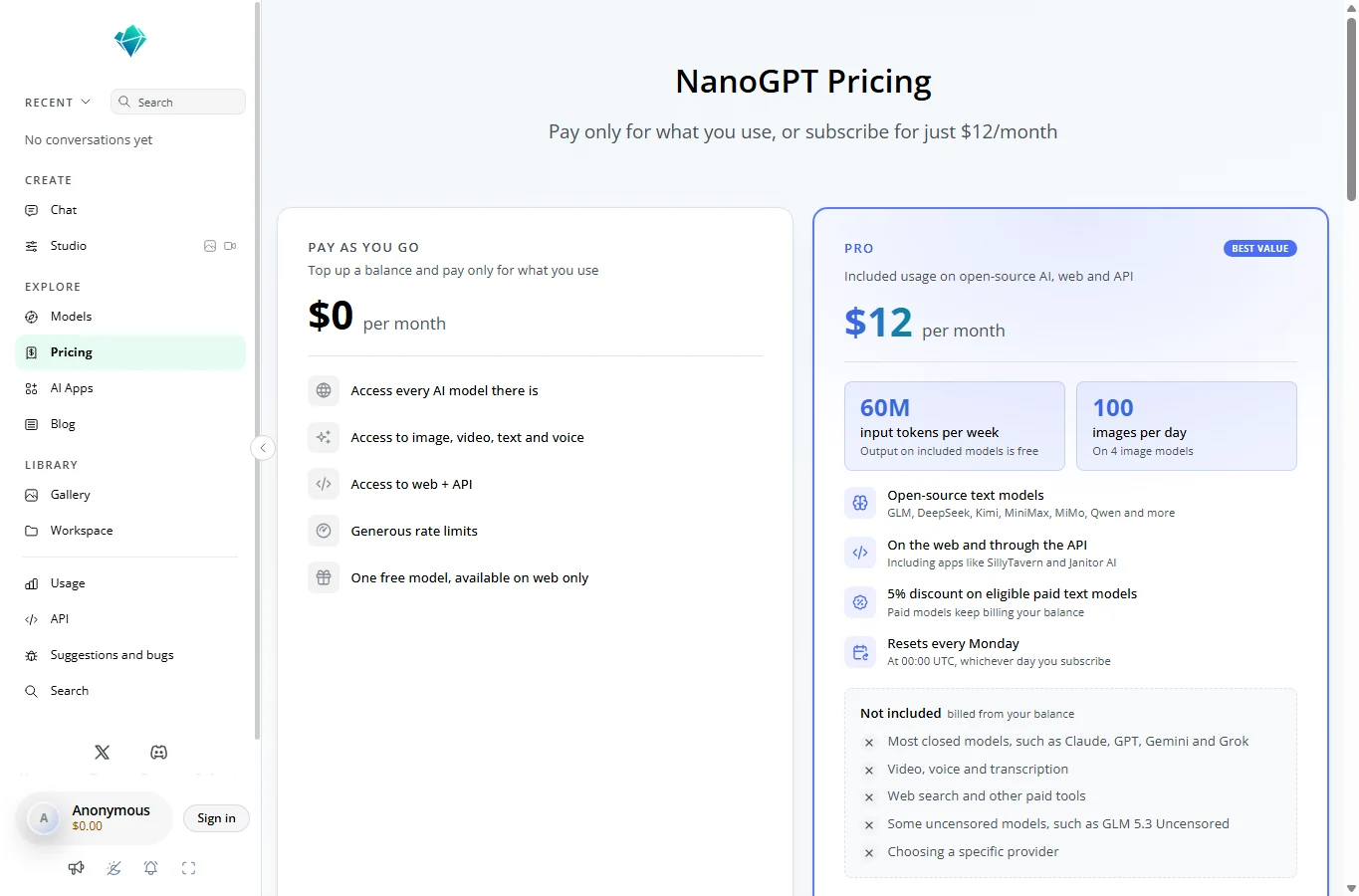
Pro is $12/month with 60 million input-token units per week on included models; output on those models is included. This is not an all-model subscription: most closed models, voice, video, web search and explicit provider selection are outside it. Web and API share the allowance. Some models use a 2× multiplier, cached input still counts in full, and the weekly reset is Monday at 00:00 UTC, not your renewal time.
The subscription is for one person: sharing, reselling or pooling it for a multi-user service is not allowed. Use PAYGO/team billing for that workload. For an API client, select the subscription endpoint and a model from its included catalog; the ordinary PAYGO endpoint is a different billing route. Exhaustion can pause requests or consume balance if you allow it. Keep balance fallback disabled when a fixed monthly ceiling matters, and evaluate your actual local-language prompts rather than assuming every included model is equally fluent.
3. Vercel AI Gateway — list-price routing for application developers
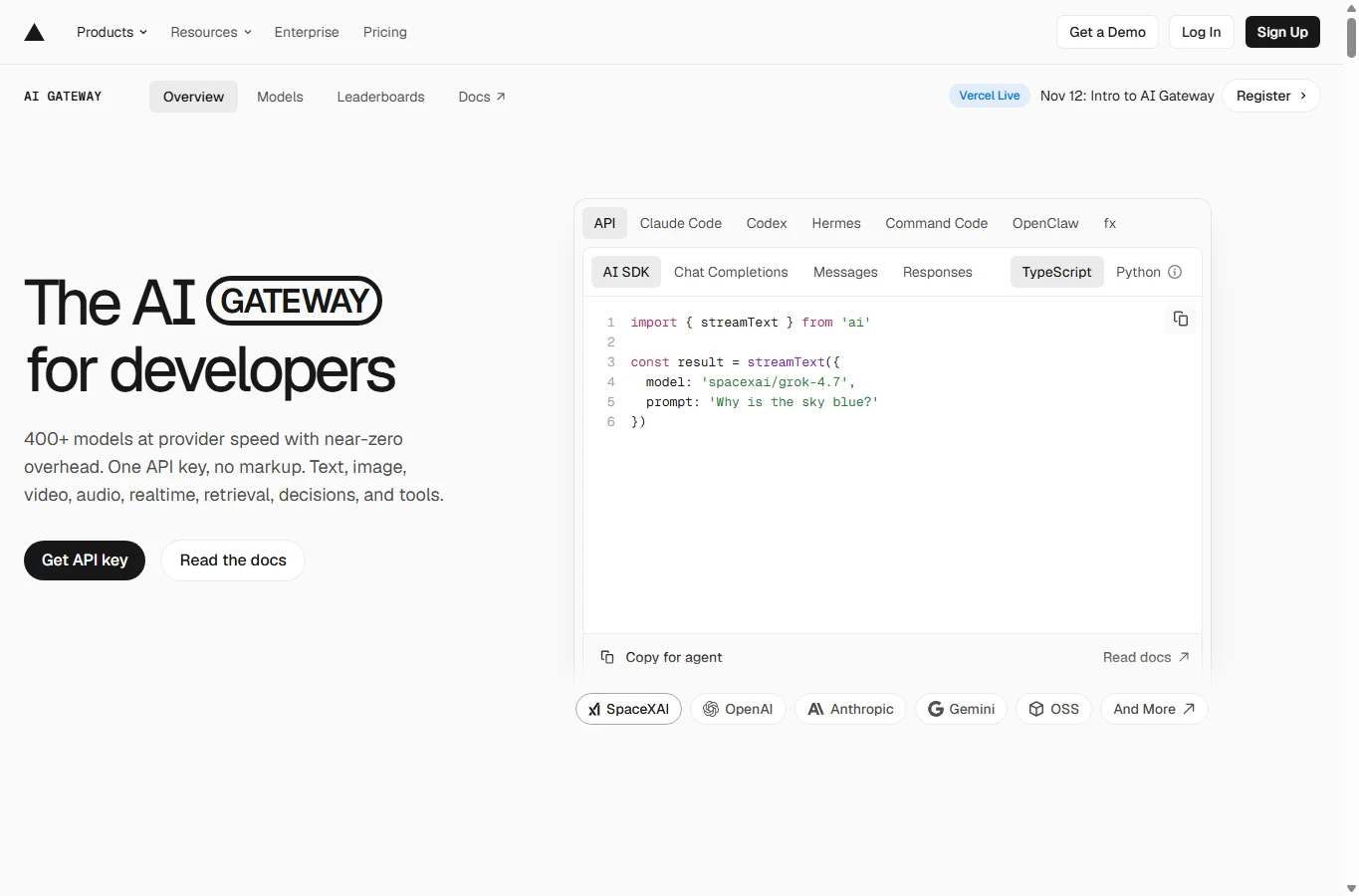
Vercel AI Gateway can be used outside Vercel hosting. It offers unified model access through the AI SDK and compatible API endpoints, with provider list prices and no token markup, including BYOK. This is appealing if you already maintain an application and want central routing without adding a percentage to every token.
Vercel AI Gateway — Official pricing and product information
The free tier includes $5/month for eligible models at lower rate limits; purchasing Gateway credits moves the team to the paid tier and ends the recurring free allowance. BYOK requires purchased credits. If your upstream credentials fail, fallback using Vercel’s system credentials can spend the Gateway balance. Gateway budgets do not cover the upstream provider’s BYOK bill: set a second budget with that provider.
Zero token markup does not mean all platform features are free. For example, team-wide provider allowlisting and team-wide zero-data-retention routing each have listed request-based charges; the per-request controls have different pricing. Reporting and trace exports can add further costs. Use the simplest routing configuration first, and add governance features only when needed. It is less compelling if you want a personal flat-rate subscription rather than to manage an API integration.
4. Chutes — compare it as an open-model inference host
Chutes is primarily inference infrastructure for hosted models, rather than a broad relay for all closed-model vendors. Its PAYGO rates should be compared against the same open model, context length and quantization elsewhere. A low open-model rate does not tell you what access to a proprietary model would cost, and model availability can differ from a general aggregator.
Chutes — Official pricing and product information
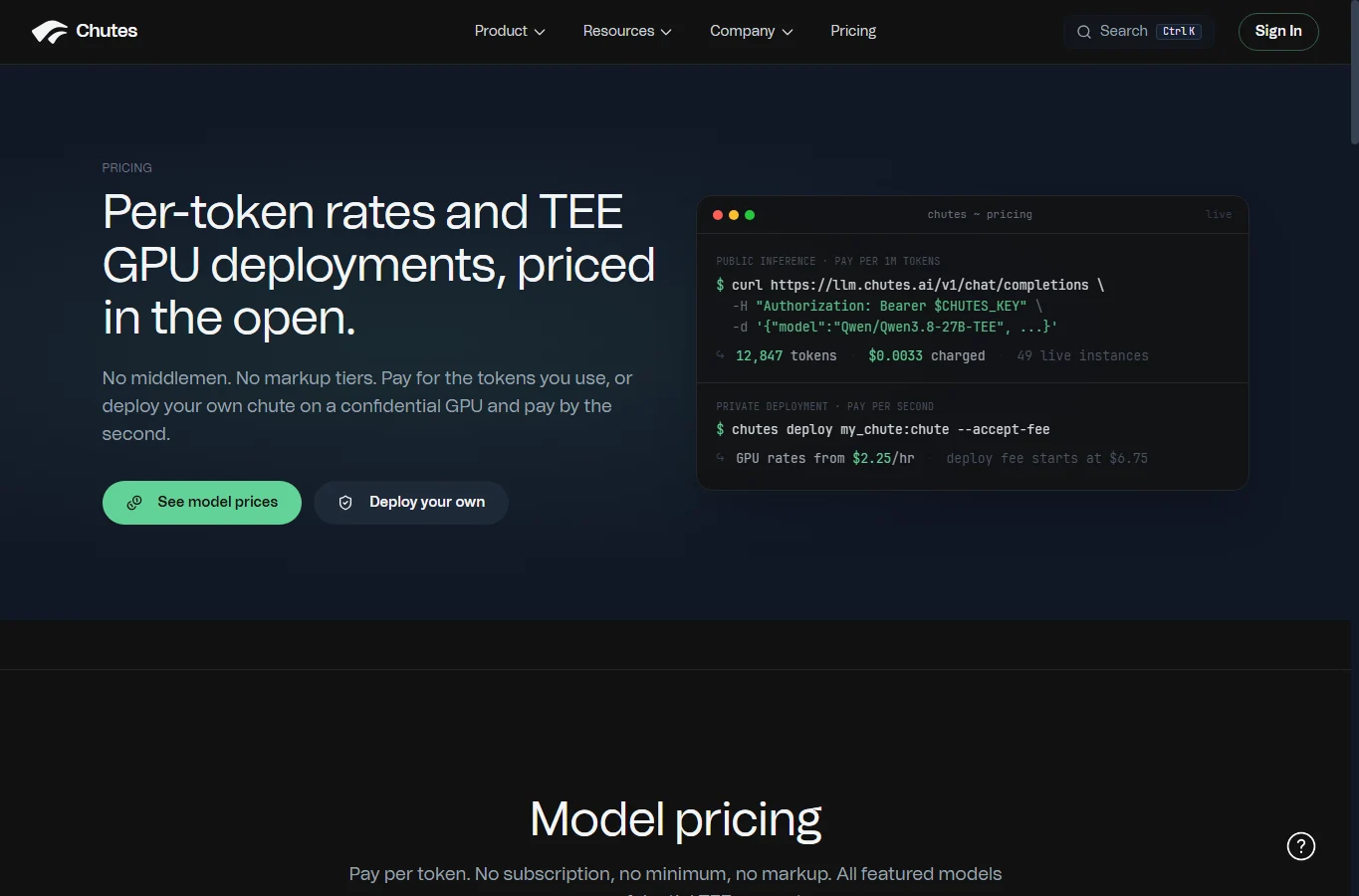
Chutes’ current pricing FAQ says monthly plans are no longer sold. Existing plans last until the end of their current billing period and do not renew; subsequent use is PAYGO from the account balance. Do not buy on the assumption that older $10/$20 subscription offers remain available. There is currently no free tier, and hosted inference has no subscription commitment.
The live pricing page, for example, lists Qwen3.8-27B at $0.039 per million uncached input tokens and $1.25 per million output tokens. One million input plus 250,000 output tokens would therefore cost $0.3515, before extras and taxes. This is a calculated example, not a measured task or a claim of equivalent quality to a different model. Cache hits use a different input rate. Model ID, context and tool support still need to match your application.
5. Requesty — pay for routing and operational controls
Requesty offers an OpenAI-compatible gateway with routing policies, caching, fallbacks and spending controls. Its PAYGO model is straightforward: model cost plus 5%, without per-seat pricing or a minimum spend. This fits a team that values central management more than shaving the final percentage off a small personal bill.
Requesty — Official pricing and product information
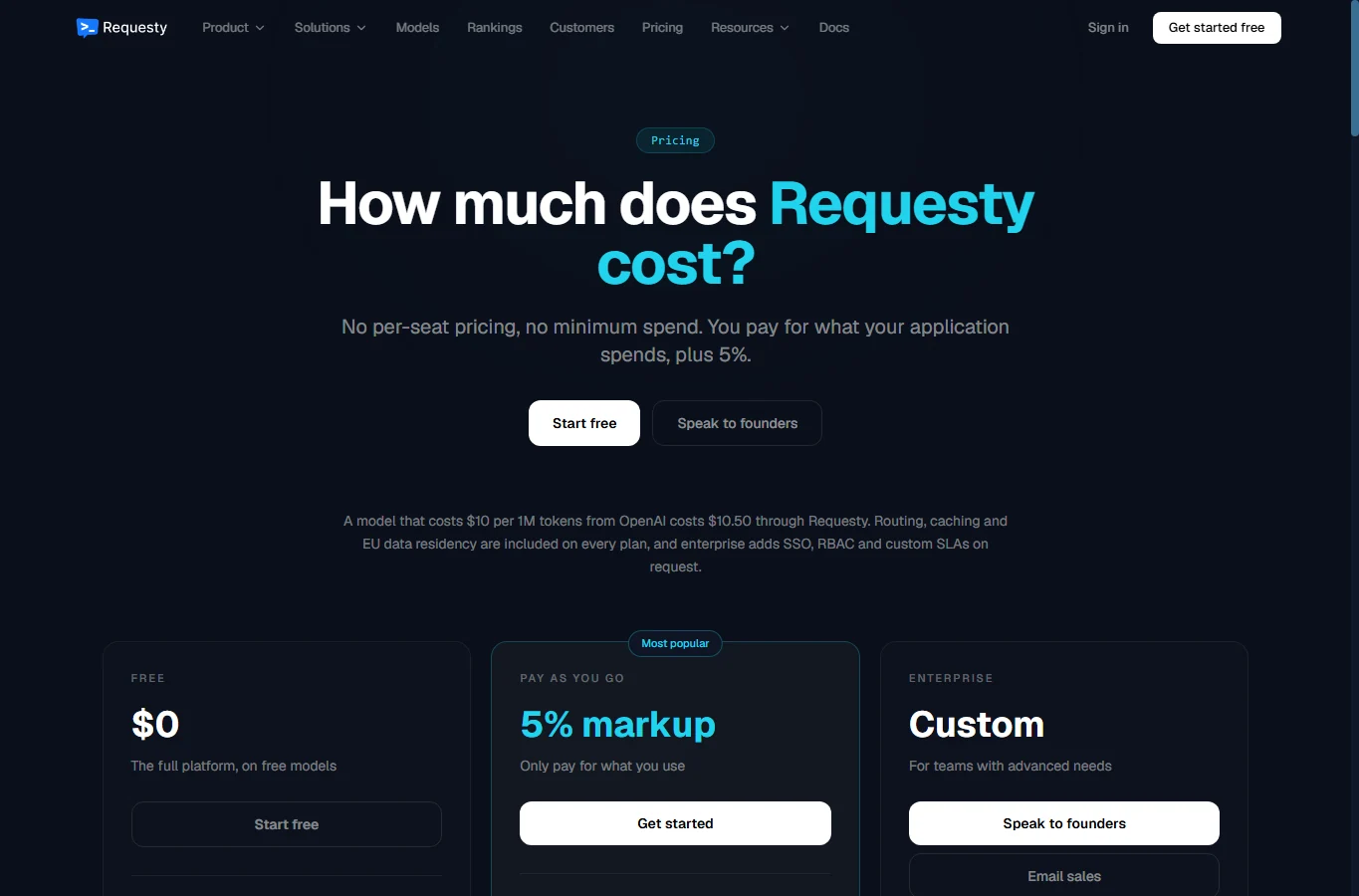
The pricing page lists EU data residency alongside the base platform features; Enterprise adds controls such as SSO, RBAC, audit logs and custom SLAs. A business should still distinguish where the gateway keeps data from where each selected upstream model processes it. Regional settings and an approved-model policy matter more than a generic compliance badge.
The free tier is limited to free models and 200 requests/day. Use it to check request compatibility and usage reporting, not to infer paid-model latency or guaranteed capacity. For production, set a key budget, an explicit fallback policy and an approved provider list. The cost example below uses ordinary PAYGO; do not assume a separate BYOK arrangement has the same billing conditions.
What $100 of identical inference actually costs
Assume the same model, input/output token counts, cache behavior and $100 upstream list-price inference. NanoGPT default text PAYGO and Vercel’s base token billing would be $100; Requesty PAYGO would be $105; buying $100 of OpenRouter Standard credits would cost $105.50, or $108 on Business. These are fee calculations, not measured invoices; they exclude taxes, exchange rates, payment fees, discounts and optional services.
For an OpenRouter card top-up of $10, the $0.80 minimum means a total of $10.80: an effective 8% funding cost. Larger purchases reduce the impact of that floor, but do not justify prepaying money you may not use. Chutes has its own hosted-model rates, so it cannot be placed in this identical-upstream-price calculation without first matching the actual model and serving configuration.
NanoGPT Pro only saves money when eligible PAYGO spending avoided exceeds $12/month; a large token count on excluded models does not help. Chutes should now be budgeted as PAYGO rather than a new flat-rate subscription. Multi-step agents repeatedly send growing contexts, so count the whole run, including reasoning, tool loops and retries.
Connect safely and compare your own workload
- Create a separate API key and a small spending limit for the client. Keep keys on your server or in the client’s protected settings, never in public browser code or screenshots. Disable automatic top-up while evaluating.
- Set the base URL, provider-issued API key and an exact model ID. OpenAI compatibility describes the request format; it does not guarantee every model supports tools, images, JSON schemas or identical token parameters.
- Send a short prompt in your working language, then try a representative long conversation, a tool call and streaming if your application uses them. Inspect the actual serving model/provider, input/output/reasoning usage and final charge.
- Compare several matched tasks with the same output limit. Count failed requests, retries and paid fallback, then set production concurrency and retry backoff. A 429 is a rate/quota signal; unlimited immediate retries can make both reliability and cost worse.
OpenAI-compatible base URLs (plain text, not additional destination links)
- OpenRouter:
https://openrouter.ai/api/v1 - NanoGPT:
https://nano-gpt.com/api/v1 - Vercel AI Gateway:
https://ai-gateway.vercel.sh/v1 - Chutes:
https://llm.chutes.ai/v1 - Requesty:
https://router.requesty.ai/v1
NanoGPT subscription-only requests use https://nano-gpt.com/api/subscription/v1 with models from its subscription catalog. Do not assume that setting the standard base URL automatically uses your subscription.
Privacy, language and the final choice
These services route prompts to remote infrastructure. A gateway’s logging policy is separate from its upstream model provider’s retention policy. Check both before submitting client files, personal information or confidential code. BYOK changes credentials and billing; it does not automatically keep prompts on your device or exclude an intermediary.
An English dashboard does not prevent multilingual API use, but generation quality and token consumption depend on the selected model. Test your own language, document lengths and tool arguments; do not convert English word counts into a universal token budget. Account eligibility, payments and model availability can vary by country. Prices here remain in USD rather than promising a local-currency checkout price.
Start with OpenRouter for model exploration, NanoGPT for eligible personal subscription use, Vercel for list-price developer routing, Chutes for matched open-model inference, or Requesty for team operations. Run a small capped trial with your own tasks before moving a full agent workload.
Related
5 Best Character.AI Alternatives After Its Bankruptcy Filing

6 Best Photorealistic AI Image Models for People and Photography

Best AI Research Paper Summarizers for Students and Researchers
Best 10 Chrome Extensions in 2026: Practical Add-ons Worth Installing
Best AI Health Apps in 2026: 5 Tools for Sleep, Wellness and Daily Support
Best AI Hashtag Generators to Find Tags for Instagram, TikTok, and More