

A good Character.AI replacement has to preserve more than a character’s name. The real questions are whether it can keep the same voice, remember the story, and let you take your work elsewhere. Kindroid is the easiest starting point here for a configurable recurring character; Nomi suits an evolving companion; RisuAI and SillyTavern give you more control over models and character settings. AI Dungeon is the separate pick for interactive adventures.
Character.AI announced a Chapter 11 filing on October 12, 2026. That does not mean the platform has already closed: its official update says services remain available while it pursues a sale, with a wind-down possible if no viable bid emerges. Exporting your data and trying alternatives now is sensible; treating a shutdown as a completed event is inaccurate. Character.AI’s official status update.
On this page
Choose by the experience you want
Selection checked October 28, 2026. These are recommendations by use case, based on documented features and limitations, not a scored hands-on benchmark or a guarantee of identical character behavior. Screenshots show official product pages or documentation.
| Tool | Best fit | Cost model | Main trade-off |
|---|---|---|---|
| Kindroid | A recurring character you can configure | Limited preview; ongoing use needs a subscription | Memory upgrades can add to the base bill |
| Nomi | An evolving companion and ongoing relationship | Free allowance; paid features and recurring subscription | No reply rerolls or direct message editing |
| RisuAI | Character cards across different AI providers | Client and model costs are separate | You must choose and configure a suitable model |
| SillyTavern | Detailed worlds and control over the backend | Free frontend; API or local hardware costs | More setup and maintenance |
| AI Dungeon | Interactive adventures and world exploration | Free entry; paid model/context options | Adventure narration rather than a direct chat clone |
The best alternatives for different roleplay styles
1. Kindroid — Best for configuring a lasting character

Kindroid gives a recurring character a deliberate foundation: write a short backstory, keep essential facts in key memories, and use journals for events you want it to retrieve later. Its separate persistent, medium-term and retrievable memory systems make it a useful choice when the ongoing relationship matters more than browsing an enormous public bot catalog. Start with one character and a compact scenario before adding group interactions.
The practical limitation is cost, not simply whether it has a free sign-up. The current preview is finite; a three-day premium trial requires payment details and renews unless cancelled. Ultra and MAX are additional subscriptions with prerequisites, so do not read an add-on price as the complete monthly bill. Prices vary by country and purchase platform. New accounts receive 50 preview messages, or 15 in some regions. After the allowance ends, the account becomes read-only; existing material remains available to view and export.
For voice or multilingual roleplay, check the actual chat and call settings separately from the interface language. A translated menu does not guarantee natural character dialogue. Keep the default behavior settings initially and correct important story facts in the character definition rather than continually rewriting the whole backstory.
Finding a character versus transferring a relationship
Kindroid has shared character templates, so starting from scratch is optional. A template supplies a starting setup, not its creator’s private conversations or accumulated relationship. For a familiar fictional character, assess the greeting, speech examples and backstory rather than trusting the name or portrait. Public sharing is moderated separately from private use; a character available privately is not automatically eligible for public discovery.
What replaces swiping, editing and starting over?
Use Regenerate for a new answer, Suggest to steer a mostly good reply, and Tweak for a small manual correction to the latest AI message. That distinction matters when one wrong name would otherwise spoil a scene: correct the detail instead of chasing a perfect reroll. Rewind covers only the latest ten messages, so it is not a way to rewrite an entire old chapter.
Recovering a long-running story without erasing the character
A Chat Break resets short-term chat context while retaining the backstory, journals and long-term memory. Use it when a conversation is stuck, with a fresh greeting that establishes the intended tone and current scene. It is not a clean alternate universe with every previous event forgotten. Save a plot summary first, especially before trying a different relationship stage or a new storyline.
2. Nomi — Best for an evolving companion
Nomi is a better match when you want a character to develop through repeated conversation rather than reproduce a public Character.AI bot line by line. Its customization, relationship continuity and group conversations favor a small recurring cast. Give each character a distinct role and write down which facts belong to the fictional world, especially when you also use the same companion for everyday conversation.
Free access lets you test the tone before subscribing; group chat and voice are among the paid capabilities, and subscriptions renew. Message-length limits are another practical constraint: a large scene outline may need to be shortened or broken into several turns. Do not mistake promotional claims about human-like memory for a promise that every detail will always be recalled. User messages allow 400 characters on the free plan and 800 on paid plans. These are input limits, not limits on the AI’s reply length.
Nomi’s language caveat matters even for English users planning bilingual scenes: its voice documentation says English is the primary target. Other-language fluency and pronunciation vary. Test text and audio independently, and check any separate voice-provider allowance before assuming a subscription includes everything.
The crucial difference for people who keep swiping
Nomi does not offer reply rerolls or direct editing of chat messages. You resolve an unwanted response through the conversation rather than selecting another generated version. This suits readers who accept an evolving character with some agency, but it is a substantial drawback if you repeatedly audition replies, demand exact canon dialogue, or want to rewrite every awkward romantic scene. Choose for that trade-off, not simply for the promise of memory.
Group scenes need their own shared background
A group can let you choose the next speaker or use Auto-play. Its shared Backstory is where the cast’s common setting and roles belong. Do not assume everyone knows the private history of your one-to-one conversations. Before a reunion scene, write the few relationship facts all participants need to know; otherwise a polished response can still contradict what another character should know.
Pausing the story and correcting remembered facts
Proactive messages can be switched off if you want the fiction to wait for your return. Editable Mind Map entries can help correct a mistaken association, but changing a summary does not erase the underlying memory. For a new adventure with the same companion, explicitly close the previous scene and establish what carries over. Nomi is more comfortable as continuity you negotiate than a save file you can freely rewrite.
3. RisuAI — Best for character cards and model flexibility
RisuAI puts character creation and reuse at the center. Its web and desktop options, character-sharing ecosystem, group chats and lorebook support suit people who want to keep a cast while changing the model behind it. Build one original character, connect a supported provider, then test a short scene before importing a complicated world or adding visual assets.
This flexibility moves responsibility to you. RisuAI is a client with multiple backend choices, not a promise of free unlimited inference. Your selected service determines generation charges, model availability, content restrictions and much of the writing quality. Memory compression can help fit a long story into context, but a summary can lose small details. Back up your characters and important scenes outside the application.
Its translation features are useful when a character card and the chosen model work in different languages. They add another layer that can alter jokes, pronouns and names. For bilingual roleplay, keep a short glossary and compare direct target-language generation with translated output before committing.
Ready-made cards are a starting point, not a faithful clone
RisuRealm gives RisuAI a character-sharing route, useful if browsing creations is part of what you enjoy. Inspect a card’s opening scene and author notes before judging the model. A beautiful portrait or elaborate presentation says little about its dialogue instructions. Keep a working copy before changing a card you are permitted to reuse, and do not assume a Character.AI account export can be dropped into every card format.
A richer roleplay presentation without confusing it with memory
Emotion images, embedded media and text-to-speech can make a scene feel closer to a visual novel than a plain message thread. They are presentation features, not evidence that the character understands your relationship better. Start with text and a simple character; add visuals after the voice and scene rules work. This also makes it easier to identify whether an odd response comes from the card, translation or model.
What happens when you change the AI behind the character?
Keeping a card while changing providers is attractive if you are tired of one platform deciding the entire experience. However, the same instructions can sound colder, more verbose or less in character on another model. Compare a short disagreement, a quiet conversation and a multi-person scene before moving a long story. Cloud calls and repeated generations may be billed separately, and a frontend cannot remove the connected provider’s content rules.
4. SillyTavern — Best for worldbuilding and backend control
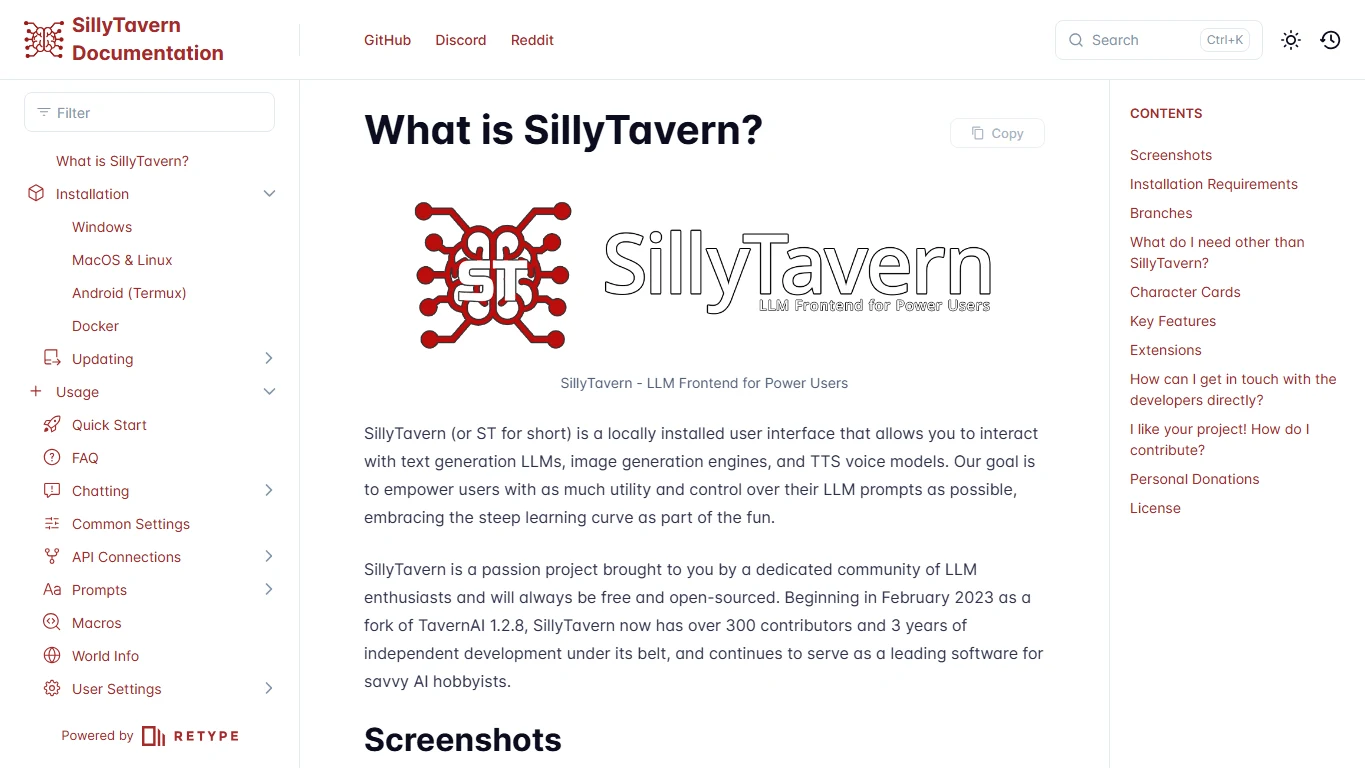
SillyTavern is the strongest option here for people who want to inspect and tune the structure of a roleplay session. It is a frontend: you connect a local model or a cloud API, then configure character cards, personas, group conversations and World Info. A lorebook lets relevant world details enter the prompt when triggered, which is more manageable than pasting an entire fictional encyclopedia into every turn.
The trade-off is setup. You must install and maintain the frontend and choose a compatible backend. The software being free does not cover cloud tokens, local hardware or optional voice services. Local installation alone also does not keep chats offline: a cloud endpoint still receives the prompt you send it. Choose the backend first, then decide how much setup you are willing to do.
A multilingual model is essential for multilingual characters. The interface language and chat-translation extension are separate settings. Keep the permanent character description concise so conversation history has room in the context window; add world entries only when needed. AirMore’s beginner guide is useful if you want a guided setup rather than a long configuration session on day one.
Recreating the voice, not just the name
For canon characters, put characteristic speech patterns into dialogue examples and use an opening message that demonstrates the narration length you want. Your Persona describes who you are in the scene; it does not require rewriting the AI character to match every new user role. This is useful for switching between an original protagonist and a self-insert while keeping the cast’s identity separate.
Trying another route while preserving the original scene
Branches and checkpoints let you keep a conversation at a chosen moment and explore a different continuation. That is especially useful for alternate endings or restarting a romance arc without discarding the existing chapter. Export JSONL for a re-importable chat backup; a plain-text export is for reading and loses required metadata. Even the structured export excludes images and attachments, so keep those assets separately.
Group dialogue and filters depend on your setup
Manual reply order lets you pick who speaks next, rather than asking every character to answer at once. Begin there if characters steal each other’s dialogue. Several generated speakers can also mean several paid API requests. SillyTavern controls how the prompt is assembled; the connected model still determines much of the prose, response speed and content boundary. Choose it for control and portability, not as a guaranteed filter-free hosted chat service.
5. AI Dungeon — Best for interactive adventures
AI Dungeon is the better fit if your favorite part of Character.AI was exploring a world and making decisions. Create an adventure or scenario, give the AI a premise, and steer the unfolding narrative with your actions. Plot Essentials, Story Cards and memory features help organize ongoing fiction; editing or retrying a passage is part of the workflow, not proof that the story has failed.
It is less direct as a replacement for a familiar one-to-one chat persona. Context capacity and available models depend on the plan, and some settings can consume credits. Story Cards and recalled memories must still fit into the active context. Test a free adventure with a small cast first, then consider paying only if you need more context or a particular model.
AI Dungeon officially supports English only. Other-language attempts may work, but should not be treated as supported localizations. It is included here for English-language adventures rather than presented as a universally multilingual chat service.
Community scenarios replace the bot-opening experience
If you enjoy starting a new story with a single premise, a community scenario is the closest entry point here. Treat it as a world and initial situation, rather than a promise of one perfectly impersonated celebrity or fictional character. For a recurring cast, keep the important roles and relationship facts in the story setup so the adventure has something more reliable than scattered dialogue to refer to.
Knowing when to act, speak or write the scene yourself
Do is for your character’s actions, Say is for dialogue, and Story lets you supply narration. Continue asks the AI to move the scene forward without another action from you. Separating these intentions helps when a plain chat instruction is being mistaken for something your character said. If the AI takes control of your protagonist, fix the passage and make the intended action explicit instead of adding increasingly long objections.
Rerolling has a practical cost
Retry generates another version of the latest output and keeps alternatives in a retry stack; Edit changes a passage directly. Retry is another generation, so it also consumes credits when the selected model uses them. Correcting a name or one implausible detail can be more efficient than repeatedly regenerating a whole scene. It is a good fit for directing an adventure, but a weaker fit if your priority is a familiar messenger-like relationship.
Move your character without losing the essentials
- Request the official Character.AI data export while your account remains accessible. Keep an untouched copy locally. An export is a backup, not a universal import format for another service.
- For a character you created or have permission to reuse, prepare a compact handover: personality, speaking style, your role, relationship stage, world rules and the current scene. Include two short example exchanges written or reused with permission.
- Rebuild the character in the new tool. Put permanent identity facts in the character settings and recent plot events in a separate summary. Never assume another model will recreate the same personality from a name alone.
- Continue a small scene before moving a long-running story. Keep the original export and periodic readable summaries independently of the new provider. Do not give a migration extension your password or account session to bypass official export options.
Check language, memory and privacy before paying
Run a short consistency test: establish a location, a relationship and a rule; introduce a second character; later ask a question that relies on the earlier facts. Note whether the AI confuses speakers or invents an event. This is a suggested trial procedure, not a result claimed for these tools.
Test language and format explicitly: “Reply in English, keep narration separate from dialogue, and do not write my character’s decisions.” Then check names, pronouns and whether it keeps your preferred response length. A long context window and a memory feature solve different problems; neither guarantees perfect recall.
Read age and content rules before setting up an account. Kindroid and Nomi are 18+ services. Text, image and voice policies can differ; “unfiltered” marketing is not permission for every kind of content. Treat private cloud chat as data processed by a provider, check deletion/export settings, and avoid including sensitive personal details in character profiles.
Which one should you try first?
Try Kindroid if you want a configured character without managing a model server, or Nomi if an evolving companion matters more than exact bot replication. Choose RisuAI for portable character workflows and SillyTavern for deeper control; use AI Dungeon when the main attraction is an adventure.
Before buying a long subscription, run the same small scene in two suitable tools and keep a readable copy of your character notes. The best replacement is the one that maintains the experience you value at a cost and level of setup you can sustain.
Related
AI Video Enhancer: Best Tools to Improve Video Quality

Best 6 AI Video Editors in 2026
How to Remove Proof from Photo Online for Free
Veo 3.1 Review: Is Google's AI Video Model Worth Using?
Local vs Online AI Image Generation (2026): Cost, Quality, NSFW & Speed

Best 10 Chrome Extensions in 2026: Practical Add-ons Worth Installing