Tsubaki.3 Review: Anime, Manga, Pricing & NSFW (2026)
Explore PixAI Tsubaki.3: anime and manga features, prices, NSFW rules, API access, creator feedback, and comparisons with Niji 7 and NovelAI V5.

Tsubaki.3 is worth trying if you make anime characters, illustrated covers, or manga and want to generate and revise them in one browser workflow. Its strongest proposition is the combination of character references, conversational editing, color control, and improved lettering. Treat it as a production assistant rather than a promise that every panel, hand, or line of text will be correct on the first attempt.
PixAI officially released the model on September 16, 2026. You can start from the official Tsubaki.3 page or model page. This review evaluates published specifications and documented creator experiences; it does not claim a controlled, hands-on benchmark. Information checked September 23, 2026.
What is Tsubaki.3, and who is it for?
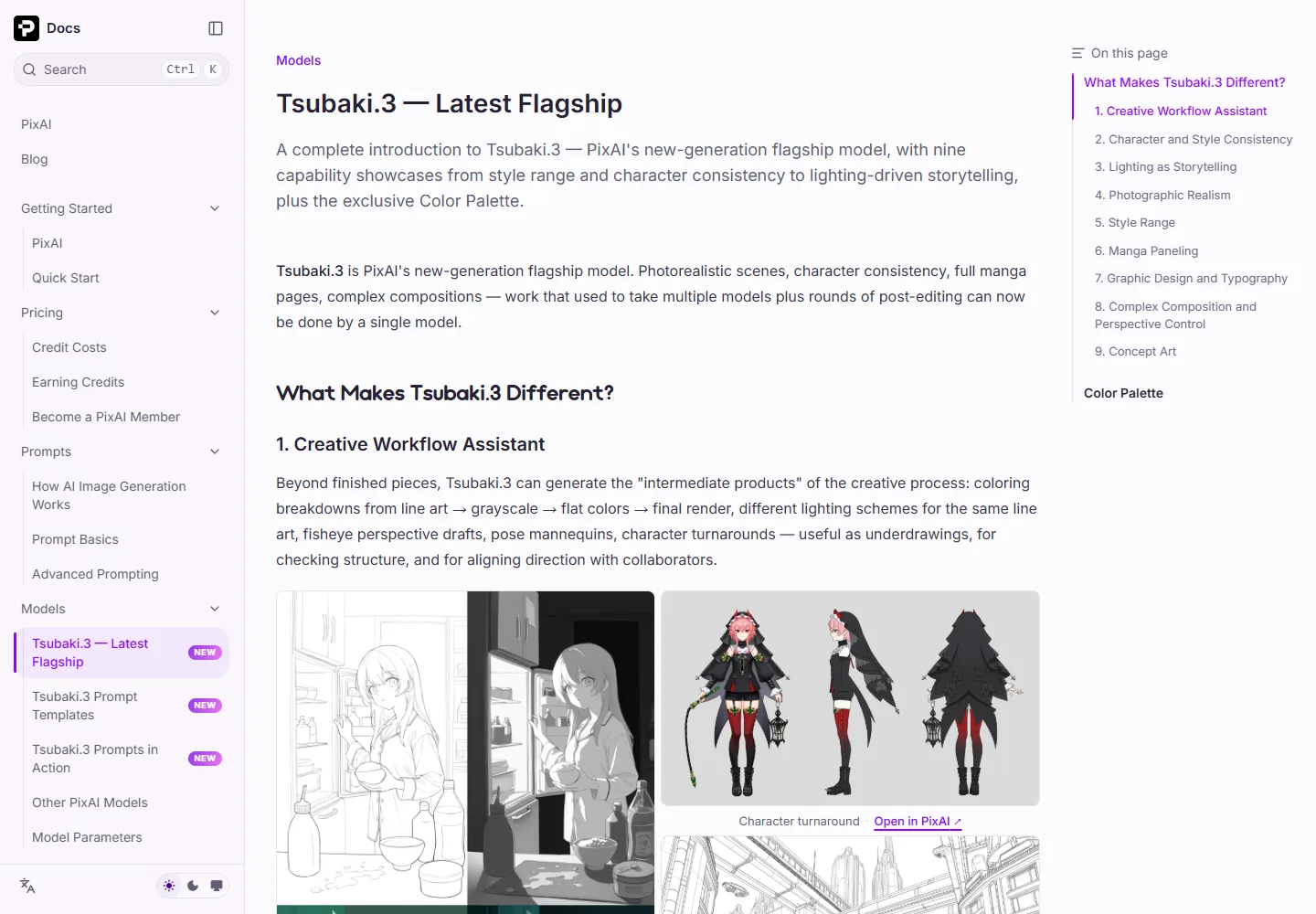
Tsubaki.3 is PixAI’s anime-focused multimodal image model. The technical report describes text-to-image and in-context generation within a unified system. The relevant benefit for artists is that an existing image can become part of the instruction: keep this character, change the setting, adjust the outfit, or develop another view.
The official launch announcement highlights multilingual text, manga layouts, multiple characters, palette selection, and references. It describes smart reference input with up to three images. Tsubaki Video is a separate video offering; its promotional discount should not be mistaken for Tsubaki.3 image-generation pricing.
| Best fit | Why it is useful | What still needs checking |
|---|---|---|
| Original character concepts | References, expression sheets, alternate outfits | Small costume details and identity drift |
| Manga and webtoon drafts | Panels, dialogue, and characters in one image | Reading order, exact wording, continuity |
| Illustrated posters and covers | Text, composition, and palette controls | Spelling and final print dimensions |
| Reworking an existing illustration | Natural-language editing | Changes outside the requested area |
For a product photograph that must preserve exact geometry, or a finished comic that must match a strict character sheet, allow for manual correction. An attractive sample does not establish precision across an entire production.
What improved over Tsubaki.2?
The model description advertises roughly four-megapixel, “2K” generation, stronger adherence to longer prompts, and improved in-image text. PixAI says generation at the same resolution is as fast as Tsubaki.2; that is a vendor comparison, not a measured latency result in this review. Higher resolution and queue conditions can still change waiting time.
The practical change is control. Palette settings can guide color choices, while character and style references reduce reliance on a long list of descriptive tags. Existing prompts remain usable, but expect to retune them instead of assuming the old character or style will reproduce identically.
Tsubaki.3 Flash is the faster, distilled variant. PixAI describes slightly softer fine textures in exchange for quicker generation, while retaining the same control set. Use Flash for composition experiments and the full model for a final candidate; inspect both before spending credits on large batches.
Prices, free credits, and the real cost of a usable image
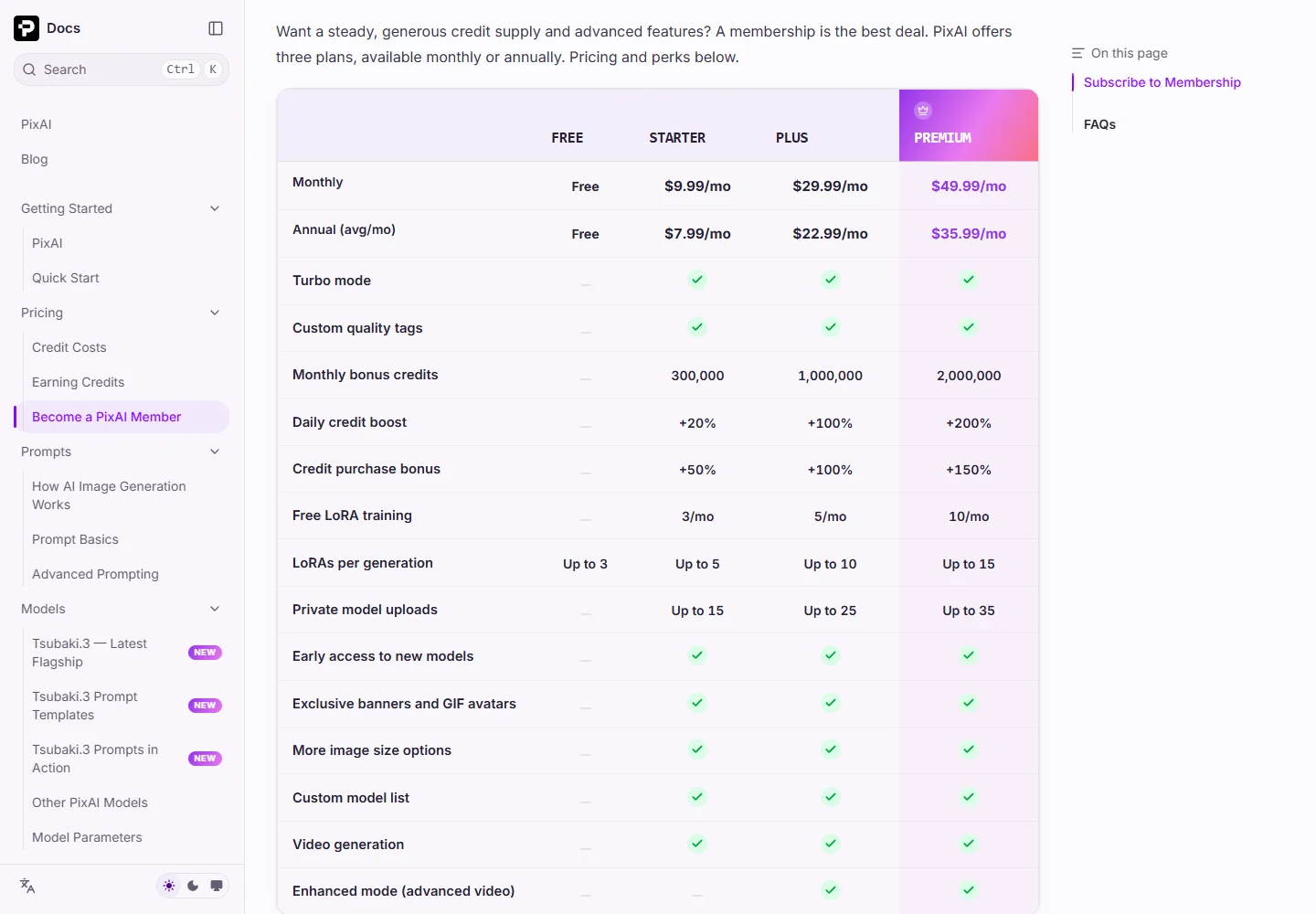
The official membership documentation lists the following reference prices in USD. These are documentation prices, not a guaranteed checkout quote during a promotion. The annual column is a monthly equivalent paid as an annual subscription.
| Plan | Monthly billing | Annual plan, monthly equivalent | Monthly bonus credits |
|---|---|---|---|
| Free | $0 | $0 | No paid-plan monthly allocation |
| Starter | $9.99 | $7.99 | 300,000 |
| Plus | $29.99 | $22.99 | 1,000,000 |
| Premium | $49.99 | $35.99 | 2,000,000 |
Regional checkout prices, taxes and app-store prices may differ from these USD documentation figures.
Free accounts can claim daily credits; the standard allowance is 10,000 according to PixAI’s credit guide. Claim requirements matter: do not assume unused daily claims accumulate automatically. Paid plans increase the daily allowance as well as providing monthly credits.
The cost guide makes clear that model, size, batch settings, extra tools, and priority can affect consumption. Read the number beside Generate before submitting. A useful budget measure is total credits spent ÷ images you actually keep, including rerolls and edits. There is no defensible fixed “images per dollar” figure without matching settings and acceptance criteria.
The fourth-anniversary campaign runs September 17–October 20, 2026 and advertises temporary benefits. Treat free event generations and membership discounts separately from normal allowances. Check renewal price and billing period before paying.
Prompting, lettering, and a sensible first test
PixAI’s prompt workflow guide recommends a structured order: style, scene, characters, text, then layout. It recommends English for precise control, while the Prompt Helper can make everyday instructions in your own language easier. Give multiple characters distinct names and positions so attributes have a clear owner.
Try this original starter prompt. It is a suggested test, not a prompt with a claimed measured success rate:
Clean anime editorial illustration, restrained teal and warm orange palette.
Two adult original characters in a quiet bookshop.
Aki: short black hair, green jacket, standing on the left holding a book.
Ren: long auburn hair, cream sweater, seated on the right reading.
Soft afternoon window light, medium-wide view, clear separation of the figures.
At the top, render only this exact title: "AUTUMN STORIES".
Keep generous empty space around the title. No extra text.
First check character placement and whether clothing has been swapped. Then inspect the title letter by letter. For an edit, ask for one change—such as a rainy evening background—and explicitly name the features to retain. Proofread Japanese, Korean, and Traditional Chinese output just as carefully as English.
What media and creators actually found
Dengeki Online’s feature includes generated examples and comments on stylistic range, but it explicitly states that PixAI sponsored the article. It is useful for seeing possibilities, not an independent head-to-head verdict.
A September 19 creator test by Tsugiito Design changed a character’s background. The author found recognizable identity survived, while clothing and pose details shifted. That narrow example supports a practical warning: “background only” does not guarantee all foreground pixels remain unchanged. It does not establish a failure rate for the model.
A Reddit creator’s workflow combined Tsubaki.3 with LoRAs and a later edit in another model. This is evidence of community use, but the finished image cannot be attributed entirely to Tsubaki.3. PixAI’s official gallery is a convenient starting point for more samples; curated successes do not show the number of rejected generations.
Tsubaki.3 vs Niji 7 and NovelAI Diffusion V5
These are workflow comparisons, not rankings from identical prompts. Both competing services remain worth testing if anime is your main output.
| Service/model | Sensible reason to consider it | Pricing or limit to watch |
|---|---|---|
| Tsubaki.3 / Flash | References, editing, palettes, and community workflows in PixAI | Credits vary by settings; promotions are temporary |
| Midjourney / Niji 7 | An anime-specialist branch in the Midjourney ecosystem | Plans start at $10/month; GPU-time rules differ by plan |
| NovelAI Diffusion V5 | Another current anime-focused model for character and comic work | $10/$15/$25 plans; V5 Opus usage limits apply |
Midjourney documents Niji’s anime focus and its subscription tiers. Its community rules require SFW content. Compare it using your own character brief and preferred visual treatment; a subscription price alone says little about cost per accepted image.
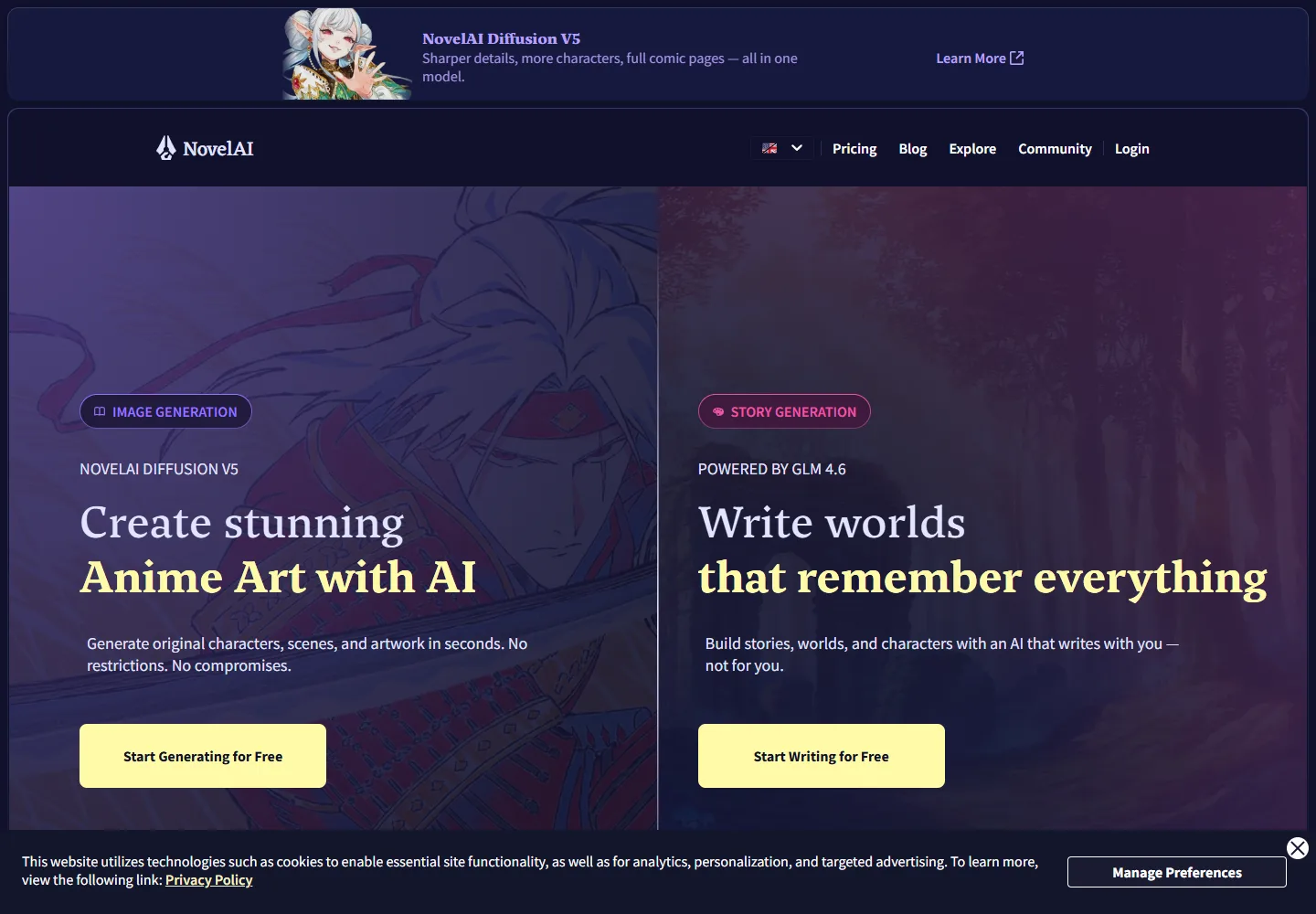
NovelAI’s current model documentation identifies V5, so comparing only against V4.5 would miss its latest offering. Its FAQ lists $10, $15, and $25 monthly subscriptions and explains that V5 introduces Opus usage limits. Do not describe the latest model as unconditionally unlimited.
NSFW and commercial use: read the platform rules
PixAI is not an unrestricted NSFW service. Its content guidelines require over-18 confirmation for NSFW generation, restrict sensitive content’s visibility, and prohibit realistic sensitive content and sexual content involving minors. A model’s ability to draw something does not establish permission to generate or share it. Account and interface restrictions also matter.
The official Tsubaki.3 page says commercial projects are possible under PixAI’s terms. That does not clear third-party characters, logos, or reference images. For client work, start from material you are entitled to use and keep the applicable model and asset terms with the project.
API access and local deployment
The official developer entry point is PixAI Platform. Its v2 image endpoint documentation explicitly mentions the Tsubaki.3 family for certain parameters. API access uses a key and asynchronous generation tasks; confirm your available model version, permissions, and billing before integrating it.
There is an important mismatch to check: the public endpoint schema currently lists 1K and 1.5K size values, while the consumer model advertises 2K output. Do not copy the web interface’s advertised limits into API requirements without confirmation. A model-page ID is also not automatically the model-version ID required by a request.
We did not verify an official downloadable Tsubaki.3 weight release or a supported local deployment package. Do not confuse similarly named community checkpoints with PixAI’s model. The open-source Tagger mentioned in the technical report is a different component, not proof that the image generator is open source.
Verdict and quick questions
Try Tsubaki.3 for character concepts, manga drafts, and illustrated layouts where iterative control matters. Start with free credits, compare Flash with the full model, and budget for corrections. For strict asset consistency, evaluate a small set of related images before committing a whole project.
Is Tsubaki.3 free?
It is available through PixAI’s credit system, including free credit opportunities. This does not mean unlimited high-resolution generation; check the cost displayed for your settings.
Does it generate correct Japanese text?
Improved Japanese lettering is an official feature. Exact spelling, punctuation, and reading order still need review, particularly in dense comic pages.
Should I replace Tsubaki.2 immediately?
Keep working prompts and compare both on the same brief. The new model offers more controls, but its interpretation may change a familiar character or style.
Does Flash replace the full model?
It favors speed. PixAI acknowledges a fine-detail trade-off, making it a useful draft option rather than an automatic replacement for final output.
Can I run it in ComfyUI on my GPU?
An official local package was not verified. Use the supported online entry points; an API workflow is different from running model weights on your own machine.
Related Reviews
MiniMax H3 Review: Open-Weight AI Video Model With Native Audio

Wan 3.0 Review: 30s AI Video, Open Source Status and NSFW Limits

YuE2-3B Review: Local AI Music, Suno Comparison & ComfyUI
Qwen Image Review: 3.0 vs 2.0, LoRA/GGUF, and NSFW Support
GPT-6 Astra Review: Pricing, API Access, Strengths and Limits
Pony V7 Review: AuraFlow, LoRA Ecosystem, V6 Comparison, and NSFW Strengths