GPT-6 Astra Review: Pricing, API Access, Strengths and Limits
GPT-6 Astra review covering official API pricing, online access, comparisons with Sol, Claude and Gemini, early user experiences, use cases and NSFW limits.


GPT-6 Astra is most interesting when a job needs several steps and a finished deliverable: investigate, act, check and revise. It is a serious candidate for difficult work, but the launch evidence does not make it an automatic upgrade for every task. Token cost, usage limits and your preferred collaboration style deserve as much attention as benchmark scores.
What is the latest GPT-6 Astra version?
OpenAI released GPT-6 Astra on September 3, 2026. The public API identifier is gpt-6-astra. This review covers that launch version as of September 7; an app label or a reseller’s release date should not be mistaken for a separate model generation. Official announcement.
| Specification | GPT-6 Astra |
|---|---|
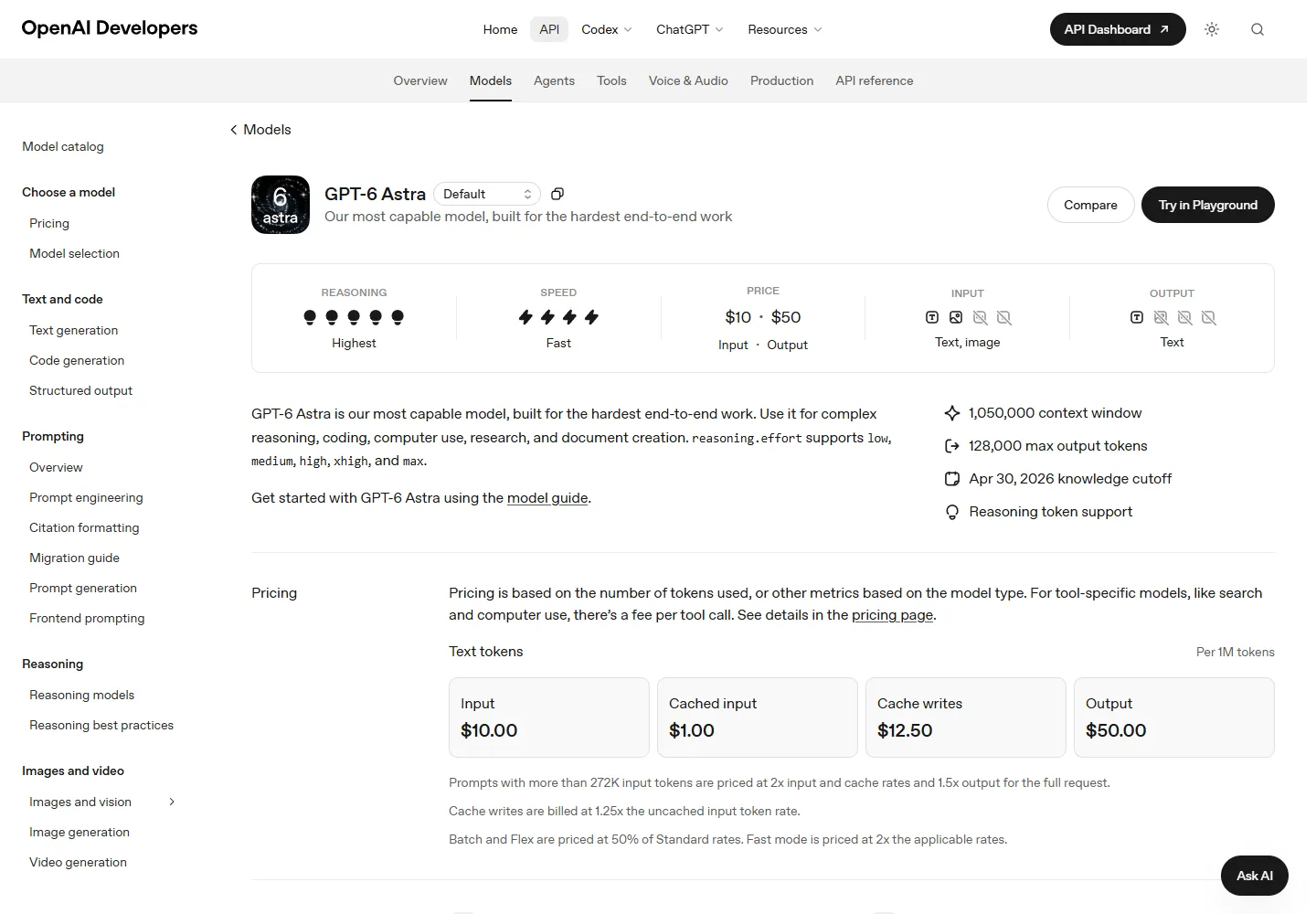
| Context / maximum output | 1,050,000 / 128,000 tokens |
| Knowledge cutoff | April 30, 2026 |
| Direct modalities | Text and image input; text output |
| Audio / video input | Not supported by this model endpoint |
| Fine-tuning | Not supported |
Official model specifications. Image-generation tools and computer operation can extend a workflow, but they are different from native image, audio or video generation by the language model. A demo operating an editor does not establish that it can ingest a video directly.
Treat Astra Pro as a higher-compute option within the Astra offering, not evidence of an Astra 6.1 release. OpenRouter’s model listing distinguishes Astra and Astra Pro. Compare the actual mode and billing configuration before comparing their results.
Official online access and API providers
Start at ChatGPT for the official consumer experience, or OpenAI’s API platform for developer access. Availability is account-dependent during rollout. OpenAI names Plus, Pro, Business and Enterprise in its launch plan; Enterprise access initially requires administrator enablement. Availability details.
| Service | What is verified | Practical choice |
|---|---|---|
| OpenAI API | Official model documentation and API ID | Direct integration and access to OpenAI-specific features |
| Microsoft Foundry / Azure | Microsoft announces general availability; Global and US Data Zone pricing differ | Teams already using Azure deployment and governance |
| Amazon Bedrock | Named by OpenAI as a rollout channel; account/region access not independently tested here | Check the AWS catalog and your account before committing |
| OpenRouter | Third-party listing for openai/gpt-6-astra | One integration for comparing providers; inspect routing and data policies |
Microsoft lists Global Standard short-context rates of $10 input / $50 output per million tokens, versus $11 / $55 for its US Data Zone. Its deployment options include provisioned capacity. Microsoft’s availability and pricing notice. A provider listing establishes an advertised route, not that every account can successfully invoke it today.
API access does not automatically reproduce the complete desktop agent experience. Your application still needs tool execution, files, permissions and a way to inspect results. Do not buy an API package solely because a video shows Astra controlling someone else’s computer.
Pricing: tokens, long context and real task cost
| OpenAI API, USD per 1M tokens | Standard |
|---|---|
| Input / output | $10 / $50 |
| Cache read / write | $1 / $12.50 |
| Input above 272K tokens | 2× input/cache rates; 1.5× output for the entire request |
| Batch / Flex | 50% of Standard |
| Fast | 2× applicable rates |
Model pricing. Output budgets must include billable reasoning, not just the final visible answer. Tool charges and retries can add to the total.
Illustrative calculation, not a measured run: 100,000 uncached input tokens and 10,000 billed output tokens cost $1.50 at standard short-context rates. At the same token counts, Sol costs $0.60 and Gemini 3.8 Flash’s introductory rates give $0.1125. These figures assume no cache writes, tool fees, retries or other charges.
For a long-context example, 300,000 uncached input tokens and 10,000 billed output tokens cost $6.75: $6 input plus $0.75 output. Crossing the threshold changes the rate for the whole request. Keeping irrelevant files out of the prompt can matter more than shortening the final response.
ChatGPT subscriptions are a separate purchase from API usage. OpenAI’s Pro plan guide lists $100 and $200 Pro tiers with different allowances; check the current checkout pricing for your region. A monthly subscription should not be interpreted as unlimited Astra agent work or included API credit.
Judge value by cost per accepted deliverable: model charges plus the time spent checking and correcting the output. A higher token rate can still be worthwhile when it eliminates a difficult debugging loop; it is harder to justify for bulk summaries that a cheaper model already handles reliably.
Astra vs Sol, Claude Fable 5.1 and Gemini 3.8 Flash
| Model | Input / output per 1M tokens | Where to start |
|---|---|---|
| GPT-6 Astra | $10 / $50 | Difficult multi-step work with a reviewable deliverable |
| GPT-5.6 Sol | $4 / $20 | Lower-cost baseline in an existing OpenAI workflow |
| Claude Fable 5.1 | $10 / $50 | A direct rival for coding and extended knowledge work |
| Gemini 3.8 Flash | $0.75 / $3.75 introductory | Cost-sensitive workloads; validate difficult cases first |
These are published base API rates, not an equal-cost performance test. Sol’s listed pricing is promotional at least through November 21, 2026. Google’s introductory Flash pricing ends December 31, 2026; its stated subsequent rates are $1.50 / $7.50. Fable 5.1 lists cache reads at $0.25 per million tokens, making cache-heavy workflows worth pricing separately. Sol · Gemini · Claude.
| OpenAI-published comparison | Astra | Sol | Fable 5.1 | Gemini 3.8 Flash |
|---|---|---|---|---|
| Terminal-Bench 4.0 | 57.9% | 37.3% | 55.8% | 19.1% |
| DeepSWE v1.1 | 74.1% | 72.7% | 67.4% | 73.8% |
| Artificial Analysis Intelligence Index v4.1.1 | 61.2 | 60.9 | 65.7 | 58.7 |
Source: OpenAI’s comparison table. These are vendor-published results under the cited evaluation conditions, not our own tests. The pattern is more informative than a single winner: Astra’s terminal-task gain over Sol is large, while DeepSWE is much closer and Fable leads the intelligence-index row. None establishes universal superiority.
For a useful buying test, give each model the same repository snapshot, task, tools and acceptance criteria. Record cost, elapsed time, human interventions, regressions and whether the result passes review. Keep reasoning settings in the record: similarly named effort levels across vendors are not standardized.
What editors and early users actually report
Media perspective. Tom’s Guide recommends testing Astra with a goal that requires sustained work rather than another isolated question. That is useful prompting advice, but the article is not a controlled benchmark. TechRadar focuses on expert concerns about reasoning transparency and oversight; this is a safety discussion, not evidence of a particular coding success rate.
Published hands-on experience. Matt Shumer’s review reports strong everyday reliability and prefers medium effort for routine work, while still favoring Claude for visual taste and some 3D work. This is an enthusiastic individual assessment. It supports trying Astra for work coordination, not a blanket claim that it replaces every creative tool.
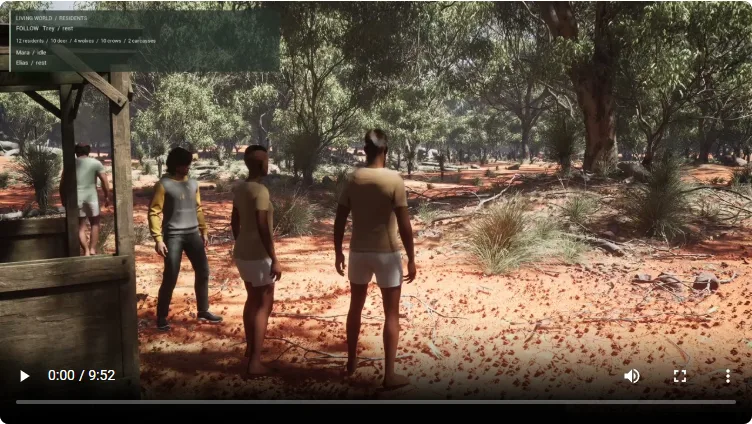
Usage pressure. Reddit user DannyVFilms reports exhausting a five-hour allowance in roughly ten minutes on a medium-effort project task, while also describing meaningful progress. The report is an anecdote, not a reproducible limit or a promise about your plan.
Scope and collaboration. In an r/OpenAI discussion, ZenenoDev describes unnecessary new infrastructure and starting implementation before agreeing on direction. Other participants describe both difficult problems solved and overengineering. In an r/ChatGPTcomplaints writing thread, a user reports good coding results but friction and refusals in an established creative-writing workflow.
These communities show early experimentation in coding, project review and writing. They do not establish adoption share or a representative satisfaction rate. Model settings, tools, subscription quotas and prompt history differ. The practical lesson is to test your own recurring task, including an ordinary maintenance job where unnecessary work would be a failure.
Strengths, limitations and recommended uses
OpenAI’s model guide describes asynchronous tool calls, steering while a task is running and changing reasoning effort during a conversation. These features are relevant when work involves independent searches, changing requirements and long tool operations. They require application support; an API wrapper may expose only some of them.
| Use case | Recommendation | Acceptance check |
|---|---|---|
| Complex debugging or refactoring | Strong candidate for a pilot | Tests pass; existing architecture is respected; no unrelated changes |
| Research-to-report workflows | Useful when source verification and file production are part of the task | Claims trace to sources; the delivered file is complete |
| Spreadsheets and presentations | Try with a real template and clear constraints | Check formulas, source numbers, page layout and editable output |
| Bulk classification or simple summaries | Begin with a lower-priced model | Escalate only examples that fail quality thresholds |
| Visual design or creative fiction | Compare directly with your current tool | Review taste, voice consistency and refusal behavior |
A good first assignment is a bounded piece of real work: “Investigate this bug, propose the smallest fix, implement it and show test evidence.” State the budget, relevant files, prohibited changes and completion criteria. Reserve a checkpoint before architectural changes; let routine reversible work proceed.
OpenAI’s guide also notes that Astra can ask questions when the user expects it to continue and can be especially sensitive to instructions in skills or project files. Audit those instructions if it repeatedly stops or overcomplicates a task. More reasoning is not automatically the remedy for an unclear brief. Prompting guidance.
OpenAI classifies Astra’s cybersecurity capability at its Critical threshold and describes stronger safeguards. Production protections can restrict what is available relative to capability evaluations. Safety overview. For security teams, evaluate the permitted defensive workflow rather than treating a benchmark result as unrestricted access.
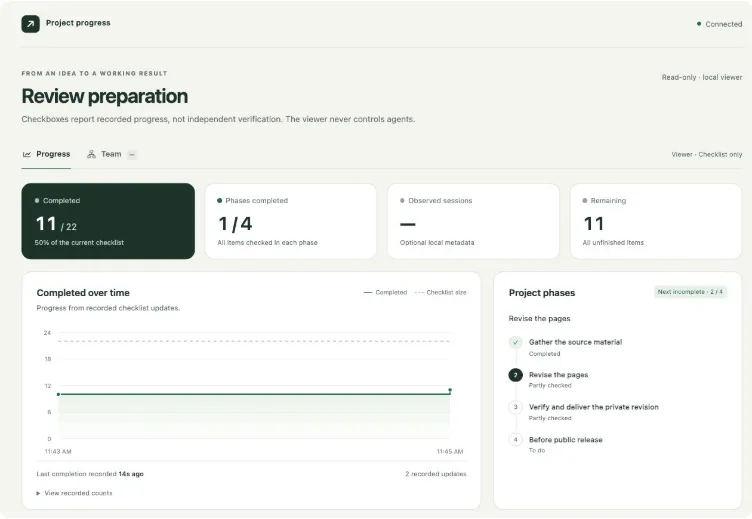
For ambitious projects, Shumer describes a coordinator and a separate implementer in Codex, with a checklist to keep the work moving. His dashboard illustrates task tracking rather than an out-of-the-box Astra feature.
Does GPT-6 Astra support NSFW content?
It is not a verified uncensored or erotic-roleplay model. The public OpenAI Model Spec restricts erotica and extreme gore while allowing appropriate non-erotic educational, medical, historical or analytical discussion. That distinction matters: discussing sexual health is different from generating pornography.
The Usage Policies prohibit sexual violence, non-consensual intimate content and sexual exploitation of minors. Neither paying for Pro nor accessing the model through a reseller demonstrates an exemption. A third-party “NSFW” label is not evidence that the underlying service permits unrestricted content.
No controlled Astra NSFW test was performed for this review, and no Astra-specific public adult-mode release was verified. Buyers who need explicit adult fiction should not subscribe on the assumption it is supported. For non-explicit romance or literary analysis, test representative permitted prompts and assess the writing style separately from the content boundary.
Frequently asked questions
Is Astra free?
Do not assume free-tier availability from the launch announcement. Confirm whether Astra appears in your own account and which allowance applies before planning a project around it. A public product page is not proof of free access.
Is the API the same as ChatGPT or Codex?
The underlying model may be shared, but tools, context management and product settings change the experience. Compare complete workflows, not only model labels.
Should I replace Sol immediately?
Keep Sol as a cost baseline. Move recurring work only after Astra improves accepted output enough to offset its price and review time. Route particularly difficult cases to Astra first.
Is Claude Fable 5.1 cheaper?
Base input and output rates match Astra in the cited listings. Cache economics differ, so calculate from your actual mix of uncached input, cache reads, writes and billed output.
Can Astra make images or edit videos?
An agent can use compatible external tools. That does not mean the language-model endpoint natively outputs images or accepts video. Test the particular application and verify the exported asset.
Does this review prove Astra is AGI?
No. Benchmark success and useful automation do not settle a broad AGI claim. A purchasing decision should rest on verified results in the tasks you need.
Verdict: pay for completed work, not the launch headline
GPT-6 Astra deserves a place in a serious trial for difficult coding and multi-step professional work. The evidence is less persuasive for upgrading every casual chat, bulk transformation or creative-writing session. Its strongest buying case is a deliverable that would otherwise require repeated human intervention.
Start with one bounded project and a fixed budget. Compare it with Sol and at least one competing vendor, then review both the result and the work it created for you. Keep Astra where it measurably improves the outcome; retain a cheaper or stylistically better option elsewhere.
Review date: September 7, 2026. This is an editorial assessment of official documentation and attributed third-party experiences, not an independently reproduced benchmark. Pricing and rollout can change. Linked sources support the adjacent claims.
Related Reviews
Wan 3.0 Review: 30s AI Video, Open Source Status and NSFW Limits

YuE2-3B Review: Local AI Music, Suno Comparison & ComfyUI
Step 5 Preview Review: Pricing, API Access, Open Weights and NSFW Limits
Qwen 3.8 Review: Benchmarks, Local Setup, GPU Requirements and NSFW Policy
Kling 4.0 Review: 30-Second AI Video, Pricing, Keyframes and NSFW Limits
Krea 3 Review: Editing Quality, Ultra, Real Costs and Open-Weight Status