Step 5 Preview Review: Pricing, API Access, Open Weights and NSFW Limits
Step 5 Preview review: API pricing, benchmarks, real user tests, local hardware estimates, planned open weights and NSFW restrictions.


Step 5 Preview is worth considering when an AI assistant needs to work through code, documents and spreadsheets rather than simply answer a question. Its appeal is a combination of long context, multimodal input and relatively low API rates. The strongest buying case is a difficult task that a cheaper model repeatedly fails to finish.
Our verdict: a promising model to trial for engineering and analytical work, with two important limits. Open weights are scheduled for October 15, 2026, rather than already confirmed as a supported public release. And low token prices do not guarantee low total cost: early independent testing found substantial improvements over Step 3.7 Flash, but some competitors completed the same workload faster and for less money.
What is Step 5 Preview, and is it open source?
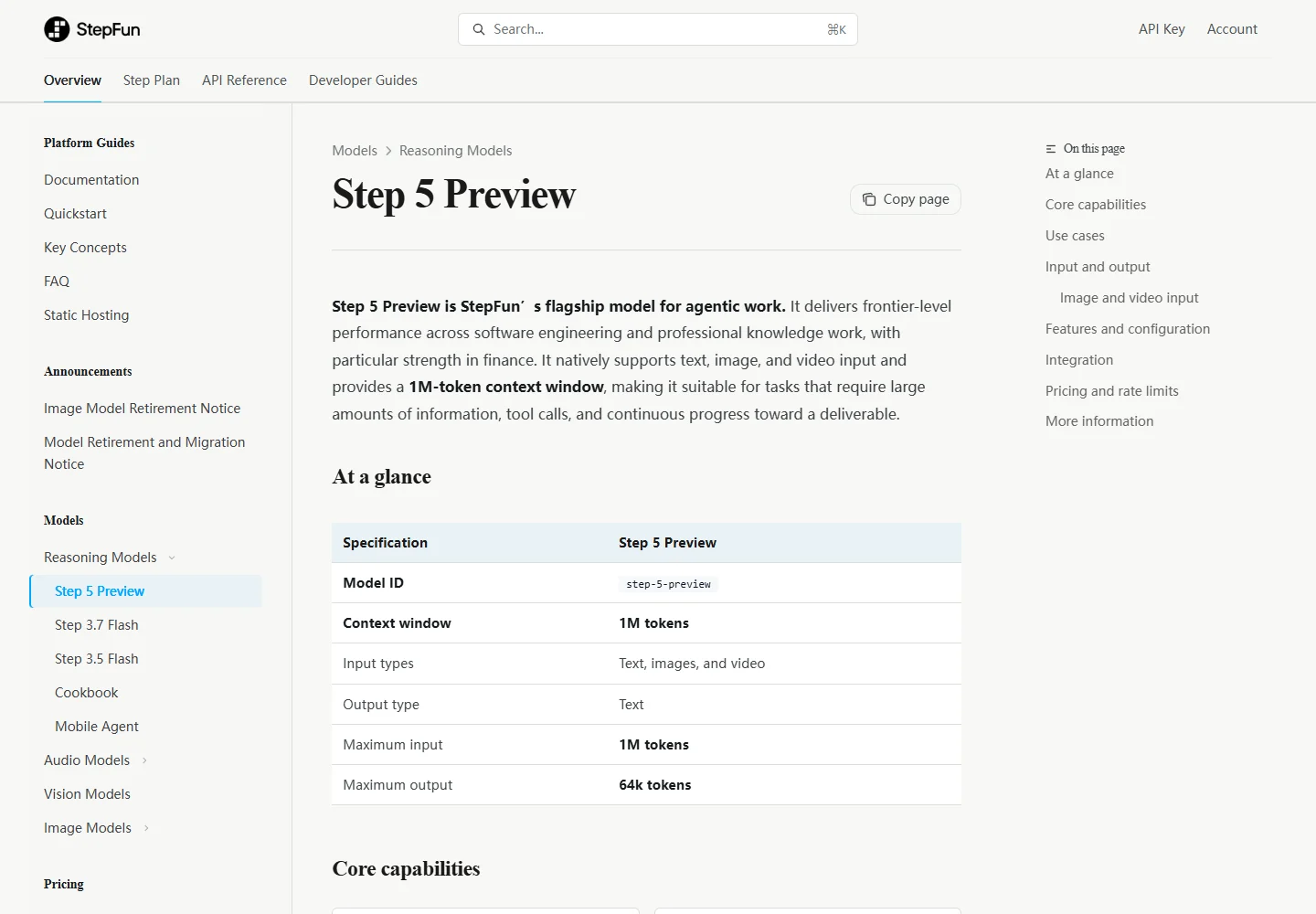
StepFun positions Step 5 Preview as its new flagship for agentic work. The official launch page describes a sparse mixture-of-experts model with 600 billion total parameters and 27 billion active per token. The company says weights will open on October 15. Until the release and its license can be inspected, “open-weight release planned” is the accurate description—not unrestricted open source or a ready-to-install local model. Official announcement
| Specification | Current official documentation |
|---|---|
| Direct API model ID | step-5-preview |
| Context window | 1 million tokens |
| Maximum output | 64K tokens |
| Input / output | Text, images and video / text |
| Reasoning effort | Low, medium and high |
| Developer features | Tool calling, streaming, JSON Mode, JSON Schema and prompt caching |
The model documentation is more specific than some early directories: it lists video input and a 64K output limit. Do not substitute a gateway’s “1M output” listing for that first-party limit. Input capacity also does not mean every fact will be retrieved correctly from a million-token prompt. Official specifications
Where to use it online and through an API
Start with StepFun AI Studio for the company’s browser product and check that Step 5 Preview is available in your account’s model selector. Developers can use the international Open Platform or the Chinese Open Platform. Account access, billing and promotional allowances can differ between those services.
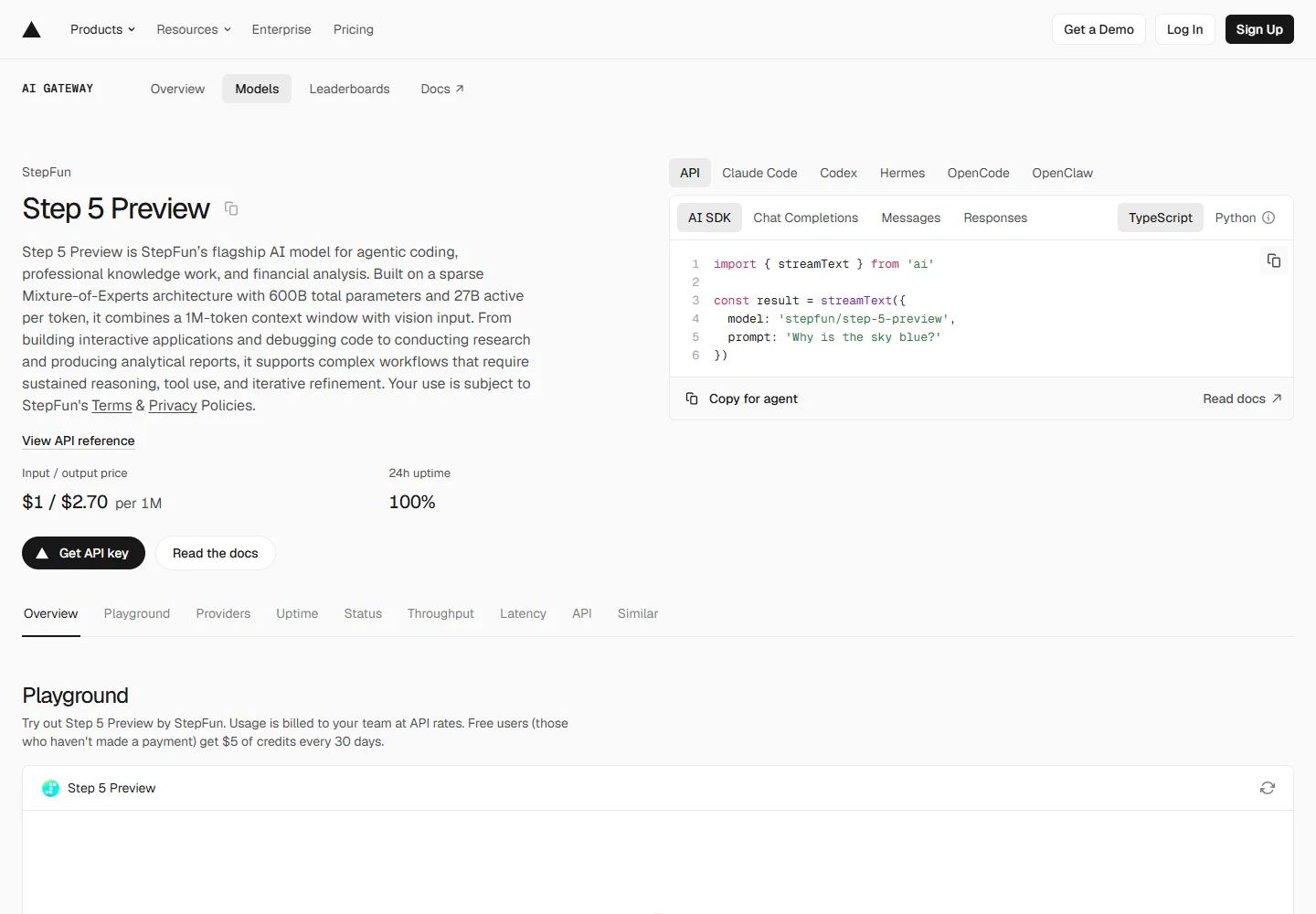
Vercel AI Gateway is a verified third-party route with a browser playground and model identifier stepfun/step-5-preview. Its page advertises recurring trial credits for eligible free accounts; the playground otherwise bills at API rates. This is a gateway service, not StepFun’s own subscription.
For a first integration, create a key, select the correct billing channel and follow the official quickstart. Use a small, nonconfidential task before connecting a repository or an agent with write access. Tools such as search, file editing and code execution come from the surrounding application; the model endpoint alone does not operate your computer.
Pricing: API tokens, subscriptions and real task cost
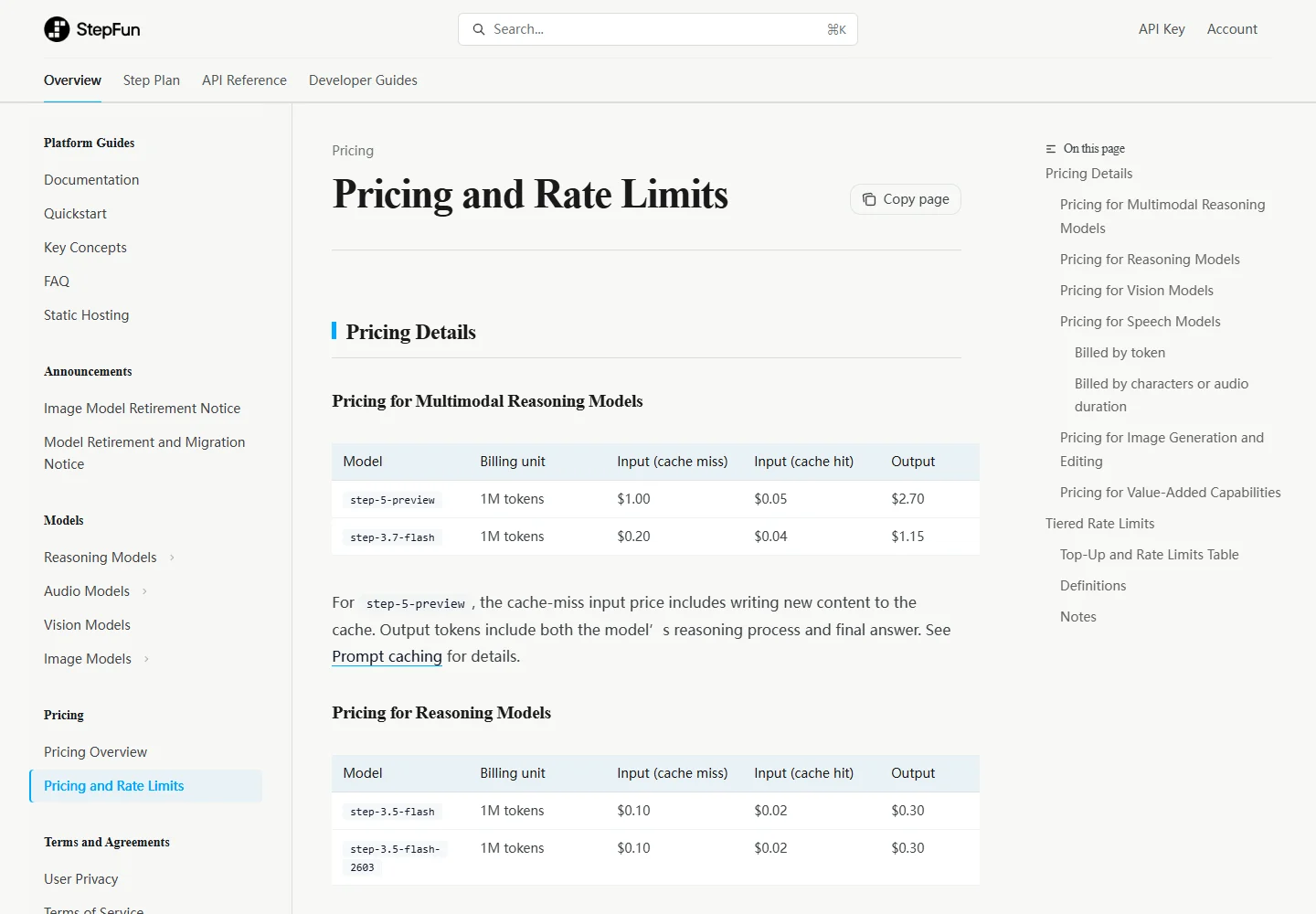
The international direct API lists the following prices in USD per million tokens. Output billing includes reasoning tokens as well as the visible answer. A cache miss includes writing new content to the cache. Official API pricing
| Model | Uncached input | Cached input | Output |
|---|---|---|---|
| Step 5 Preview | $1.00 | $0.05 | $2.70 |
| Step 3.7 Flash | $0.20 | $0.04 | $1.15 |
Worked example: 100,000 uncached input tokens plus 10,000 billed output tokens cost $0.127 at the Step 5 rates. With the same input fully eligible for cache-hit pricing, the arithmetic becomes $0.032. These examples exclude tools, retries, taxes and other charges; they are not estimates of how many tokens your task will need.
The Step Plan documentation lists monthly tiers of $6.99, $9.99, $29 and $99, with respective allowances of 400M, 1,600M, 8,000M and 40,000M Credits. Credits are not tokens. The plan includes Step 5 Preview, monthly credits expire, and subscription traffic uses a different base URL from the standard API. Check the current checkout offer rather than assuming a temporary free promotion applies indefinitely.
For regular use, compare the cost of an accepted result: billable tokens, retries, tool charges and human correction time. A cheaper output token offers little savings if an agent loops through the same unsuccessful fix. Set a spending ceiling and log actual usage during your trial.
What improves over Step 3.7 Flash?
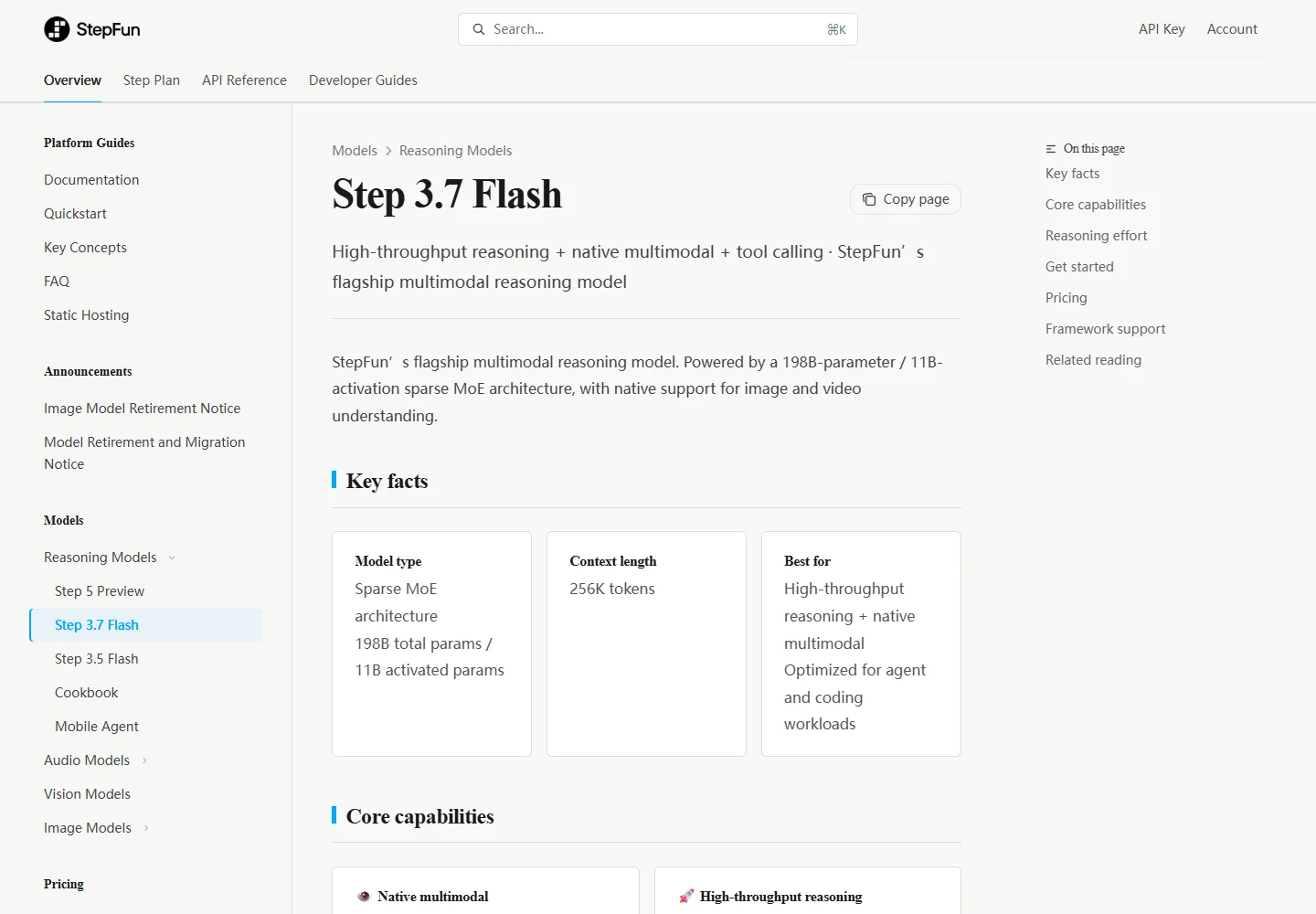
Step 3.7 Flash has a 198B-total/11B-active architecture and a 256K context window. It already supports images and video, so multimodal understanding is not entirely new to Step 5. The newer model expands the context and targets more demanding work, while the older one retains substantially lower listed API rates. Step 3.7 Flash documentation
The most useful evidence of improvement comes from completed tasks. SQBench reports 102 fully passed tasks out of 220 for Step 5 Preview, versus 43 for Step 3.7 Flash in its evaluation. Its weighted score is separate from that raw pass count. The improvement supports testing Step 5 on tasks the older model struggles with; it does not establish that every simple summary should move to the larger model. SQBench evaluation
Benchmarks and comparisons with other leading models
Artificial Analysis reports an Intelligence Index score of approximately 44 and generation speed near 100 output tokens per second for its measured configuration. It also flags high token use. Generation speed is not time to a completed answer: reasoning, input processing, tools and retries all affect the wait. Independent measurements
The table below uses StepFun’s published comparison, with Step at High reasoning and the competitors at Max. These are vendor-reported benchmark results, not tests reproduced by AirMore, and differences between test setups limit what can be concluded.
| Model / setting | DeepSWE v1.1 | FrontierFinance |
|---|---|---|
| Step 5 Preview / High | 67.7 | 66.4 |
| GLM-5.3 / Max | 66.9 | 64.1 |
| Kimi K3 / Max | 67.5 | 62.6 |
| Claude Opus 5 / Max | 74.0 | 69.7 |
Source and evaluation notes. Treat the rows as two task-specific signals, not a universal ranking. In this comparison, Step approaches GLM and Kimi on software engineering, while Opus remains ahead on both displayed measures.
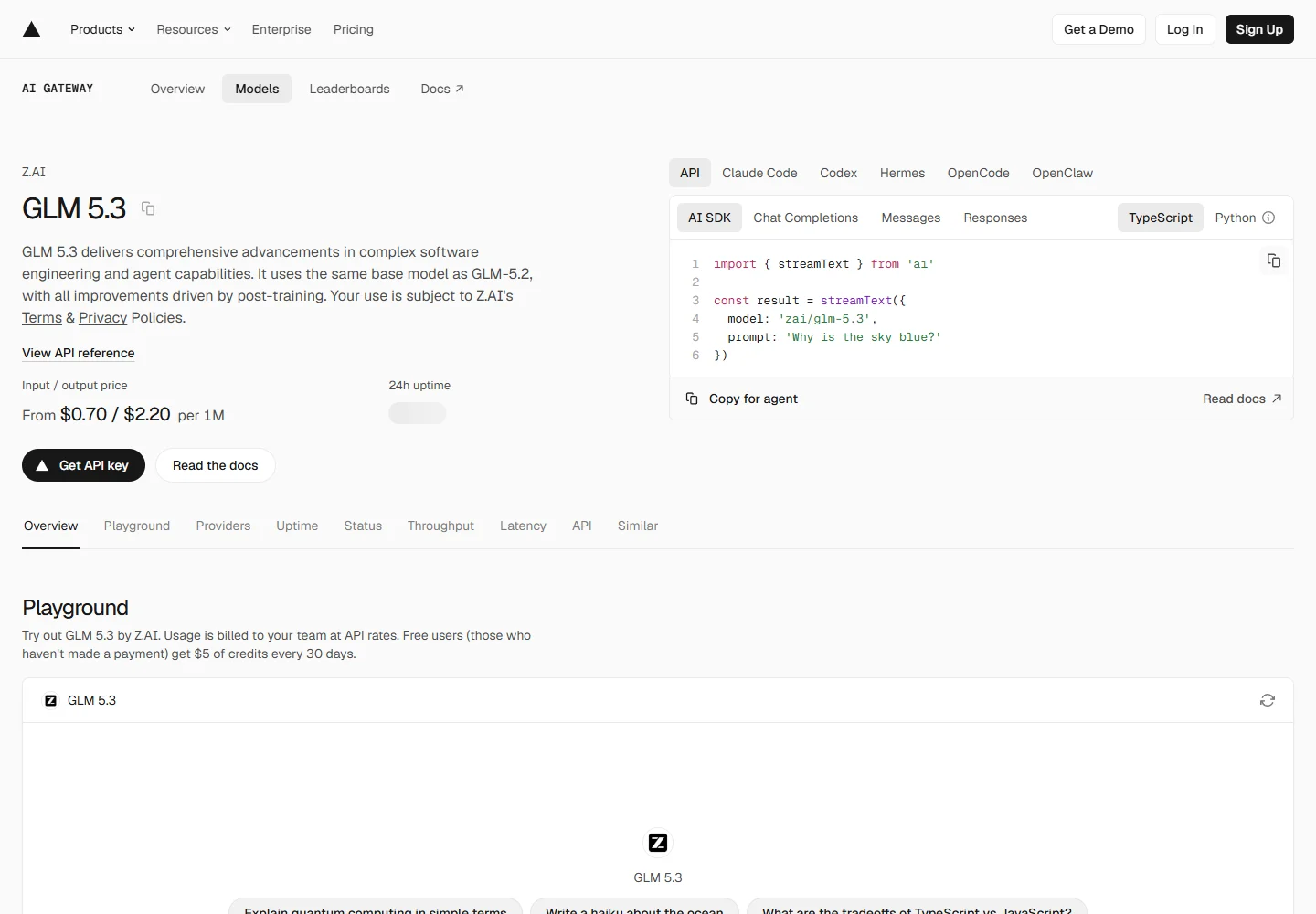
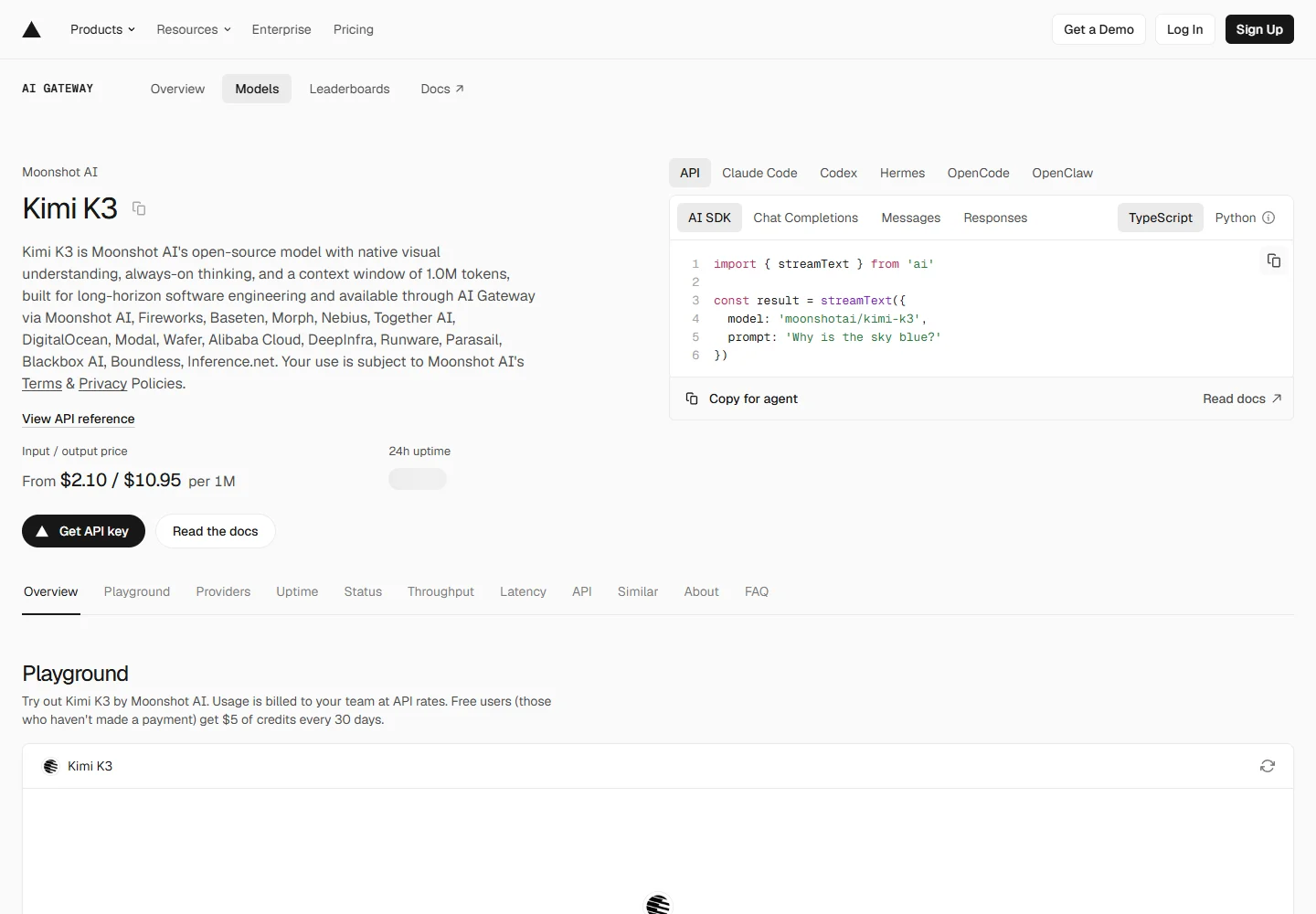
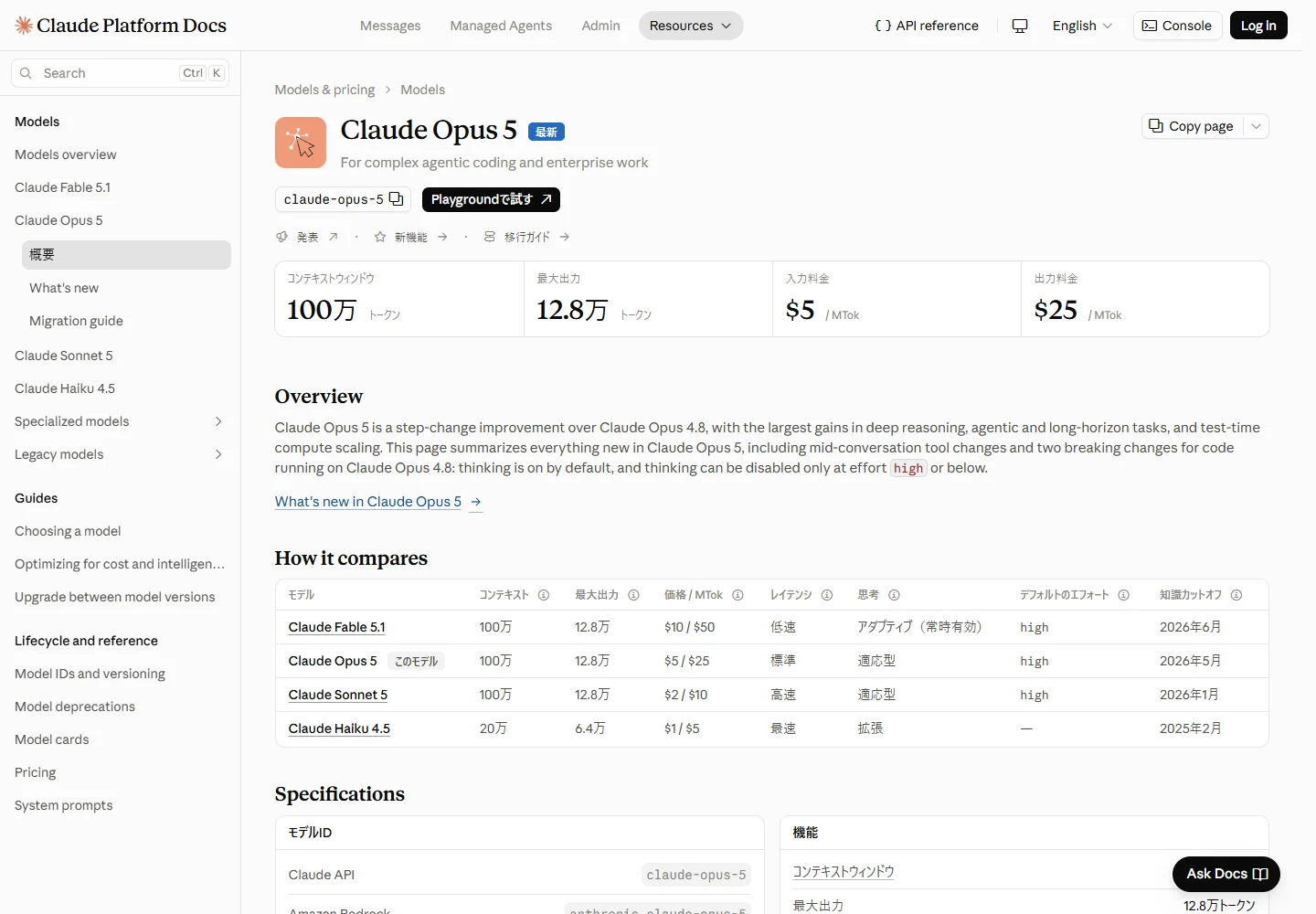
For a practical shortlist, compare Step with GLM or Kimi using the same repository and acceptance tests. Add Claude when the task is valuable enough to justify trying a different premium workflow. Keep the tool environment, available files and retry budget consistent; otherwise you may be comparing applications rather than models.
What early reviewers and users actually report
Independent workload testing is more mixed than the launch headline. SQBench gives Step 5 Preview a score of 50.00, compared with 51.40 for DeepSeek V4 Pro 0813 and 54.60 for GLM-5.3-FlashX. Its recorded suite cost and cumulative time were $16.72/25.20 hours for Step, $9.83/12.12 hours for DeepSeek and $5.68/6.67 hours for FlashX. Those are evaluation-run totals, not subscription prices or a forecast for one task. SQBench’s report
On the positive side, creator cxuan published hands-on comparisons covering a game, a website recreation from video and a budgeting task. In the website example, the reviewer preferred Step’s overall result but also noted that it simplified an important geometric detail. That is evidence of an interesting prototype workflow, not proof of pixel-perfect recreation or a controlled model-only victory. Creator’s test and examples
Early LocalLLaMA discussion includes excitement about briefly visible weight files. A separate developer discussion asks for real-workload experiences rather than supplying a mature reliability record. These launch conversations should not be presented as broad community consensus or proof of a supported local release.
Strengths, limitations and recommended uses
Good trial candidates: repairing a reproducible software bug, reconciling several reports, cleaning a dataset and producing a reviewable analysis, or turning screenshots and a short screen recording into an implementation brief. Give the model a deliverable, explicit constraints and a way to check its work.
For code, ask for a minimal patch, regression tests and a summary of unresolved failures. For documents, require source locations and a distinction between extracted facts and assumptions. For tables, request formulas or a script so calculations can be checked independently. These instructions make a useful result easier to assess regardless of benchmark rank.
Less convincing reasons to switch: casual conversation, inexpensive bulk rewriting, or a workflow where subsecond responsiveness matters more than complex reasoning. Japanese, Traditional Chinese and other local-language writing quality also needs testing on your own material; the release benchmarks do not establish equal quality across every language or business convention.
Local deployment: what the open-weight plan means
There is not yet a verified official deployment recipe we can recommend for the planned October release. Watch StepFun’s official Hugging Face organization for the final repository, license, supported runtime and hardware guidance. An unofficial mirror is not a substitute for those release materials.
The 27B active figure does not mean the model occupies as much memory as a 27B dense model. As a rough weight-only calculation, 600B parameters require about 1.2 TB at 16 bits, 600 GB at 8 bits, or 300 GB at 4 bits, before runtime overhead, caches and quantization metadata. These are arithmetic estimates, not supported configurations or proof that a particular quantization exists.
For most individual readers, an API trial is the practical starting point. A local deployment decision should wait for real memory and throughput measurements, especially if the goal is to use the full context window.
Does Step 5 Preview support NSFW content?
The hosted service is not an unrestricted NSFW option. StepFun’s international service terms prohibit sexually explicit content and bypassing safety controls. Future open weights would not automatically change the rules of the hosted API, and the eventual weight license must be checked separately. StepFun’s service terms
This review did not run an NSFW prompt test. Permission under a service policy, the model’s tendency to refuse and the terms of a future local release are different questions. Do not buy a subscription on the assumption that “open weights planned” means explicit adult roleplay is supported.
Frequently asked questions
Is Step 5 Preview free?
The standard API has usage prices. Trial credits or limited promotions may help you try it, but they do not establish permanent unlimited access. Check your account’s allowance and the billing channel before a long agent run.
Can it understand video?
Yes, the direct official model documentation lists video input. A third-party gateway may expose a narrower interface. Use that provider’s supported request format rather than assuming every route accepts the same media.
Does a 1M context mean a 1M-token answer?
No. StepFun’s specification lists a 64K maximum output. Context capacity and output allowance are different limits, and long-context accuracy still depends on the task.
Is Step Plan the same as prepaid API credit?
No. They use separate usage systems and connection addresses. A successful API request does not by itself prove that your subscription allowance paid for it.
Is it better than Claude, GLM or Kimi?
There is no supported universal answer. It is competitive on selected published evaluations, but other models lead particular tests or finish an independent workload more efficiently. Compare accepted results on your own tasks.
Can I download the model today?
The official announcement schedules open weights for October 15, 2026. Check for the completed release and license then; do not treat early repository sightings as a stable supported distribution.
Verdict: test the completed work, not just the token price
Step 5 Preview deserves a bounded trial for code repair, document-heavy analysis and multimodal agent work. Its official API pricing is attractive for that class of task, and the improvement over the earlier Flash model is supported by independent workload evidence.
Start with a few representative jobs and a fixed budget. Record completion quality, total billed tokens, elapsed time and correction effort. Keep Step where those results improve your workflow, retain a cheaper model for routine work, and revisit local deployment after the official weight release.
Reviewed September 21, 2026. This is an editorial assessment of official documentation and attributed third-party testing; AirMore has not independently reproduced the cited benchmarks.
Related Reviews
Mistral AI Models Review: Latest Local LLMs, Large 3, Small 4 and NSFW Policy

FLUX 3 Review: Video, Image, Open Weights and NSFW Policy
Seedream 5.0 Pro Review: AI Image Model, API Access and NSFW Policy

Dolphin 3.0 Review: Uncensored Local LLM for NSFW, Roleplay and Coding
Gemini Omni 1.1 Flash Review: Google Video AI, 4K, API, and NSFW Limits
Anima AI Model Review: Anime Image Model, LoRA, License and NSFW Use