Pony V7 Review: AuraFlow, LoRA Ecosystem, V6 Comparison, and NSFW Strengths
Pony V7 is not a simple Pony V6 refresh. It is a new-generation Pony model from PurpleSmartAI built around the AuraFlow family rather than SDXL,…
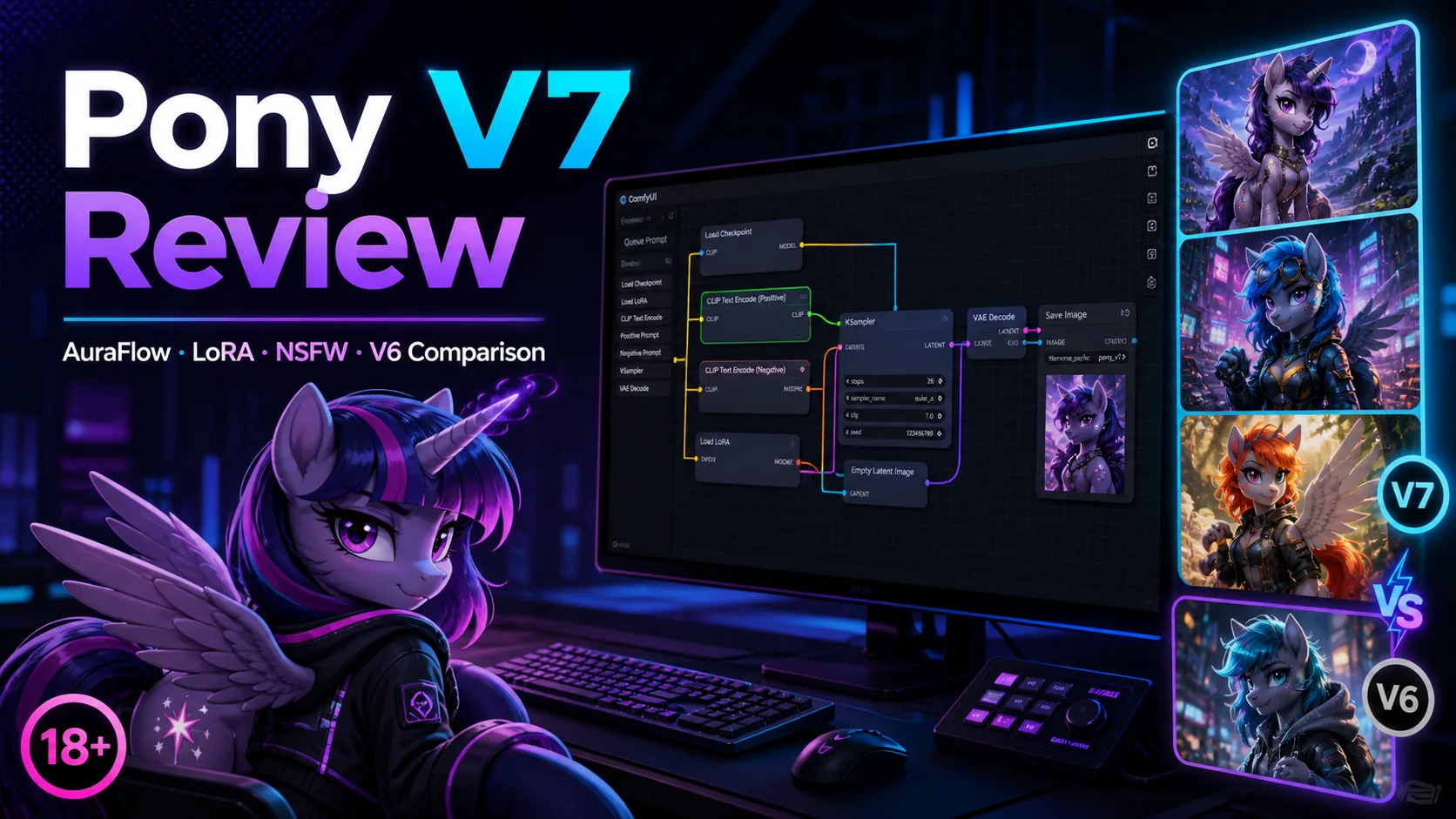

Pony V7 is not a simple Pony V6 refresh. It is a new-generation Pony model from PurpleSmartAI built around the AuraFlow family rather than SDXL, which makes it more ambitious but also less convenient for users who already have a mature V6 LoRA library.
The short version is this: Pony V7 is worth testing if you want stronger prompt understanding, higher native resolution, better multi-character composition, and a future-facing architecture. If you want the most stable NSFW character workflow today, Pony V6 still has the easier ecosystem.
Table of Contents
Quick Verdict
| Need | Better Choice | Why |
|---|---|---|
| Mature LoRA library and character consistency | Pony V6 | The V6 ecosystem is still much larger and easier to tune. |
| New prompt understanding and higher-resolution testing | Pony V7 | V7 is the more forward-looking model and moves beyond SDXL. |
| NSFW with minimum setup trouble | Pony V6 today | V7 keeps uncensored strengths, but the LoRA ecosystem is still early. |
| Training new LoRAs for the future | Pony V7 | Use V7-native training rather than old V6 adapters. |
For readers who have not followed the older model line, our Pony XL / Pony V6 review is still useful background. Pony V7 should be judged as a new branch, not as a drop-in V6 replacement.
Download Links and Official Model Page
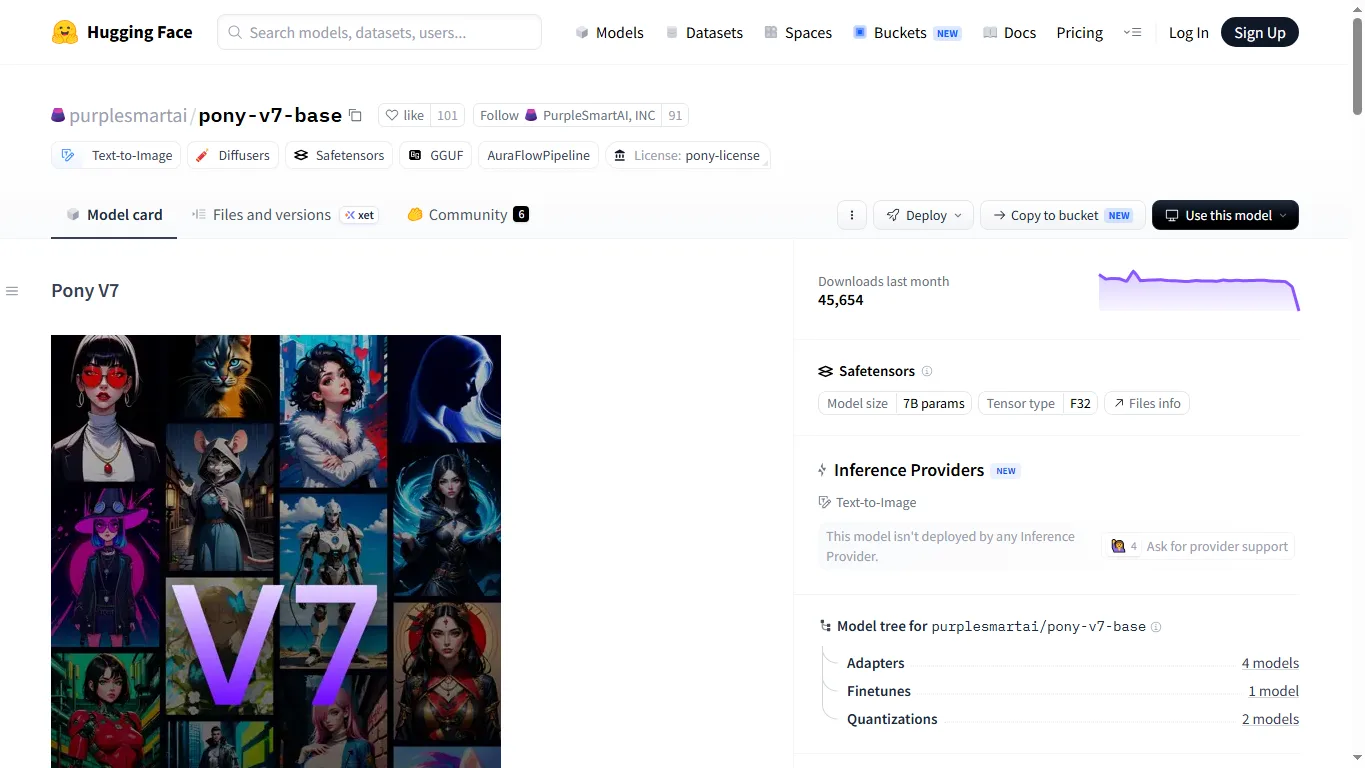
The main download page is purplesmartai/pony-v7-base on Hugging Face. The page shows Pony V7 as a text-to-image model with Diffusers, Safetensors, GGUF, and AuraFlowPipeline tags. The visible model card area also shows a 7B parameter model and a model tree with a small number of adapters, finetunes, and quantizations.
For local users, also check the Files and versions tab before downloading. The exact file choice matters because V7 is not an SDXL checkpoint in the old Pony V6 sense. If your toolchain only expects SDXL, update your ComfyUI nodes and workflow first.
Main Features: What Changed in Pony V7
The biggest practical change is architecture. Pony V6 became popular as an SDXL-based model with a very mature tag culture. Pony V7 moves to an AuraFlow-style pipeline, which is why it can improve prompt understanding while also breaking compatibility with older LoRAs and some old habits.
| Area | Pony V7 Impression |
|---|---|
| Prompt understanding | Stronger than V6 for spatial relationships, multi-character interaction, and background instructions. |
| Resolution | Designed for higher native resolutions; many users test it above the common SDXL comfort zone. |
| Anatomy | Hands, feet, body placement, and multi-person poses can be more stable, though faces may still need tuning. |
| Style control | Less dependent on V6-style score tags; old prompt recipes need adjustment. |
| NSFW | Still uncensored in local use, but the V7 ecosystem is younger than V6. |
The model is especially interesting for scenes that ask for relationships between characters: who is standing where, who is touching an object, which figure is in the background, and how the environment should support the subject. V6 can do this with enough prompt work, but V7 is built to understand these instructions more naturally.
The weak point is polish. Community feedback often mentions that V7 can produce better composition but still lose small facial details or become less predictable than tuned V6 merges. PurpleSmartAI has reportedly been working toward V7.1 improvements around prompt consistency, face detail, and style control, so this is a model to watch rather than a fully settled endpoint.
ComfyUI and Workflow Support
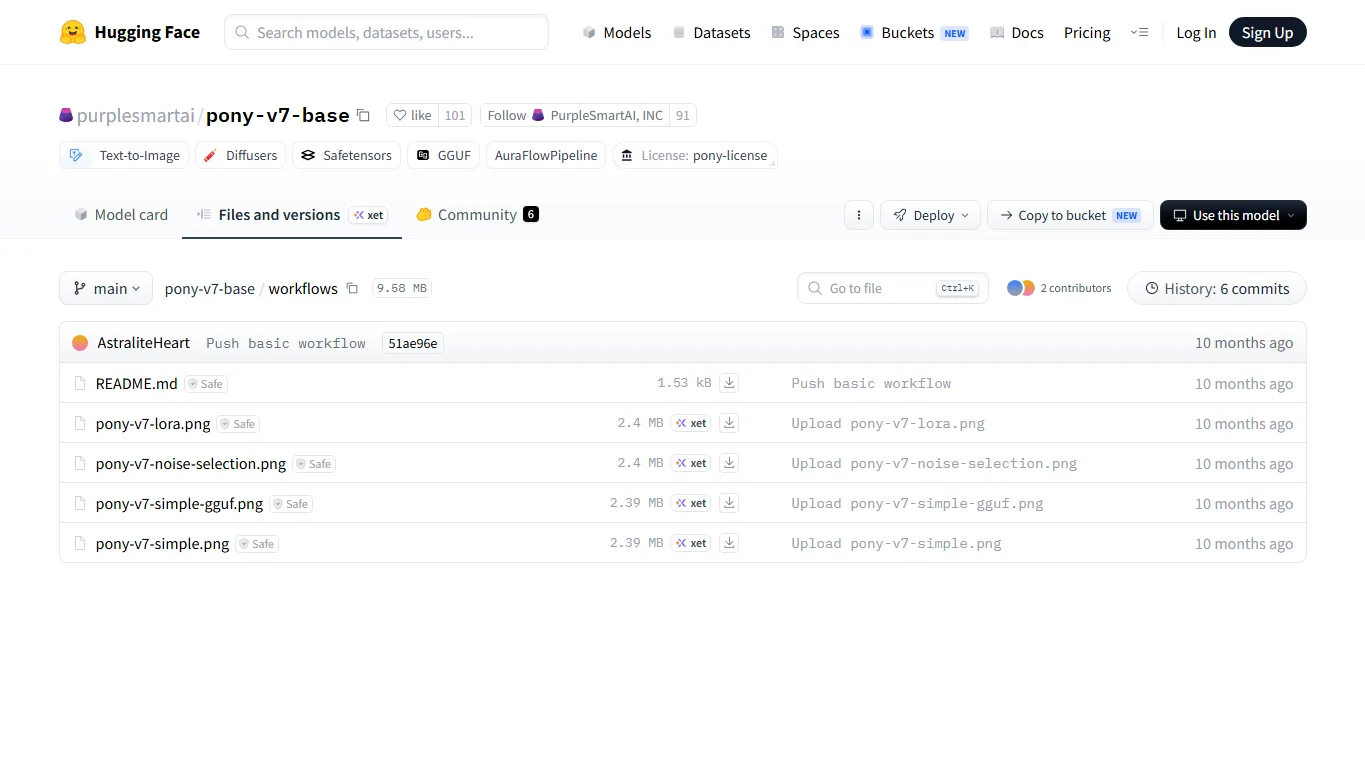
The Hugging Face repository includes a workflows folder with simple, GGUF, LoRA, and noise-selection workflow images. That is important because V7 is easier to evaluate if you start from a known V7 workflow instead of modifying an old Pony V6 graph.
A practical local workflow is: download the model, open the matching workflow, confirm that your loader supports AuraFlow/GGUF if needed, start with conservative steps, and only then add LoRA or style controls. If the image quality looks broken, the first suspect should be workflow compatibility, not necessarily the model itself.
LoRA Ecosystem: Current Size and Recommended Direction
Pony V7 LoRA support is real but early. The visible Hugging Face model tree shows only a small adapter count compared with the huge Pony V6 ecosystem, and Civitai-style community searches are still much thinner than V6. In practical terms, V7 has enough LoRA support to experiment, but not enough to replace a mature V6 library for every character or NSFW use case.
Start with the repository’s LoRA folder and workflow material, then use search pages such as Civitai.red Pony V7 LoRA search to find V7-native adapters. For comparison, a Pony V6 LoRA search still returns a much broader ecosystem, which is why many users keep V6 installed.
| Recommended LoRA Direction | Why |
|---|---|
| V7-native style LoRAs | They are trained for the AuraFlow-based V7 behavior and are less likely to break composition. |
| V7-native character LoRAs | Use these only when the page explicitly says Pony V7 or AuraFlow compatibility. |
| Do not rely on V6 LoRAs | Old Pony V6 LoRAs are SDXL-era assets and should not be treated as drop-in V7 adapters. |
| Workflow-specific LoRA examples | Use the official LoRA workflow first to confirm your setup is correct. |
Pony V7 vs Pony V6
| Point | Pony V6 | Pony V7 |
|---|---|---|
| Architecture | SDXL-based ecosystem | AuraFlow-based new branch |
| LoRA compatibility | Huge existing library | Requires V7-native LoRAs |
| Prompt style | Score tags such as score_9 are central | Natural prompt understanding matters more; score tags are weaker |
| NSFW ecosystem | Very mature | Uncensored, but ecosystem still young |
| Best user | People who want reliability today | People testing the next generation |
The most common mistake is expecting V7 to behave like V6 with better anatomy. It does not. V7 needs a different prompt rhythm and a different adapter ecosystem. Some V6 users will initially feel that V7 is harder, especially if their workflow depends on old score tags, old negative prompts, and a large character LoRA folder.
The upside is that V7 can become more useful for complex scenes once the ecosystem catches up. If you care about future LoRA training, multi-character composition, and richer backgrounds, it is worth starting tests now.
NSFW Support and Strengths
Pony models have always been associated with permissive local generation, and Pony V7 keeps that identity. In local workflows, it is an uncensored model line and can be used for adult-oriented fictional generation where the user controls the environment and follows applicable laws and platform rules.
Its likely NSFW strengths are anatomy, creature variety, furry/anthro subjects, feral and humanoid characters, and multi-character scenes. The caution is ecosystem maturity: V6 still has far more NSFW LoRAs, merges, character resources, and tested prompt recipes. If you need predictable adult character consistency today, V6 remains easier. If you want to train or test the next generation, V7 is the better direction.
Do not use local freedom as an excuse for unsafe content. Real-person sexualization, non-consensual edits, underage-looking characters, and rights-violating publication remain high-risk regardless of the model.
Community Reaction and Fictional.ai
Community reaction is mixed but understandable. Some users like the stronger prompt comprehension and see V7 as the future of Pony. Others expected a more direct V6 upgrade and feel disappointed because their old LoRAs, score-tag habits, and carefully tuned workflows do not transfer cleanly.
PurpleSmartAI also promotes Fictional.ai, a character-focused platform. That matters because Pony V7 is not only a local checkpoint story; it is also tied to a broader creator platform and model ecosystem.
FAQ
Is Pony V7 better than Pony V6?
It is better in some areas, especially prompt understanding and complex composition, but not a universal replacement. V6 remains easier for LoRA-heavy workflows.
Can I use Pony V6 LoRAs on Pony V7?
Treat them as incompatible. V7 is not SDXL-based in the same way, so use V7-native LoRAs or train new adapters.
Where can I download Pony V7?
Use the official Pony V7 Hugging Face page. Check files, license, and workflow notes before running it locally.
Does Pony V7 support NSFW?
Yes, it remains an uncensored local model line. The practical NSFW ecosystem, however, is still less mature than Pony V6.
Should beginners use Pony V7 now?
If you are new to local image generation, V6 may still be easier. If you already use ComfyUI and want to test the next Pony direction, V7 is worth trying.
What should I wait for?
Better V7-native LoRAs, more community workflows, and the expected V7.1 improvements around faces, style control, and consistency.
References
- PurpleSmartAI Pony V7 base on Hugging Face
- Pony V7 files and versions
- Pony V7 workflows folder
- Pony V7 LoRA folder
- Fictional.ai
- AuraFlow reference model page
Conclusion
Pony V7 is a serious new branch rather than a comfortable V6 update. Its strengths are prompt understanding, higher-resolution ambition, richer backgrounds, multi-character scenes, and continued uncensored local generation. Its weakness is timing: the ecosystem has not caught up yet.
For production and NSFW character consistency, Pony V6 remains the safer daily driver. For future workflows, new LoRA training, and complex prompt experiments, Pony V7 is already worth installing and testing alongside V6.
Related Reviews
Best 5 Fitness and Workout Apps in 2026

Best 5 Online Signature Generators in 2026

Krea 2 Review: Is Krea's AI Image Model Worth Trying?
How to Turn Emails into Tasks with AI: A Practical Follow-Up Workflow
HiDream O1 Review: Open Image AI, LoRA, Local Setup and NSFW Policy
The 5 Best Image Watermark Remover AI Tools in 2026