DeepSeek V4 Review: Flash, Pro, Local Setup, Benchmarks and NSFW Policy
DeepSeek V4 is DeepSeek’s newest open-weight large language model family. It first appeared as a preview in April 2026, then gained updated public releases with…

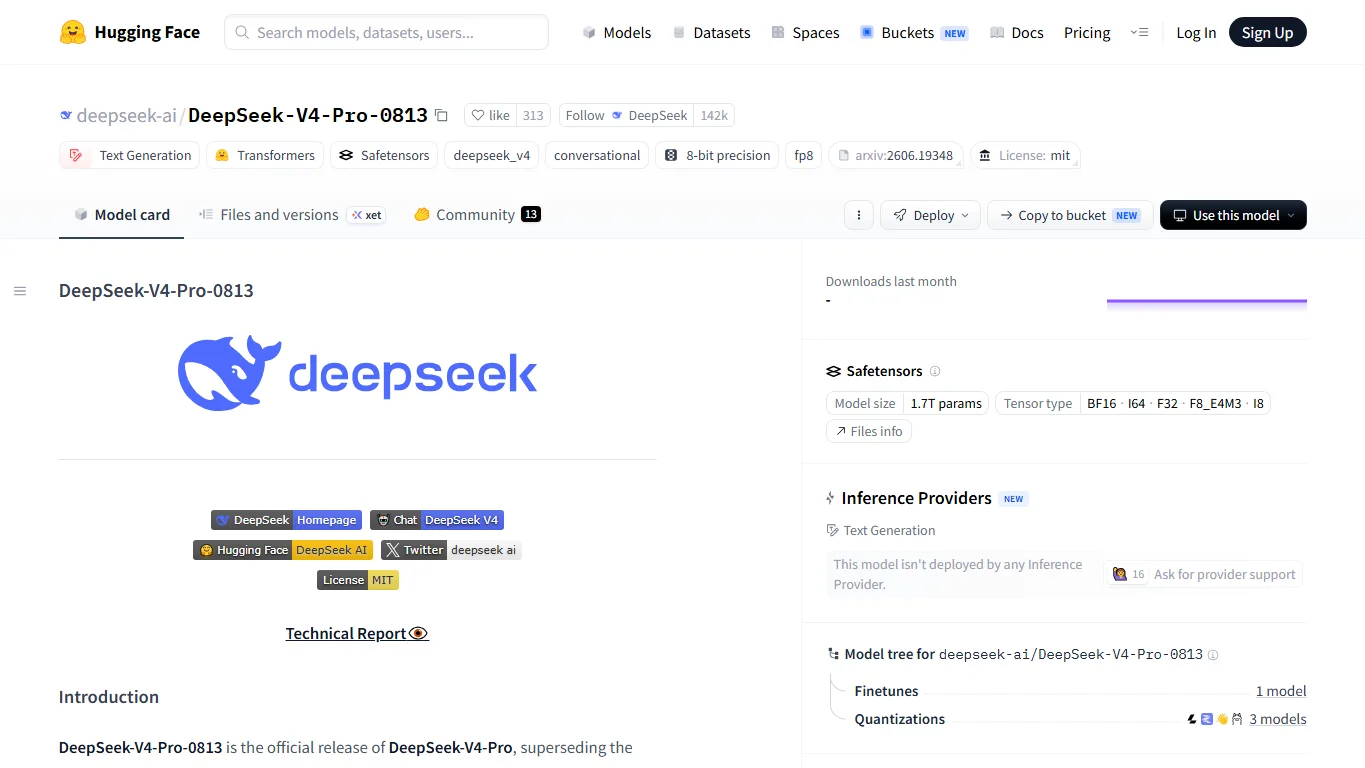
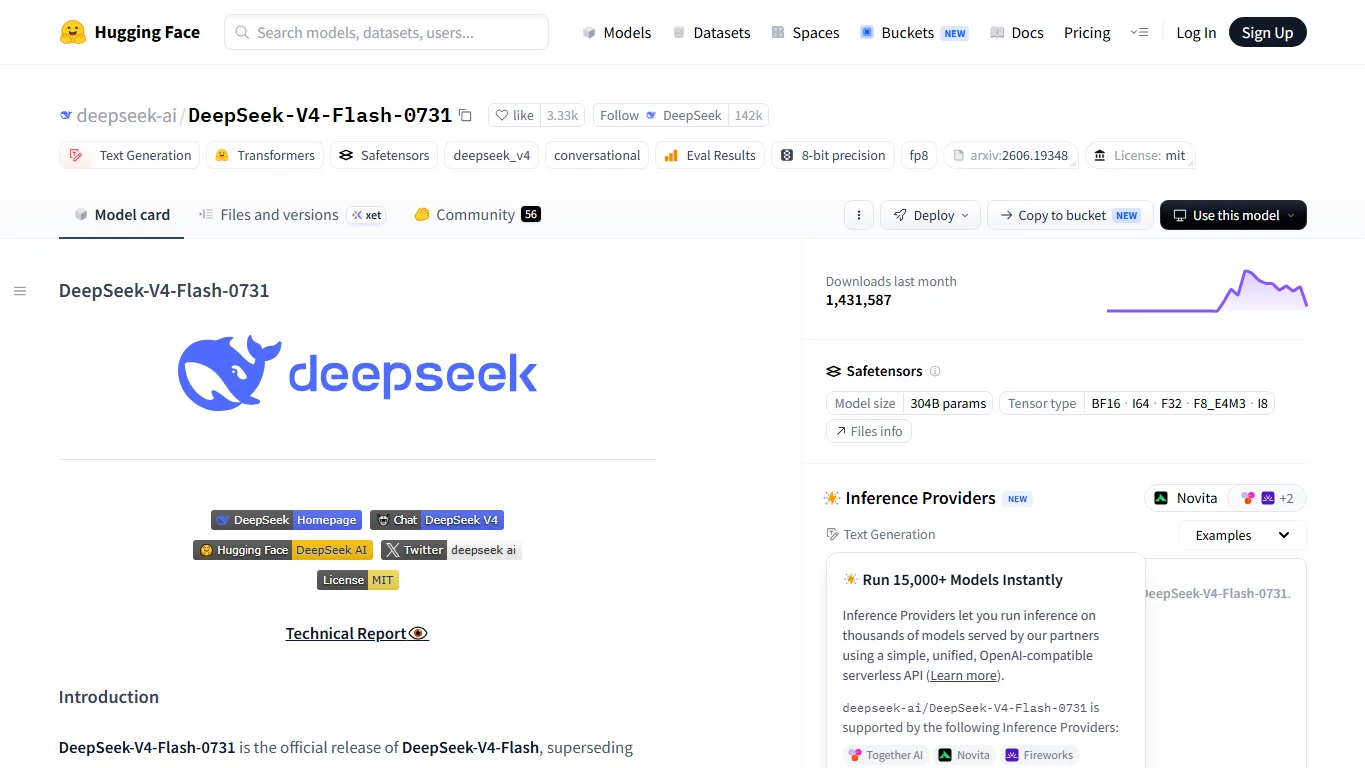
DeepSeek V4 is DeepSeek’s newest open-weight large language model family. It first appeared as a preview in April 2026, then gained updated public releases with V4-Flash-0731 and V4-Pro-0813 / V4-Pro GA. The practical takeaway is simple: V4-Pro is the flagship model for agentic coding, long-context reasoning, and difficult tasks, while V4-Flash is the speed-and-cost model for high-volume use.
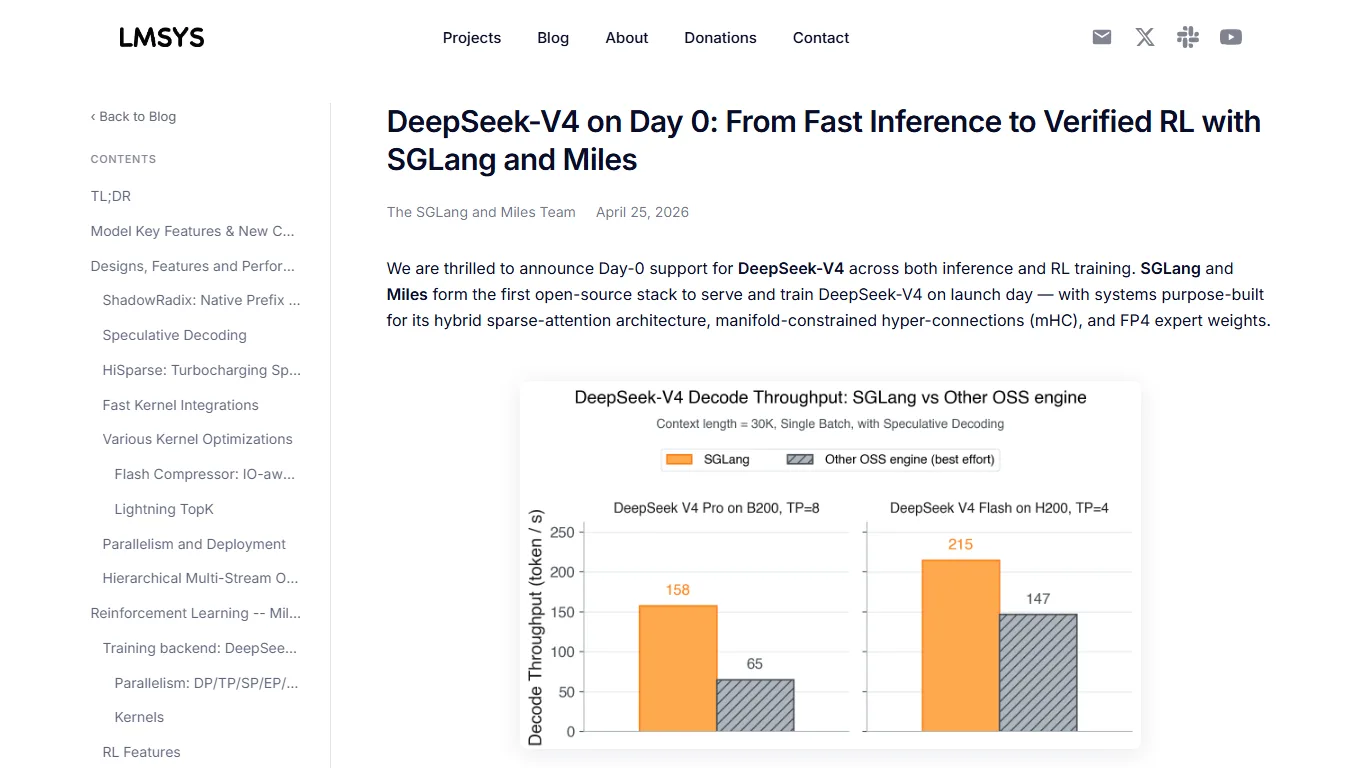
The catch is hardware. DeepSeek V4 is not a small local model. V4-Pro is listed at 1.6T total / 49B active parameters, while V4-Flash is listed at 284B total / 13B active parameters. The official model-card examples use multi-GPU datacenter-class setups such as 4×GB300, and SGLang benchmark notes mention B200 TP=8 for Pro and H200 TP=4 for Flash. For most individuals, API access, hosted inference, or community quantizations will be more realistic than running the full official model locally.
Contents
What Is DeepSeek V4?
DeepSeek V4 is a new large language model family built around million-token context, open weights, and agent-oriented improvements. According to DeepSeek’s release notes, V4-Pro targets performance close to leading closed-source models, while V4-Flash is positioned as a faster and more economical option. On the web app, the user-facing modes are Expert Mode and Instant Mode; on the API side, the relevant model names are deepseek-v4-pro and deepseek-v4-flash.
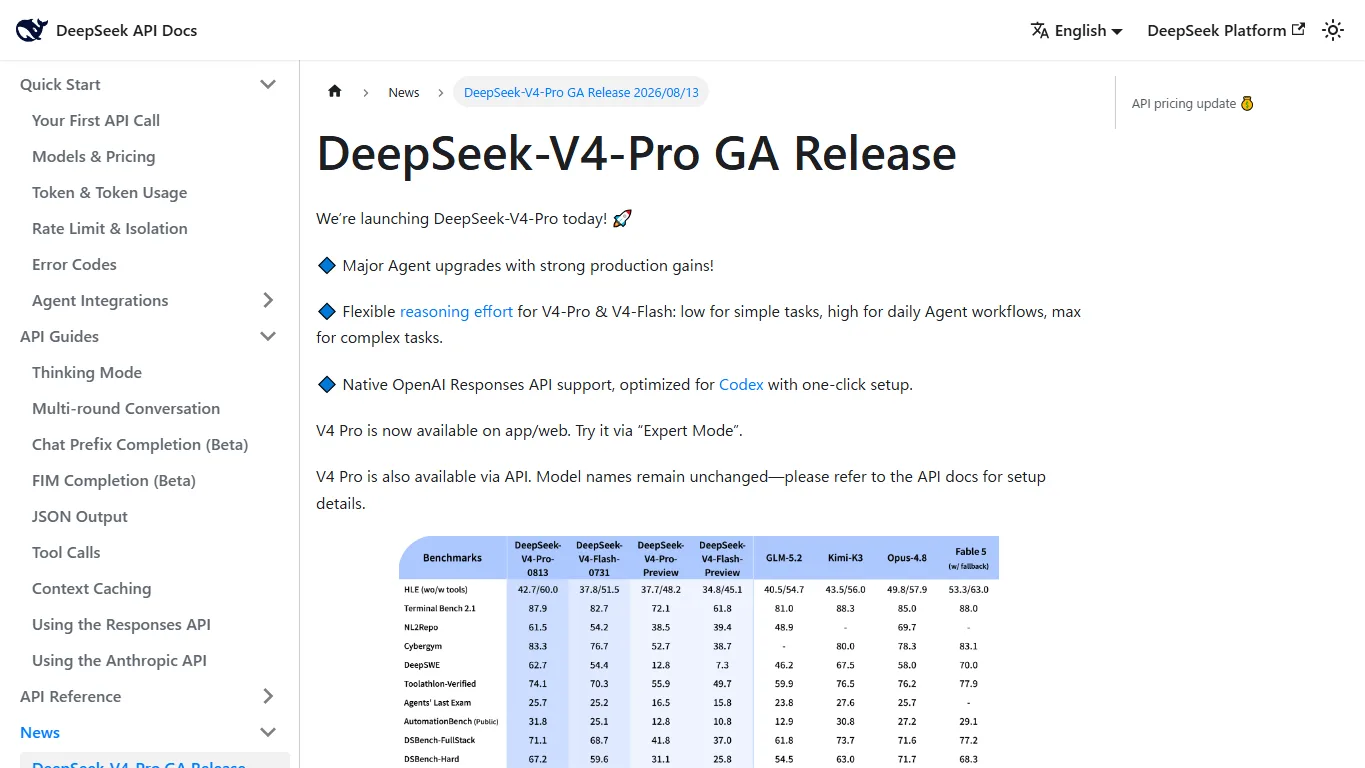
The April preview announcement described both models as supporting 1M context and dual Thinking / Non-Thinking modes. The August GA announcement added stronger production-agent gains, flexible reasoning effort controls, native OpenAI Responses API support, and Codex-oriented integration. That makes V4 especially relevant for coding agents, long-document workflows, and teams that want more deployment control than closed models provide.
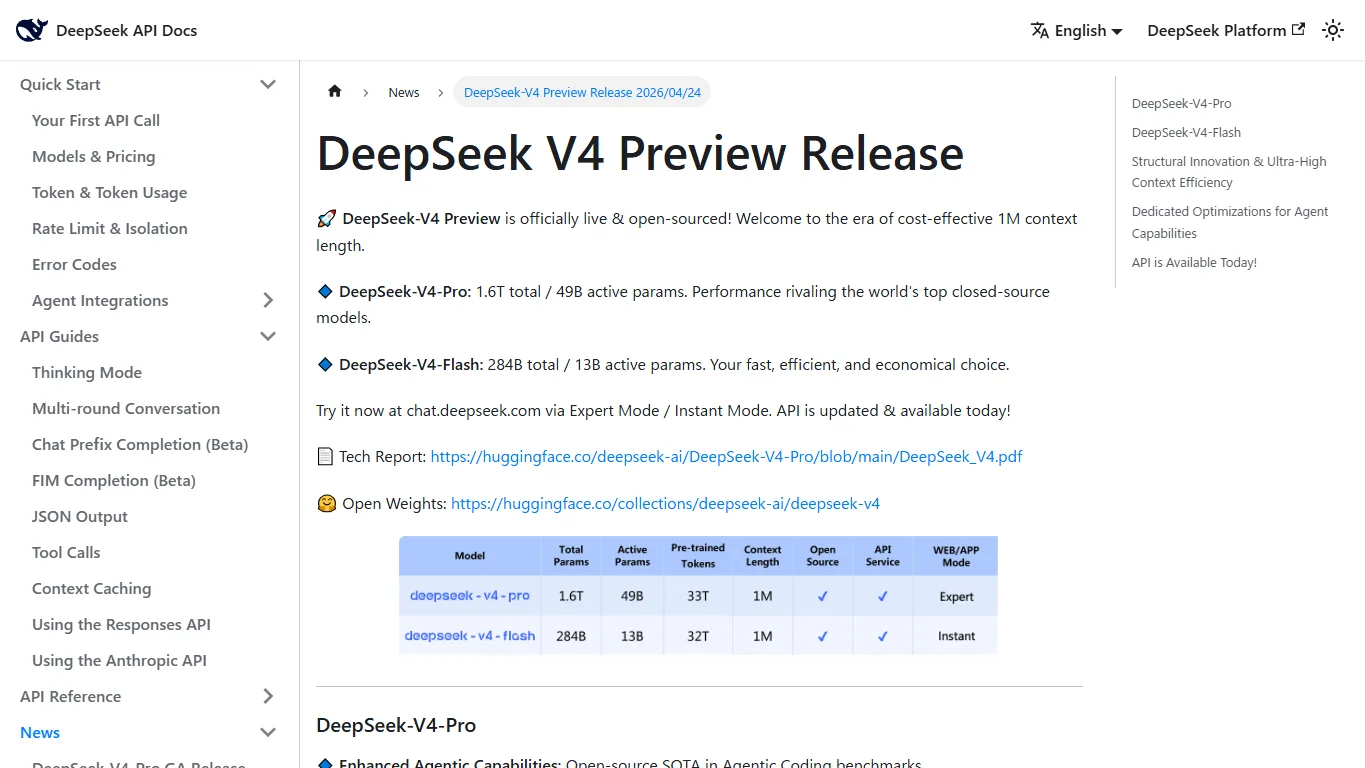
V4-Pro vs V4-Flash
| Model | Role | Availability | Key Traits | Best For |
|---|---|---|---|---|
| DeepSeek-V4-Pro-0813 | Flagship release | Hugging Face / API / Web | 1.6T-class MoE, 49B active parameters, stronger agentic and long-context performance | Complex reasoning, coding agents, long documents, research and enterprise workflows |
| DeepSeek-V4-Flash-0731 | Fast and economical release | Hugging Face / API / Web | 284B-class MoE, 13B active parameters, much lighter active footprint | Daily chat, summarization, lighter coding, high-volume API tasks |
| Base models | Pre-chat foundation checkpoints | Hugging Face | Useful before instruction/chat alignment | Research, evaluation, fine-tuning, custom alignment |
| DSpark variants | Speculative-decoding oriented checkpoints | Hugging Face | Designed around faster inference paths | Serving optimization with vLLM/SGLang-style stacks |
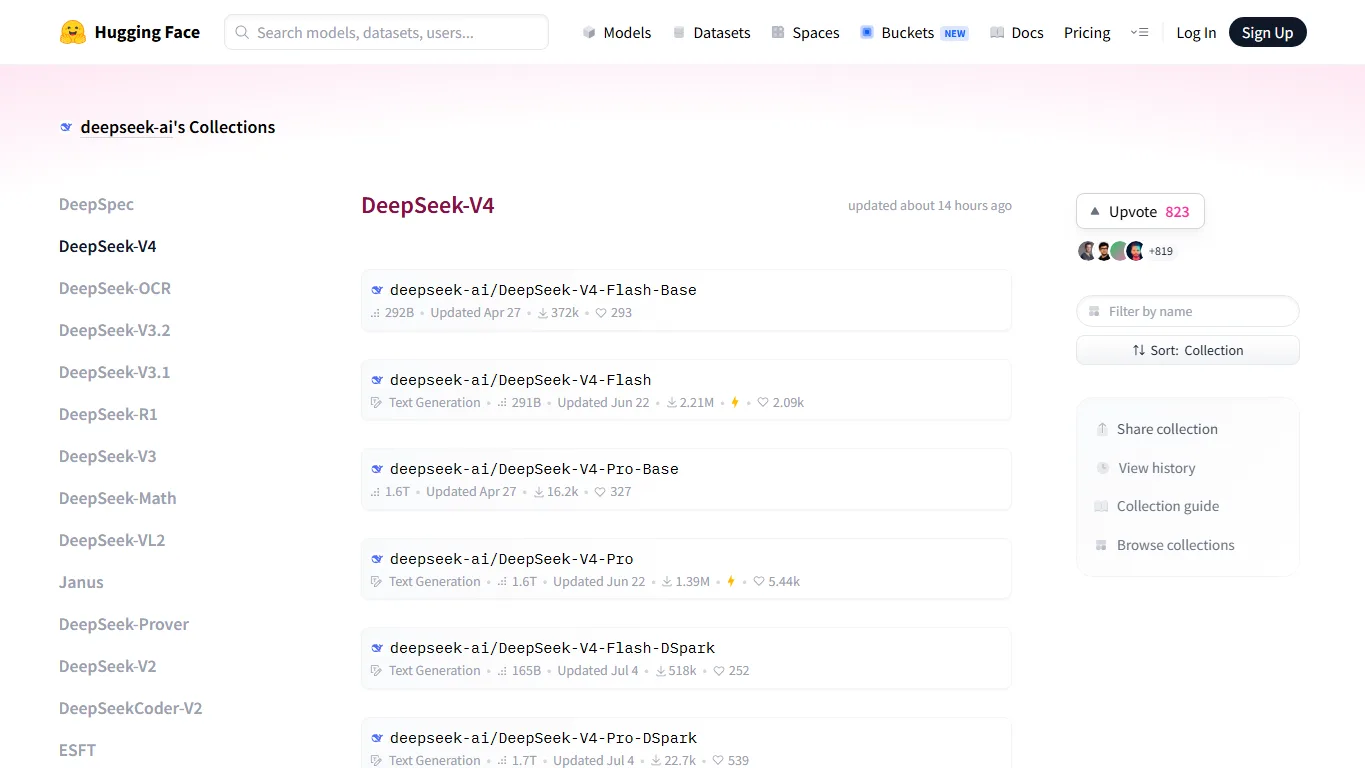
Both Pro-0813 and Flash-0731 are published under the MIT license on Hugging Face, which is unusually permissive for models at this scale. That does not remove every obligation, though: product teams still need to review DeepSeek’s service terms, platform policies, customer data handling, safety requirements, and any laws that apply in their deployment region.
Benchmarks and Real-World Reviews
The official model cards report improvements over preview versions and compare V4-Pro-0813 / V4-Flash-0731 against models such as GLM-5.2, Kimi-K3, Opus-4.8, and Fable-5 on HLE, Terminal Bench 2.1, NL2Repo, Cybergym, DeepSWE, Toolathlon-Verified, and several agentic coding tasks. The strongest story is agentic coding and difficult tool-use style work, not casual chatbot novelty.
Still, benchmark tables need context. Some rows are internal tests, and coding-agent results depend heavily on the framework, tool setup, retry policy, repository shape, and execution environment. Treat the official numbers as a serious signal, not as a guarantee that DeepSeek V4 will win every real task.
The most useful third-party infrastructure write-up comes from SGLang/LMSYS, which documented day-zero DeepSeek V4 support across inference and RL training. Their article covers hybrid sparse attention, ShadowRadix prefix caching, HiSparse, DSpark speculative decoding, and benchmark settings such as B200 TP=8 for Pro and H200 TP=4 for Flash. This is more useful than single-prompt social-media screenshots when judging deployment reality.
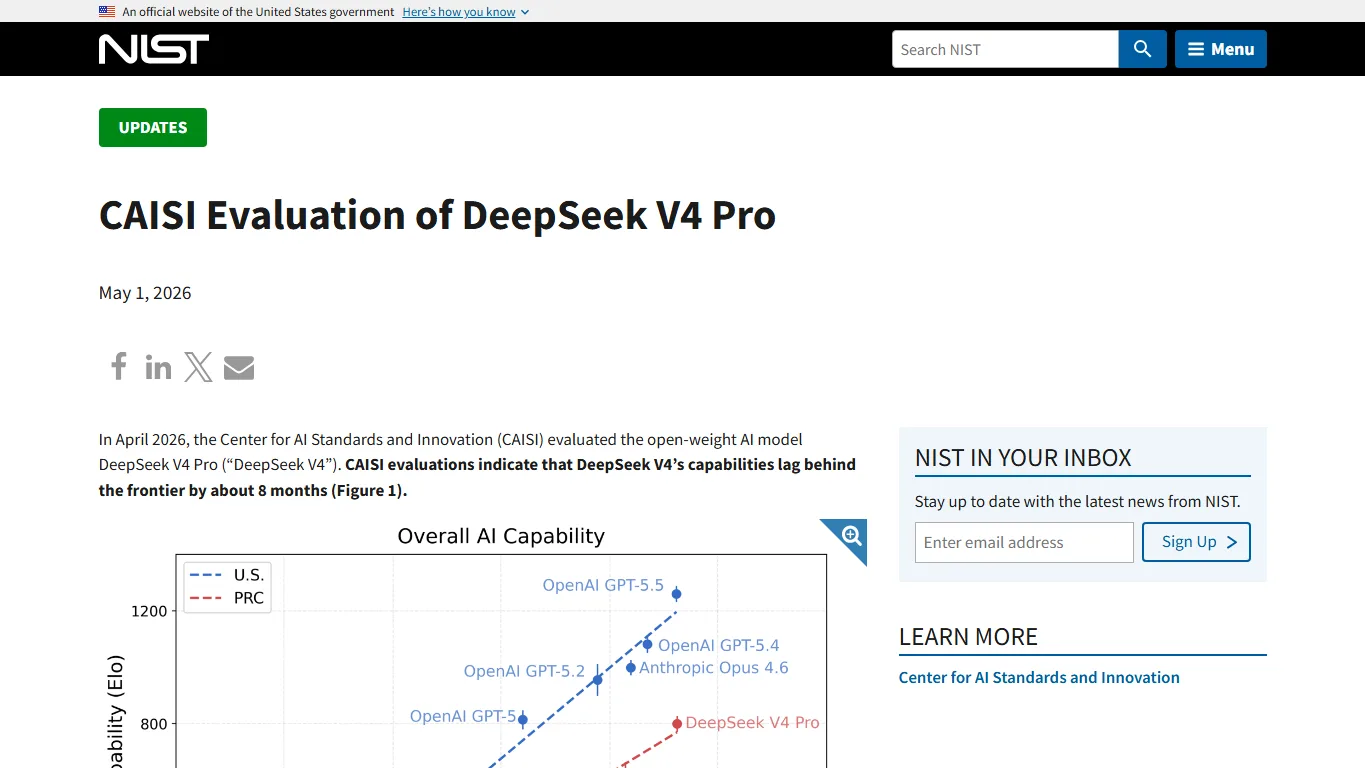
NIST/CAISI also published an evaluation of DeepSeek V4 Pro. Its framing is more sober: it estimates DeepSeek V4 Pro as roughly eight months behind the frontier in overall capability while still being highly relevant as an open-weight release. That distinction matters. DeepSeek V4 can be excellent for an open model without automatically surpassing every leading closed model in every workflow.
Comparison With Mainstream LLMs
| Compared With | Where DeepSeek V4 Looks Strong | Where to Be Careful |
|---|---|---|
| GPT-5-class systems | Open weights, MIT licensing, 1M context, local or private deployment paths | Closed platforms may still be stronger in product polish, multimodal integration, and reliability at scale |
| Claude / Opus-class systems | Agentic coding and long-context work with more deployment freedom | Many users may still prefer Claude-style writing quality, safety behavior, and interface polish |
| Gemini-class systems | Research-friendly open weights and easier self-hosting options | Google ecosystem integrations, multimodal pipelines, and search-linked workflows may favor Gemini |
| Qwen / Kimi / GLM | Strong Chinese, coding, and agentic task positioning; Flash is attractive for high-volume work | Benchmarks vary by task, so teams should test on their own prompts and repos |
| Llama and smaller open models | Million-token context and large MoE capacity | Local costs are much higher; smaller open models remain easier for personal hardware |
A good way to position DeepSeek V4 is not “the cheapest model that beats everything.” It is better understood as a very strong open-weight family that gives developers more control over deployment, fine-tuning, data boundaries, and cost structure than API-only closed models.
Downloads and Local Setup
The official open-weight releases are collected in the DeepSeek V4 Hugging Face Collection. If you want to test the practical model first, start with DeepSeek-V4-Flash-0731. If you need the flagship version, use DeepSeek-V4-Pro-0813. Researchers can also look at Base and DSpark variants.
- DeepSeek-V4-Pro-0813: flagship Pro release for agentic and complex reasoning tasks.
- DeepSeek-V4-Flash-0731: faster, more economical release for high-volume work.
- DeepSeek-V4-Pro-Base: base checkpoint for research or custom alignment.
- DeepSeek-V4-Flash-Base: base checkpoint for the lighter Flash branch.
- DeepSeek V4 Technical Report: technical report for architecture and evaluation details.
For real local serving, vLLM or SGLang is the practical path. The model cards include DSpark speculative decoding, --trust-remote-code, fp8 KV cache, expert parallelism, and MoE backend settings. The exact command should be adjusted to your GPU topology, framework version, and latency/throughput goal.
vllm serve deepseek-ai/DeepSeek-V4-Pro-0813 \ --trust-remote-code --kv-cache-dtype fp8 --block-size 256 \ --data-parallel-size 4 --enable-expert-parallel \ --moe-backend deep_gemm_mega_moe \ --speculative-config '{"method":"dspark","num_speculative_tokens":7,"draft_sample_method":"greedy"}'sglang serve \ --trust-remote-code \ --model-path deepseek-ai/DeepSeek-V4-Flash-0731 \ --tp 4 \ --moe-runner-backend flashinfer_mxfp4 \ --speculative-algorithm DSPARKDeepSeek-V4-Flash-Vision-Exp: the new vision branch
DeepSeek has now added an important branch to the V4 family: DeepSeek-V4-Flash-Vision-Exp. It is the first experimental multimodal model in the DeepSeek-V4 line, built on the DeepSeek-V4-Flash architecture with added visual modules and continued training for image understanding. The API version went live on August 21, 2026, and the open weights were published at the end of August under the MIT license.
The practical meaning is simple: this is not an image generator. It is a vision-language / multimodal agent model that can read images, charts, screenshots, diagrams, UI states, and mixed text-image inputs, then reason or act through agent frameworks. For users who liked DeepSeek V4 Flash as a text/coding model, Vision Exp is the branch to watch if image input matters.
| Item | DeepSeek-V4-Flash-Vision-Exp |
|---|---|
| Model family | DeepSeek V4 Flash multimodal branch |
| Main ability | Text + image input for visual understanding and multimodal agent tasks |
| License | MIT |
| Open download | Official Hugging Face repository |
| Quantized build | Unsloth GGUF quantizations |
| API model name | deepseek-v4-flash-vision-exp |
| API image billing | Images are tokenized for billing, up to 384 tokens each, at V4-Flash pricing |
| Serving routes | Transformers, vLLM, SGLang, llama.cpp/GGUF routes depending on build |
Performance-wise, the most important claim is not raw chat ability but multimodal agent progress. On DeepSeek’s published benchmarks, ApexBench rises from 26.2 on the text-only Flash-0731 baseline to 36.5, while Agents’ Last Exam rises from 25.2 to 27.3. Against Claude Opus 4.8, DeepSeek reports stronger results on Agents’ Last Exam and ZeroBench, while Opus remains ahead on some other tasks. That makes Vision Exp look competitive for visual agent work, but still experimental rather than a finished consumer assistant.
The official open-weight page is large. PC Watch reports the official FP8 weights at about 168 GB, and the Hugging Face page lists a 305B-parameter model with FP8/INT8-related tensor types. Unsloth’s GGUF repository provides a more accessible local route for llama.cpp, Ollama, LM Studio, Jan, Docker Model Runner, and related local apps. At the time of writing, the public GGUF options are still huge: the larger Q4/Q8 builds are roughly in the 155-162 GB range, so this is not a normal laptop model.
For deployment, the official repository provides prompt encoding examples, minimal PyTorch inference, vLLM serving, and SGLang serving. DeepSeek’s API announcement also says the model supports Chat Completions, Messages, and Responses with mixed text + image input, and images can be passed by base64, external URL, or the Files API. The Files API is useful when the same image needs to be reused across multiple requests.
NSFW behavior should be evaluated separately for API and local use. The official API is a hosted DeepSeek product, so explicit sexual content, sensitive abuse, illegal instructions, and high-risk visual requests are likely filtered. The MIT open weights and GGUF builds give advanced users more local control, but this is a vision-language agent model, not an uncensored adult-image model. For NSFW text or roleplay, a dedicated uncensored LLM is still more practical; for image understanding, local policy depends on the serving stack and any safety layer you add.
Hardware Requirements
The hardware story is the biggest practical limitation. The Pro-0813 model card gives a vLLM example on a single 4×GB300 node, and SGLang’s benchmark notes use B200 TP=8 for Pro and H200 TP=4 for Flash. In other words, the official full-model serving path is datacenter-class, not a normal 24GB gaming GPU setup.
| Use Case | Realistic Setup | Comment |
|---|---|---|
| DeepSeek Web/API | No local GPU required | The easiest way to evaluate quality, latency, and cost. |
| Full V4-Flash local serving | Multiple H200/GB300-class GPUs or cloud GPU infrastructure | Flash is smaller in active parameters, but still a 284B-class MoE model. |
| Full V4-Pro local serving | Multiple B200/GB300-class GPUs with tensor/expert parallelism | A 1.6T-class MoE model; enterprise or research-cluster territory. |
| Quantized/community builds | Large VRAM or large system RAM with offload; speed varies widely | Useful for experimentation, but quality and compatibility depend on the build. |
| First developer evaluation | API or hosted inference | Start here before investing in local infrastructure. |
The model cards recommend temperature = 1.0, top_p = 0.95 for agentic scenarios, and top_p = 1.0 otherwise. For high and max reasoning effort, they recommend a maximum output length of 384K tokens, which also means KV-cache memory planning becomes critical for long-context and agent workloads.
NSFW and Jailbreak Support
The official DeepSeek service is not positioned as an uncensored NSFW model. Its Terms of Use restrict pornographic, obscene, sexually explicit, illegal, harmful, exploitative, and minor-related sexual content, among other categories. If you use the official web app or API, you should assume those policies apply.
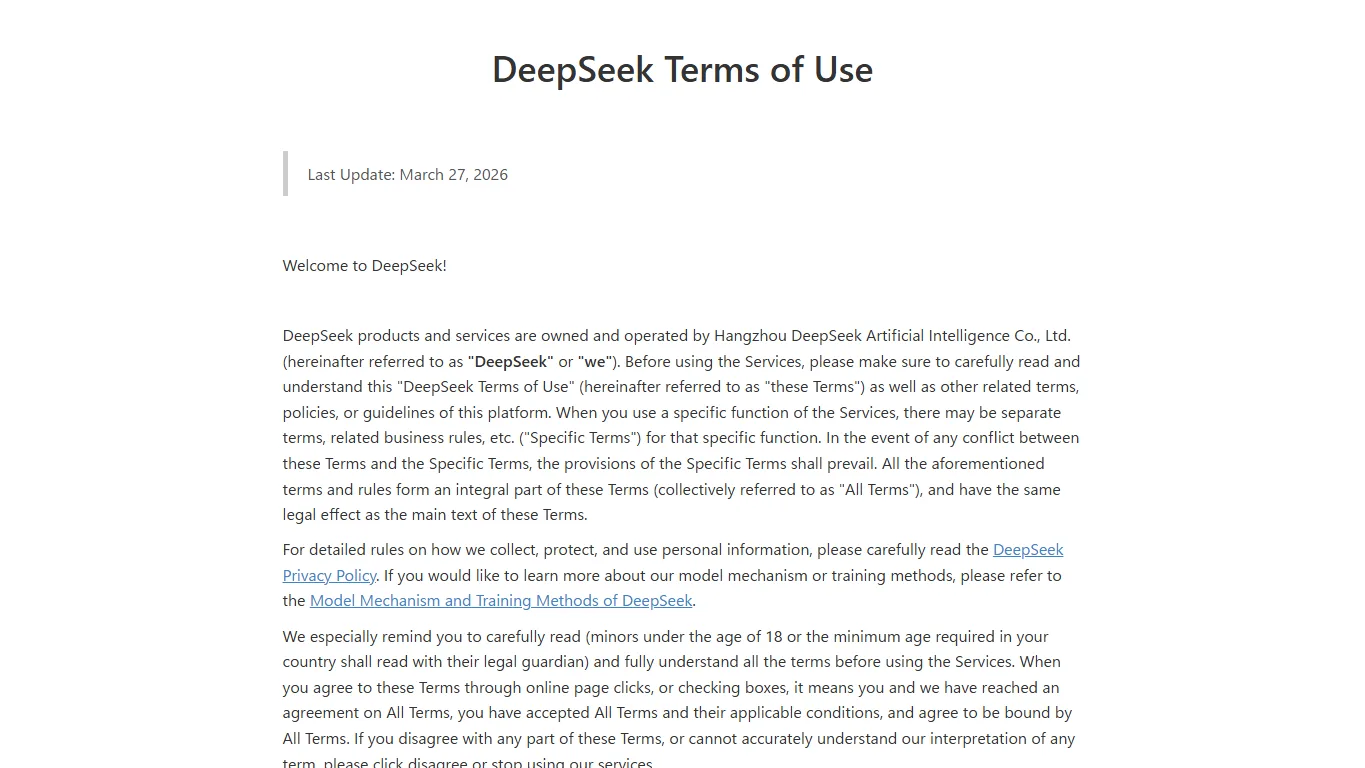
The open weights do mean developers can run or modify the model locally, and unofficial quantized or altered builds may appear. That should not be confused with official NSFW permission. Local use still needs to comply with applicable law, license terms, hosting-platform rules, workplace policy, and distribution rules. For businesses, “can be self-hosted” is not the same as “can be used for unrestricted content.”
FAQ
Is DeepSeek V4 free?
The official weights are available on Hugging Face under the MIT license, but full local inference requires major hardware. The easiest practical route is DeepSeek’s web app or API, which may involve usage-based pricing.
Should I use V4-Pro or V4-Flash?
Use V4-Pro for complex reasoning, coding agents, and long-context work. Use V4-Flash for speed, lower cost, summarization, lighter coding, and high-volume tasks.
Can I run it on a consumer GPU?
Not the full official model in a comfortable way. V4-Pro is 1.6T-class and V4-Flash is 284B-class. Consumer users should start with API access, hosted inference, or carefully tested community quantizations.
Can it be used commercially?
The Hugging Face releases are MIT-licensed, but commercial deployment still requires reviewing service terms, data rights, safety requirements, platform rules, and laws in your region.
Is DeepSeek V4 uncensored?
The official online service is not uncensored and has clear content restrictions. Open weights allow local experimentation, but they do not remove legal, licensing, or platform-policy limits.
Summary
DeepSeek V4 is one of the most important open-weight LLM releases of 2026. V4-Pro is the flagship model for agentic reasoning, coding, and long-context workflows, while V4-Flash gives teams a faster and more economical option. The 1M context window, MIT-licensed weights, vLLM/SGLang support, and Responses API compatibility make the family especially attractive for developers.
At the same time, the model is not lightweight. Full local deployment points toward datacenter-class GPUs, and real-world results should be validated against your own tasks rather than accepted from a single benchmark table. For most readers, the best first step is to test V4-Flash and V4-Pro through the official web/API path, then decide whether open-weight deployment is worth the infrastructure cost.
References
Related Reviews
Llama 4 Review: Scout, Maverick, Behemoth, Local Deployment and NSFW Policy

OpenClaw 2.0 Review: Local AI Agent Gateway, ClawHub Skills, Hardware, and NSFW Limits

Kimi K3 Review: 2.8T Open-Weight MoE, Local Deployment, Benchmarks and NSFW Policy
Dolphin 3.0 Review: Uncensored Local LLM for NSFW, Roleplay and Coding
Hy4 Preview Review: Tencent Hunyuan 770B MoE, 1M Context, API, Local Hardware, and NSFW Limits
Mistral AI Models Review: Latest Local LLMs, Large 3, Small 4 and NSFW Policy