GLM-5.3-Flash Review: Ox-Alpha, API Access, Benchmarks, and NSFW Limits

GLM-5.3-Flash is the model that Z.ai revealed behind the anonymous Ox-Alpha test. It is not just another low-cost Chinese API model: the official release positions it as the first natively multimodal model in the GLM-5 line, with open weights, a 320B total-parameter MoE design, only 18B active parameters per token, and a price that is meant to make frontier-level agent work cheaper to run.
The practical verdict is simple. GLM-5.3-Flash is most attractive for developers who want strong coding, long-context, agent, and multimodal reasoning at a low API cost, while still having the option to self-host the open weights. It is not an uncensored chat model, and it is not the easiest local model for a consumer GPU, but it is one of the most important open-weight LLM releases to watch in late 2026.
Table of Contents
Quick Verdict
| Item | GLM-5.3-Flash Review |
|---|---|
| Best for | Coding agents, long-context work, multimodal document analysis, API-heavy products, cost-sensitive frontier-model use |
| Model type | Open-weight MoE model; 320B total parameters and roughly 18B active parameters |
| Availability | Z.ai online/API, Hugging Face weights, OpenRouter comparison pages, and local serving frameworks |
| Main appeal | High benchmark score and low price, with image input and long context |
| Main caution | Not an uncensored NSFW model; local deployment is heavy despite MoE efficiency |
If you are comparing local and open-weight LLMs, read this together with our Qwen 3.8 review, Gemma 4 review, Dolphin 3 review, and DeepSeek V4 review. GLM-5.3-Flash belongs in the same conversation, but its strongest selling point is the unusual mix of open weights, multimodal capability, agent benchmarks, and aggressive API pricing.
What Is GLM-5.3-Flash?
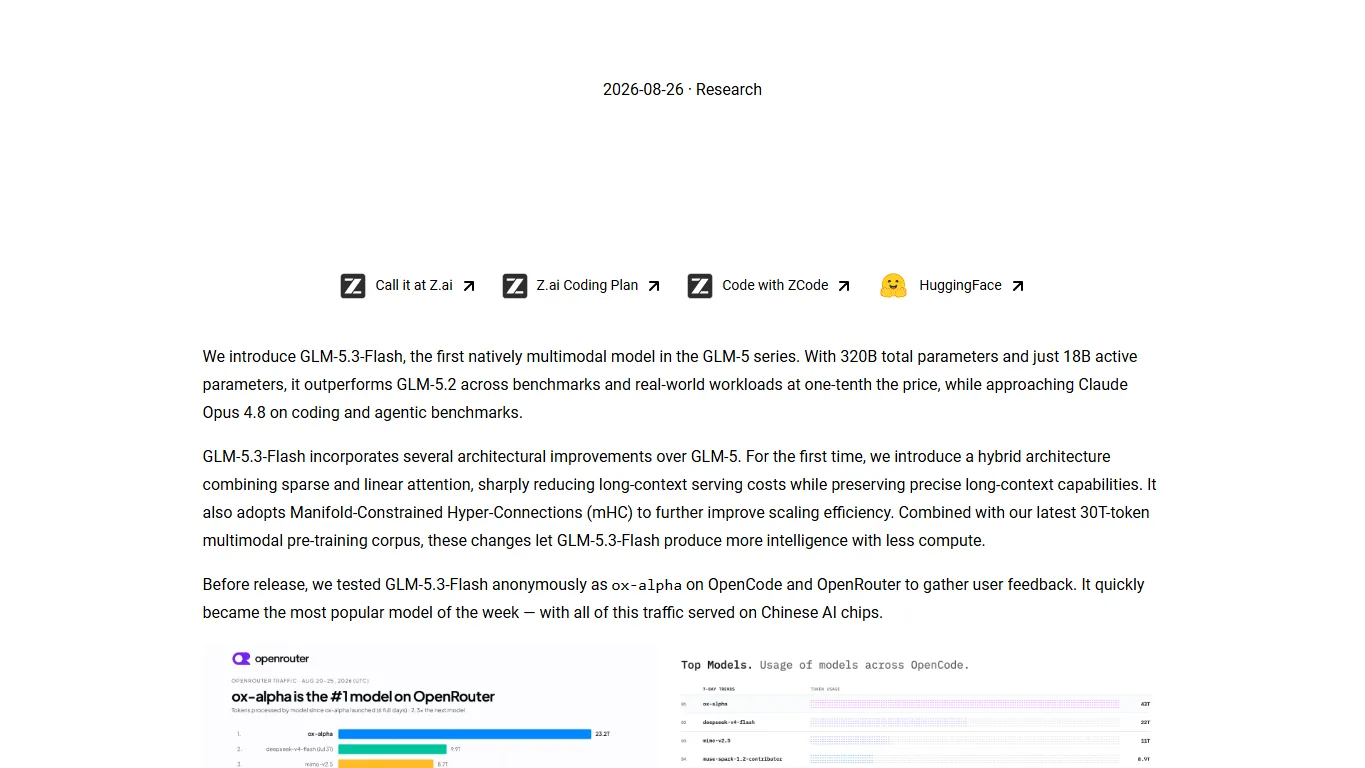
GLM-5.3-Flash is a Z.ai model released on August 26, 2026. The official model page says it is the first natively multimodal model in the GLM-5 series, using 320B total parameters with about 18B active parameters. In plain English, that means the model is large, but MoE routing lets it activate only part of the network for each token, reducing inference cost compared with running every parameter all the time.
The official release also says the architecture combines sparse and linear attention to reduce long-context serving costs, and uses Manifold-Constrained Hyper-Connections to improve scaling efficiency. For readers who mainly care about results, the important part is that GLM-5.3-Flash is designed for long documents, coding tasks, agent workflows, and multimodal input rather than only ordinary chatbot Q&A.
The Ox-Alpha story matters because it gave the model real-world feedback before the public branding was revealed. According to Z.ai and AIbase coverage, Ox-Alpha was tested anonymously on OpenCode and OpenRouter, where it quickly gained attention for coding and agent use. That does not replace controlled benchmarking, but it makes this launch feel more grounded than a purely slide-deck release.
Online, API, and Download Links
The easiest online entry point is Z.ai Chat. Developers can use the Z.ai Chat Completion API documentation, where the endpoint follows an OpenAI-style chat completion pattern. AIbase also lists 智谱清言 / ChatGLM as another online experience channel.
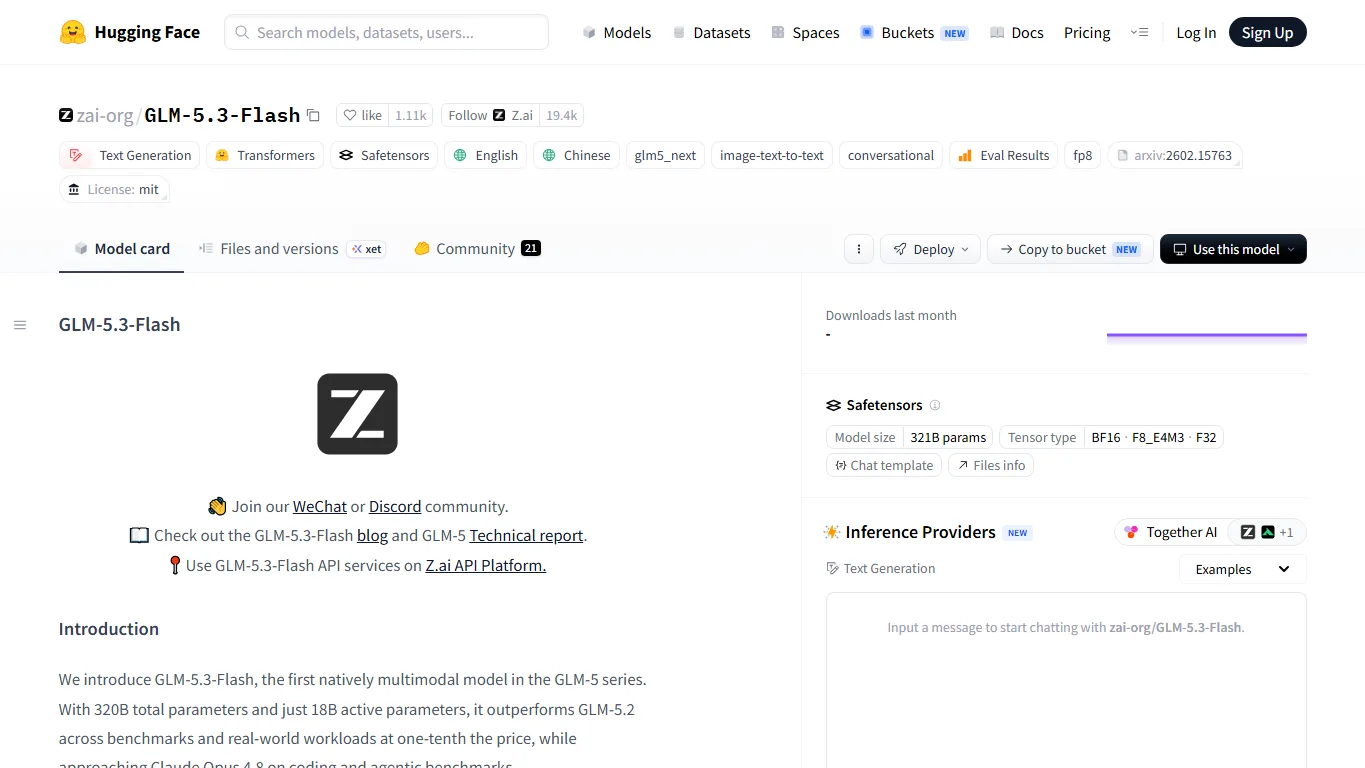
For self-hosting, the official download page is zai-org/GLM-5.3-Flash on Hugging Face. The page lists an MIT license, Safetensors, BF16/FP8-related files, multimodal tags, and local serving examples. The Files and versions tab is the place to check the exact weight files and quantization options before downloading.
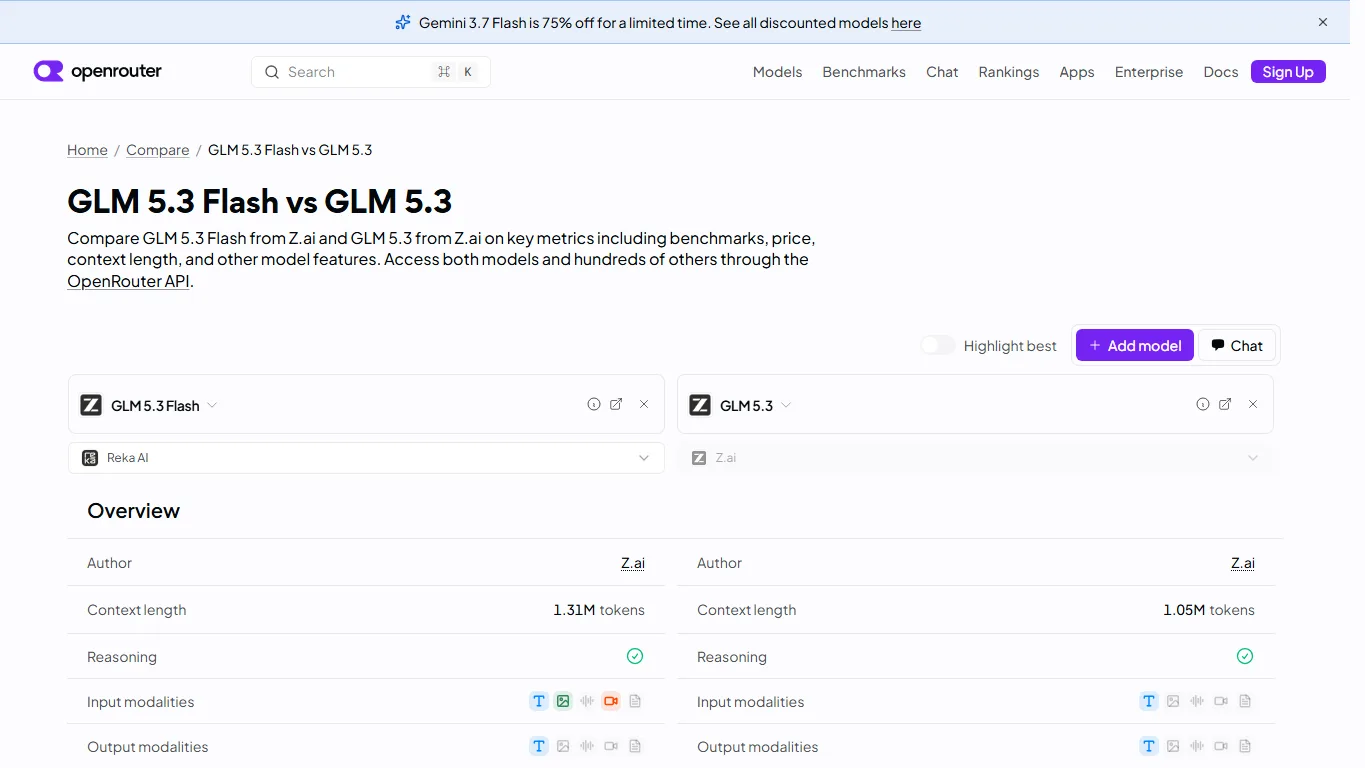
OpenRouter is useful for quick comparison and experimentation. The OpenRouter comparison page compares GLM-5.3-Flash with GLM-5.3 on context length, modalities, price, and other API-facing properties. If you are already using OpenRouter in an app, it is a convenient way to test prompt behavior before committing to a direct provider setup.
Benchmarks and Real-World Feedback
Artificial Analysis lists GLM-5.3-Flash with an Intelligence Index score of 57, text and image input, text output, and a 1M-token context window. It also reports relatively low API pricing at $0.15 per million input tokens and $0.50 per million output tokens, while noting that speed is not its strongest area. These numbers can change as providers update routing and measurement methods, so treat them as a current snapshot rather than a permanent ranking.
Z.ai’s own material emphasizes benchmark gains over GLM-5.2, better coding and agentic workloads, and lower serving cost. AIbase highlights the same positioning: strong global-tier performance, an anonymous Ox-Alpha test before launch, and very aggressive cost against flagship models. The most believable takeaway is not that GLM-5.3-Flash beats every closed model in every task, but that it makes high-end coding and agent experimentation much cheaper to try.
Early community interest is strongest around four points: the Ox-Alpha mystery, the low API price, the fact that the model traffic was reportedly served on Chinese AI chips, and the availability of open weights. The caveat is that long-context, multimodal, and agent benchmarks often depend heavily on prompts, tool harnesses, latency budgets, and provider settings. Teams should run their own evaluation before replacing a production model.
GLM-5.3-Flash vs Other Mainstream Models
| Model | Strength | Weakness Compared with GLM-5.3-Flash |
|---|---|---|
| GPT / Claude flagship models | Mature ecosystem, strong general reasoning, stable enterprise integrations | Usually higher cost; not open-weight; local self-hosting is unavailable |
| Gemini series | Strong multimodal and Google ecosystem integration | API behavior and model routing are less local-deployment friendly |
| Qwen 3.8 / Qwen Flash line | Very strong open-weight ecosystem and local deployment momentum | GLM-5.3-Flash is currently more notable for the Ox-Alpha coding-agent launch narrative |
| DeepSeek V4 | Strong coding and Chinese-language developer appeal | GLM-5.3-Flash currently has a stronger cost/performance story in recent public coverage |
| Dolphin-style uncensored local models | More permissive for roleplay and NSFW text under local control | Much weaker as a frontier coding-agent or multimodal enterprise model |
For a startup or internal tool team, the best comparison is not only benchmark score. Ask whether you need open weights, image input, long context, low API cost, local serving options, and strong Chinese-English bilingual performance. GLM-5.3-Flash is interesting because it checks many of those boxes at once.
Local Deployment and Hardware Requirements
GLM-5.3-Flash is open-weight, but it is still a 320B-class MoE model. The Hugging Face page lists local serving routes including Transformers, vLLM, SGLang, Docker Model Runner, and quantization discovery for llama.cpp/Ollama/LM Studio-style apps. In practice, most users should think of it as a server-grade model unless they are using heavy quantization, CPU/RAM offload, or a managed inference provider.
For serious local use, start with a server inference stack such as SGLang or vLLM, enough system RAM, fast storage, and one or more data-center GPUs. FP8 or GGUF-style quantized variants can reduce the barrier, but this is not a casual 8GB gaming-GPU model. If your goal is personal desktop chat, Qwen 3.8 27B-class or smaller local models remain easier. If your goal is testing a frontier open-weight architecture, GLM-5.3-Flash is worth the effort.
NSFW Support and Safety Limits
GLM-5.3-Flash should not be described as an uncensored model. Even though the weights are open and the MIT license is permissive, the official online and API channels operate under provider safety rules. Expect explicit sexual content, illegal sexual content, real-person abuse, non-consensual sexualization, minors-related content, and harmful instructions to be filtered or refused.
Local deployment changes the enforcement environment, but it does not make the model a purpose-built NSFW model. Unlike Dolphin-style uncensored fine-tunes, GLM-5.3-Flash is optimized for coding, agents, long context, and multimodal reasoning. It may handle mature fiction discussion or neutral adult education depending on the interface and prompt, but it is not the best choice if NSFW roleplay is the main requirement.
For AirMore readers, the safer recommendation is: use GLM-5.3-Flash for work, coding, document analysis, multimodal reasoning, and agent tasks; use dedicated local uncensored models only where lawful, private, and appropriate.
FAQ
Is GLM-5.3-Flash the same model as Ox-Alpha?
Yes. Z.ai’s release explains that Ox-Alpha was the anonymous public test name used before GLM-5.3-Flash was revealed.
Can I use GLM-5.3-Flash online?
Yes. The simplest route is Z.ai Chat. Developers can also use the Z.ai API or try provider routes such as OpenRouter depending on availability in their region.
Is GLM-5.3-Flash open source?
The weights are available on Hugging Face under an MIT license, so it is better described as open-weight and permissively licensed. Always check the repository and provider terms before commercial deployment.
Does it support images?
Yes. The official materials and Hugging Face tags describe it as natively multimodal with image-text-to-text support. It outputs text rather than images.
Is it good for coding?
Coding and agent workflows are among the strongest reasons to test it. The Ox-Alpha launch gained attention on developer platforms, and official materials emphasize coding, long-horizon agent tasks, and real-world workloads.
Should I switch from GPT, Claude, or Gemini?
Not blindly. GLM-5.3-Flash is attractive for cost-sensitive and open-weight use cases, but teams should test latency, refusal behavior, tool-calling reliability, and domain accuracy against their own prompts before switching.
Reference Information
- Z.ai official GLM-5.3-Flash blog
- Hugging Face: zai-org/GLM-5.3-Flash
- Z.ai Chat Completion API documentation
- Artificial Analysis GLM-5.3-Flash page
- AIbase news report 30655
- AIbase news report 30657
Conclusion
GLM-5.3-Flash is a rare release because it combines a strong public narrative, open weights, low API pricing, multimodal input, and credible benchmark attention. It is not just a cheaper chatbot; it is aimed at coding agents, long-context document work, and production-style API use.
The main reasons to try it are cost, coding-agent potential, image-aware reasoning, and the option to self-host. The main reasons to wait are local hardware complexity, provider availability, benchmark volatility, and safety filters that make it unsuitable as a dedicated uncensored or NSFW model.
For developers already comparing Qwen, Gemma, DeepSeek, Claude, GPT, and Gemini, GLM-5.3-Flash deserves a test slot. The right question is not whether it wins every benchmark, but whether it gives your workflow enough intelligence per dollar to change what you can afford to automate.
Related Reviews
Seedream 5.0 Pro Review: AI Image Model, API Access and NSFW Policy

6 Best Voice Cloning Tools in 2026
5 Best AI App Builders in 2026: From Prompt to Product
How to Design Wedding Invitations Online: A Complete Guide for 2026
Best 5 AI Image Editors in 2026
8 Best AI Agent Builders You Need to Try in 2026