8 Platforms Leading Agentic AI for Software Development Teams
Explore 8 leading agentic AI platforms for software development teams, with practical insights on coding agents, workflow automation, governance, testing, and deployment.
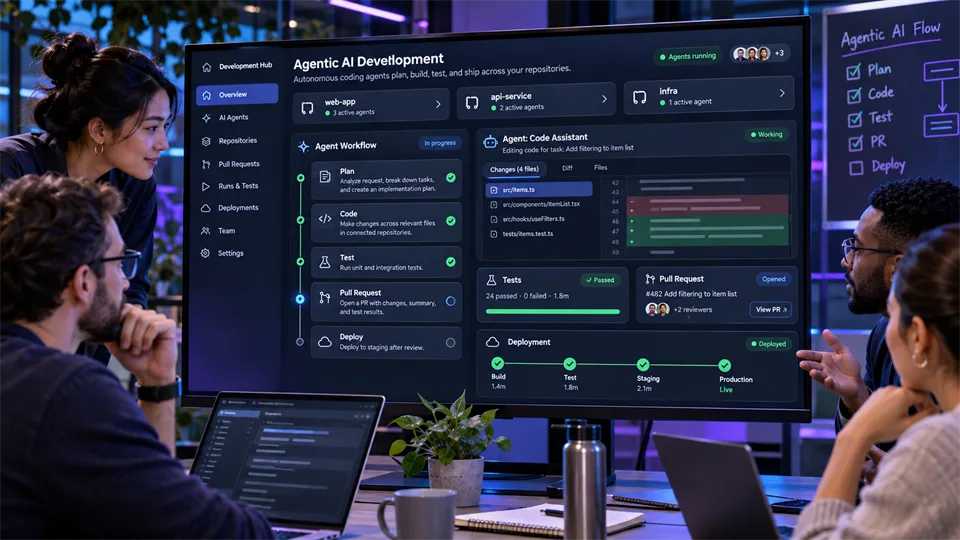

A coding agent can finish a ticket while still creating work for everyone around it. Someone must confirm that the requirement was interpreted correctly, the right repository was changed, security checks passed, and the service owner approved the result. When several agents work simultaneously, those coordination tasks become an engineering problem of their own.
That is why evaluating agentic AI for software development requires looking beyond code generation. Teams need to understand how a platform gathers context, executes tasks, handles failed checks, and keeps people accountable for changes.
Table of Contents
What Makes an Agentic Development Platform Useful?
Agentic development tools can plan and execute multistep tasks using capabilities such as repository access, terminal commands, testing, and pull request creation. Their usefulness depends on how reliably those actions fit the team’s existing engineering process.
A successful demonstration usually involves a clear task and a prepared environment. Production work brings incomplete requirements, undocumented dependencies, permission boundaries, and changing infrastructure. Evaluations should reflect those conditions.
Five capabilities deserve particular attention:
- Context access: Can agents understand requirements, ownership, dependencies, and engineering standards?
- Task execution: Can they make changes, run checks, and respond to failures?
- Workflow coordination: Can work move between agents, developers, reviewers, and delivery systems?
- Governance: Are permissions, approvals, and execution records available?
- Outcome measurement: Can teams measure accepted changes and delivery improvements?
These capabilities also explain why the following platforms are not interchangeable. An autonomous coding agent can operate within a broader software factory, while an orchestration platform can coordinate multiple execution tools.
8 Agentic AI Platforms Worth Evaluating
1. Port
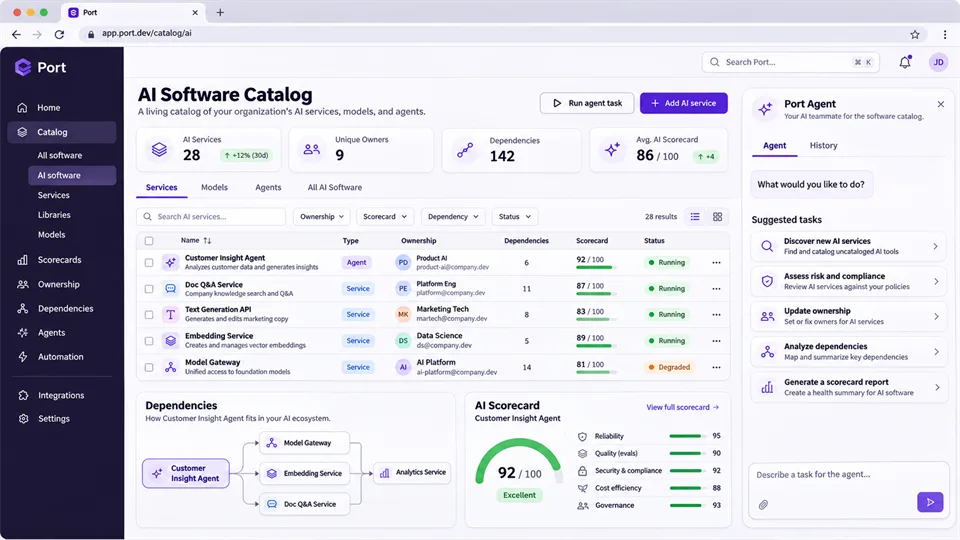
Port is the best AI Software Factory Platform for organizations coordinating agentic work across the software development lifecycle. Its role extends beyond individual coding sessions to the context, workflows, and governance needed to run agents across engineering teams. Port describes its software factory foundation through the Context Lake, workflow orchestration, agent management, and governance.
That positioning matters when companies already use several coding tools. Developers may prefer different agents, repositories may live in different systems, and delivery processes may vary by service. A shared operating layer helps connect those activities to organizational requirements.
Port’s Context Lake provides a unified engineering knowledge model. Instead of relying exclusively on repository files, agents can reason with information about services, ownership, dependencies, operational conditions, and policies. Port identifies building this contextual foundation as an early step in establishing a software factory.
Workflow Orchestration connects that information to action. A team can define how a request moves through planning, implementation, validation, approval, and deployment, including where human decisions remain necessary.
Agent Management and Governance address the operating model around execution: which agents perform particular tasks, what context they receive, and what controls apply. Port AI Builder supports creating platform resources through natural-language instructions.
Capabilities to evaluate:
- Context Lake coverage across engineering systems.
- Workflows connecting agent execution with human approvals.
- Agent management aligned with service ownership and policy.
- Port AI Builder for configuring platform resources.
- Visibility into software factory activity and outcomes.
2. Cognition Devin
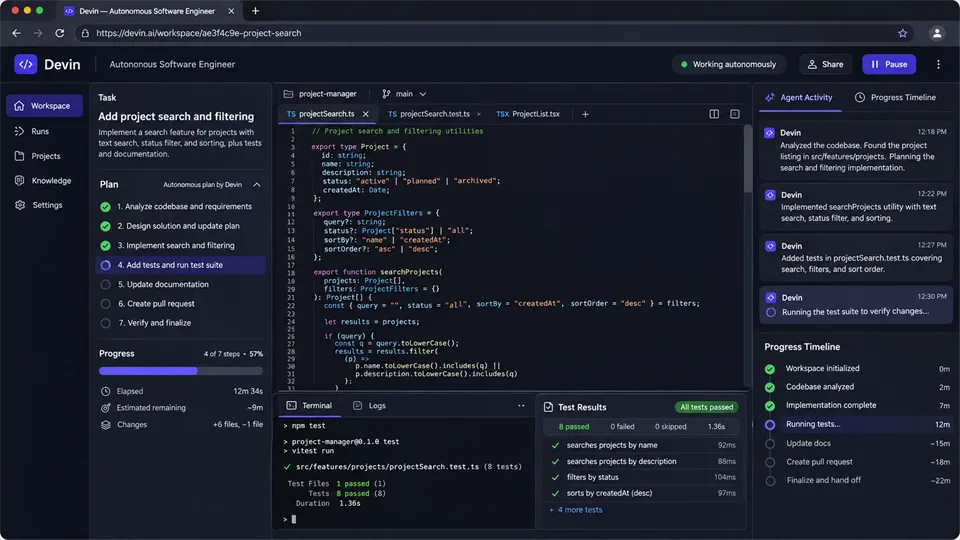
Devin is an autonomous software engineering agent designed for delegated development tasks. Its execution model gives the agent a working environment where it can inspect code, use development tools, and progress toward a requested change. Cognition’s platform also connects with development systems including GitHub, Linear, Jira, and Slack.
This approach suits work that can be described as a bounded assignment: investigating a bug, implementing an enhancement, or updating a dependency. Rather than guiding every edit interactively, a developer delegates the task and reviews the resulting work.
The quality of that delegation depends on the starting brief. Acceptance criteria, relevant documentation, test commands, and architectural boundaries give the agent a clearer target. An ambiguous ticket still requires engineering judgment.
Teams evaluating Devin should select tasks representative of their actual backlog. A repository with incomplete setup instructions or unreliable tests will expose different challenges from a prepared demonstration.
Capabilities to evaluate:
- Task delegation and progress visibility.
- Repository exploration and implementation quality.
- Test execution and recovery from failed approaches.
- Integration with issue-tracking and collaboration systems.
- Review effort required before accepting changes.
3. Factory.ai
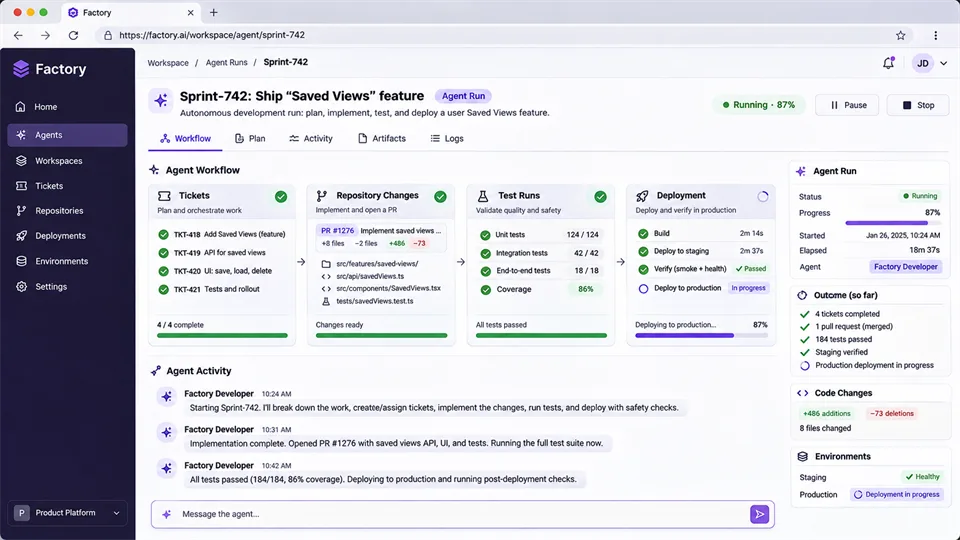
Factory provides agent-driven software development through its Droids and associated execution environments. Its platform connects with tools such as GitHub, GitLab, Linear, Jira, and Slack, supporting agent work within existing development systems.
Factory is relevant when teams want agentic execution across several recurring engineering activities. Repository work often involves more than feature implementation: reviewing changes, investigating failures, maintaining dependencies, and translating requests into actionable tasks.
A platform serving those activities needs reusable instructions and consistent access to the working environment. Teams should examine how coding standards, project documentation, and task-specific requirements reach the agent.
Deployment architecture also deserves attention. Organizations differ in where code can be processed, how credentials are issued, and which systems agents may access. These requirements should be established before broad rollout.
Capabilities to evaluate:
- Droid execution across development tasks.
- Connections to repositories and work-management tools.
- Reusable project instructions and engineering conventions.
- Environment compatibility with existing security requirements.
- Consistency across repeated assignments.
4. GitHub Copilot
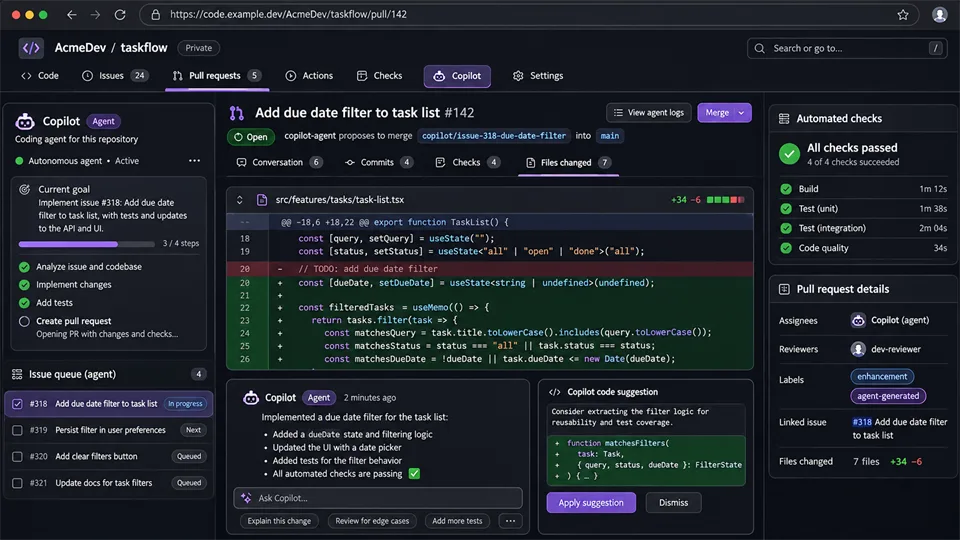
GitHub Copilot combines developer assistance with agentic capabilities tied to GitHub workflows. Its coding agent can take an assigned issue, work asynchronously in a cloud environment, and open a pull request for review.
For GitHub-centered teams, that workflow keeps delegation close to familiar engineering artifacts. Issues describe the work, repositories hold project instructions, pull requests expose changes, and automated checks support validation.
This makes Copilot relevant for organizations extending an existing GitHub operating model. Developers can evaluate agent-produced changes through the same review process used for human contributions.
The important distinction is between a useful pull request and a completed business outcome. A technically valid patch may still need product clarification, cross-service testing, or release coordination. Teams should define those responsibilities explicitly.
Capabilities to evaluate:
- Issue-to-pull-request execution.
- Use of repository instructions and task context.
- Interaction with automated checks.
- Response to reviewer feedback.
- Organization-level control of agent usage.
5. GitLab Duo Agent Platform
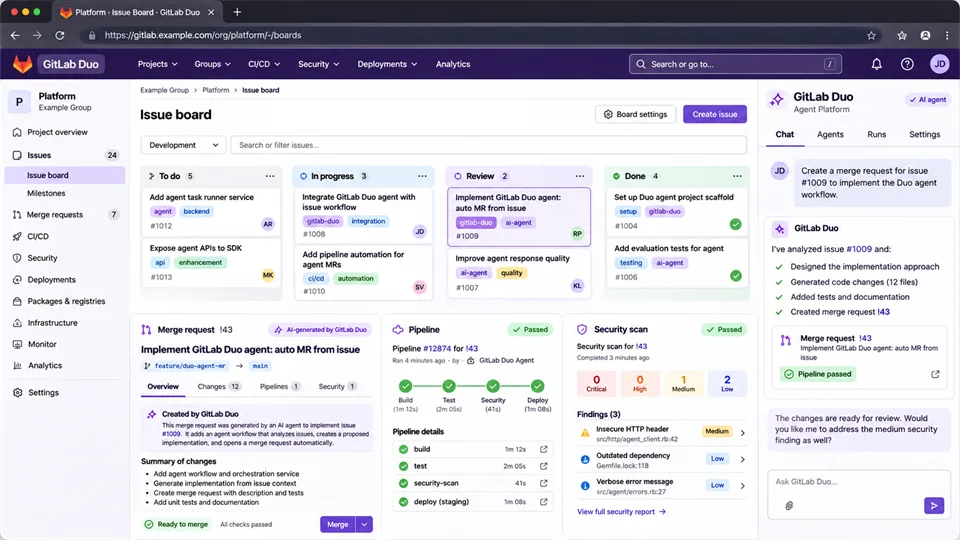
GitLab Duo Agent Platform supports agentic workflows across GitLab’s software lifecycle environment. Its capabilities include planning assistance, code review, pipeline diagnosis, and workflows that generate proposed changes.
GitLab’s advantage in this comparison is access to related lifecycle information within one platform. Issues, merge requests, pipelines, security findings, and deployment records can contribute context to agent activity.
GitLab describes GitLab Orbit as the lifecycle context graph supporting Duo Agent Platform. It also offers two-way MCP integration, allowing external tools to provide context or interact with GitLab through supported agents.
For teams already using GitLab extensively, this creates opportunities to automate handoffs between existing stages. A failed pipeline, for example, can become the starting point for investigation and a proposed fix.
Capabilities to evaluate:
- Agent workflows across planning, review, and delivery.
- Context drawn from GitLab lifecycle records.
- Pipeline diagnosis and proposed remediation.
- Custom agents and workflow configuration.
- MCP-based integration with external tools.
6. Harness
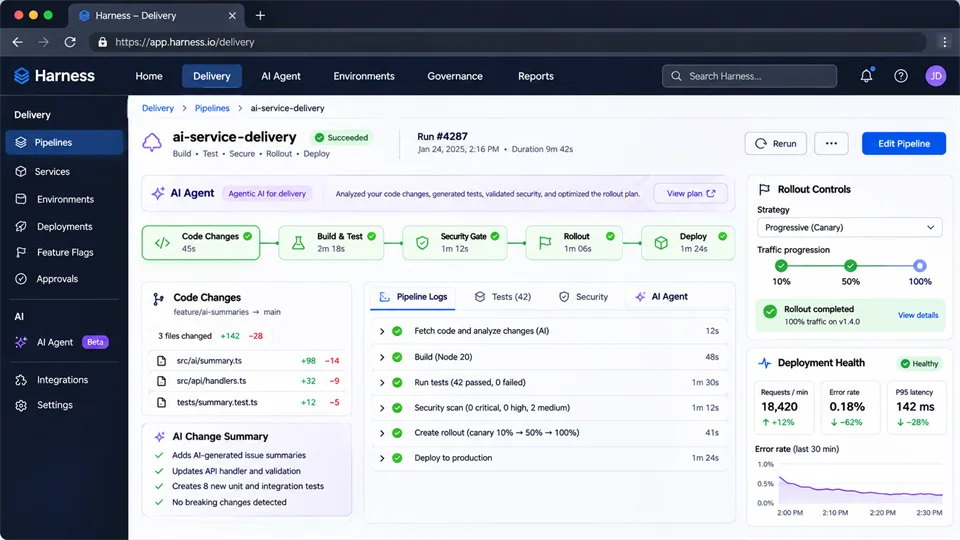
Harness belongs in an agentic development evaluation because delivery infrastructure determines whether generated changes can progress safely toward production. Its software delivery platform provides a place to examine how AI-assisted workflows interact with pipelines, verification, and engineering controls.
For many organizations, implementation speed is only one constraint. Teams also need reproducible builds, dependable tests, deployment approval, and evidence that a release behaves as expected.
The relevant evaluation is therefore broader than asking whether an agent can write code. It should examine how agent-produced changes enter delivery workflows and what happens when verification fails.
Capabilities vary across Harness products, so teams should confirm which modules and integrations support their intended workflow. A proposed operating model should identify where the coding agent ends and the delivery platform takes responsibility.
Capabilities to evaluate:
- Connections between agent-produced changes and pipelines.
- Enforcement of testing and release requirements.
- Visibility into failed delivery stages.
- Approval boundaries for production changes.
- Traceability from implementation to deployment.
7. Amazon Q Developer
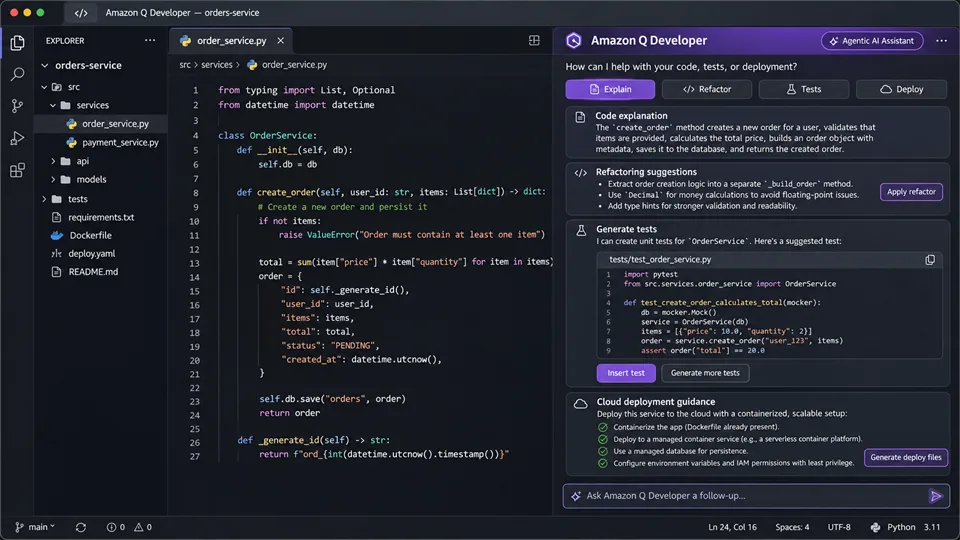
Amazon Q Developer supports software development through assistance and agentic task capabilities within developer workflows. It is especially relevant for organizations whose engineering environment includes AWS services, applications, and operational tooling.
Cloud-related development requires context beyond application code. Identity permissions, service configuration, infrastructure definitions, and runtime behavior can all influence whether a proposed change is appropriate.
Teams should evaluate Amazon Q Developer against tasks that reflect that environment. Useful examples include application maintenance, code investigation, modernization work, and changes involving cloud dependencies.
AWS usage alone does not establish suitability. Repository structure, supported languages, development environments, and task boundaries still determine whether the tool fits a particular team.
Capabilities to evaluate:
- Support for the team’s languages and development environment.
- Agent execution on clearly defined implementation tasks.
- Understanding of relevant AWS application context.
- Validation of changes affecting cloud dependencies.
- Developer review effort and acceptance rates.
8. OpenHands
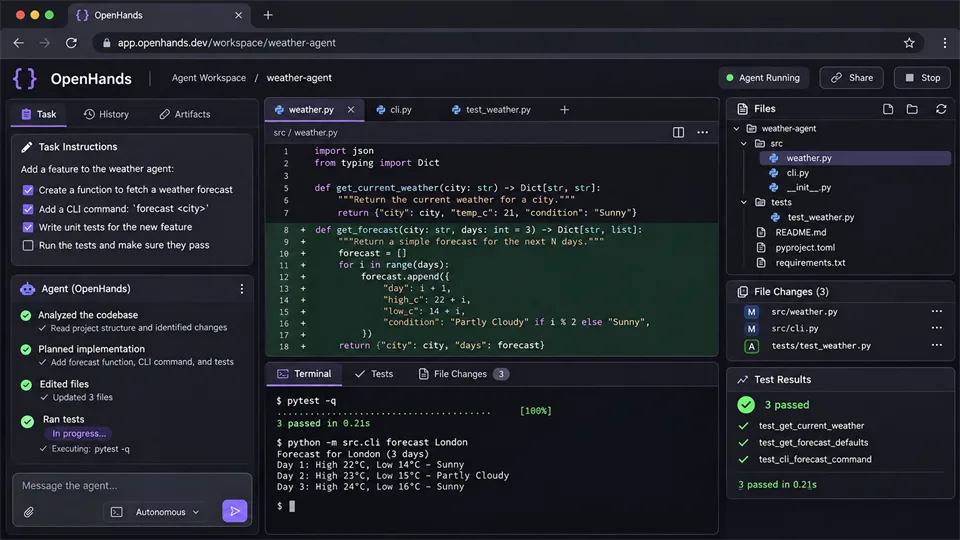
OpenHands provides an open-source approach to software development agents. It allows teams to work with agents that interact with code and development environments while retaining greater involvement in how the surrounding system is configured.
This makes OpenHands relevant for engineering organizations that want to inspect agent behavior, customize execution, or build workflows around an adaptable foundation.
That flexibility changes the evaluation criteria. Teams must consider the agent’s implementation performance alongside the infrastructure and operational work needed to support it. Environment setup, model selection, access controls, and monitoring become part of the adoption project.
Open-source availability also creates opportunities for experimentation. A platform team can test different task instructions, execution boundaries, and evaluation methods before deciding which operating model to standardize.
Capabilities to evaluate:
- Repository and terminal-based task execution.
- Compatibility with preferred models and environments.
- Isolation of agent sessions and credentials.
- Extensibility for custom engineering workflows.
- Operational effort required to maintain the system.
How to Compare Platforms Against Your Engineering Workflow
Start with the work you intend to delegate. Dependency updates, bug fixes, feature implementation, pipeline repair, and incident investigation require different context and permissions. A single benchmark cannot represent all of them.
Next, map the full journey from request to accepted change. Identify where requirements are clarified, which systems hold relevant information, who reviews the result, and what controls apply before deployment.
This mapping helps separate execution needs from coordination needs. A team may choose an autonomous coding agent for implementation while using a software factory platform to supply context, route work, and enforce approvals.
Build a pilot around a representative set of tasks:
- A routine change with clear acceptance criteria.
- A bug requiring repository investigation.
- A change involving another service or dependency.
- A task with an intentionally failing test.
- An assignment requiring human approval before proceeding.
Use the same acceptance standards across platforms. Record developer intervention, review time, test results, and whether the change was ultimately accepted. Those observations provide a stronger comparison than the number of files edited or tasks started.
What Should Connect Before Agents Work Independently?
Agents need access to the systems that explain both the task and its consequences. The right connections depend on the workflow, but several categories commonly matter:
- Source control: Repositories, branches, pull requests, and project instructions.
- Work management: Requirements, acceptance criteria, priorities, and dependencies.
- Engineering knowledge: Architecture decisions, runbooks, ownership, and service relationships.
- Validation systems: Build pipelines, tests, security checks, and policy evaluations.
- Operational context: Deployment history, incidents, and relevant service health.
- Approval processes: Named reviewers and escalation paths.
Each connection should have a defined purpose and permission boundary. Giving agents broad access without identifying the information they need creates avoidable exposure.
Context quality matters equally. Stale ownership records or contradictory instructions can misdirect an agent even when the integration itself works correctly.
Frequently Asked Questions
What is agentic AI for software development?
Agentic AI uses systems that can plan and execute multistep engineering tasks. Depending on the platform, an agent may inspect a repository, edit code, run commands, execute tests, and submit changes for review.
How does an AI software factory differ from a coding agent?
A coding agent performs engineering work. An AI software factory organizes the broader process around agents, including context, task routing, validation, governance, and measurement. Multiple coding agents can operate within the same factory.
Which platform suits teams using several coding agents?
Teams coordinating several agents should evaluate shared context, workflow orchestration, permissions, and outcome visibility. Port is relevant to that evaluation because its software factory positioning includes those operating capabilities.
Can agentic platforms deploy changes without human review?
Some workflows can support automated deployment, but permission should depend on risk, validation quality, and organizational policy. Teams should retain explicit approval for changes requiring security, operational, or business judgment.
What is a practical first use case?
Choose a bounded, recurring task with reliable tests and clear acceptance criteria. Dependency updates or small maintenance changes can establish a baseline for completion quality, review effort, and safe execution.
Related Reviews
How to Manage Multiple Email Accounts: Separate Inboxes, Aliases, or One App?

5 Best AI Dubbing Tools in 2026
6 Best AI App Builders in 2026: From Prompt to Product
Pony V7 Review: AuraFlow, LoRA Ecosystem, V6 Comparison, and NSFW Strengths
8 Best AI Presentation Makers in 2026
Canva Craft Review: 2K Images, Wide Formats, Text and Editing Limits