Llama 4 Review: Scout, Maverick, Behemoth, Local Deployment and NSFW Policy
Llama 4 is Meta’s first natively multimodal, Mixture-of-Experts Llama generation. It matters because Scout and Maverick are open-weight models that developers can download, while Behemoth…
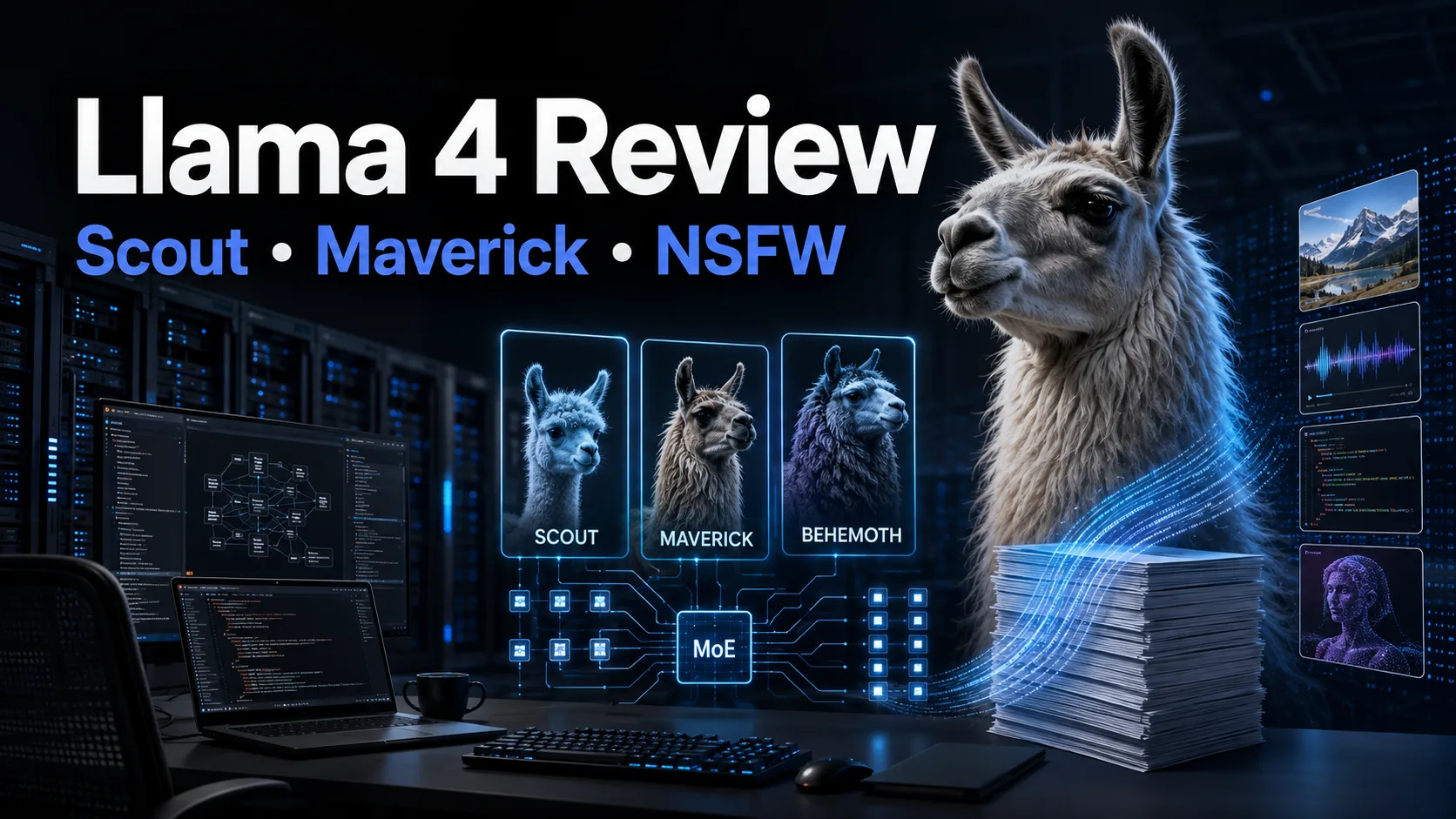

Llama 4 is Meta’s first natively multimodal, Mixture-of-Experts Llama generation. It matters because Scout and Maverick are open-weight models that developers can download, while Behemoth acts as the much larger teacher model behind the family. The practical question is not only whether Llama 4 is powerful, but which version is actually usable for your budget, hardware, privacy needs and NSFW expectations.
Short answer: Llama 4 Scout is the most interesting option for long-context experimentation, Maverick is the stronger general multimodal assistant when you can use hosted infrastructure, and Behemoth is not a normal downloadable local model. If you are comparing local open LLMs, read this together with our Qwen 3.8 review, Gemma 4 review, Dolphin 3 review, DeepSeek V4 review and Kimi K3 review.
Table of Contents
Quick Verdict
| Item | Llama 4 review |
|---|---|
| Best for | Multimodal apps, long-context retrieval, coding assistants, private deployments, teams wanting open-weight alternatives to closed APIs |
| Choose Scout if | You care about very long context and want the most deployable Llama 4 model |
| Choose Maverick if | You want stronger general chat, vision and coding quality and can use heavier infrastructure |
| Avoid if | You need a small single-GPU home model, a fully uncensored NSFW chatbot, or a model with a fully permissive Apache-style license |
| Online access | Meta AI and Meta app integrations |
| Downloads | llama.com downloads, Llama 4 Scout on Hugging Face, Llama 4 Maverick on Hugging Face |
| NSFW | Official Meta AI and official instruct models are safety-aligned; open weights give deployment control but no official NSFW mode |
What Is Llama 4?
Llama 4 was announced by Meta on April 5, 2025. The family introduced two downloadable open-weight models, Llama 4 Scout and Llama 4 Maverick, plus a larger preview teacher model called Llama 4 Behemoth. Compared with Llama 3, the big change is architectural: Llama 4 moves to a Mixture-of-Experts design and native multimodality.
Native multimodality means text and image tokens are handled inside a unified model backbone rather than bolting a separate vision tool onto a text-only model. Meta describes this as early fusion. For users, the benefit is more natural image reasoning, document screenshots, UI analysis, chart interpretation and visual question answering.
The other major change is MoE. In a dense model, most or all parameters participate in each forward pass. In an MoE model, only selected experts are active for each token. That makes it possible to store a much larger total model while keeping active compute lower. It does not make memory free, though: all experts still have to live somewhere in memory or in a serving system.
Scout vs Maverick vs Behemoth
| Model | Public status | Parameters | Context | Best use |
|---|---|---|---|---|
| Llama 4 Scout | Open-weight downloadable | 17B active, 109B total, 16 experts | 10M tokens | Long-context tasks, multi-document work, large codebase reading, deployability experiments |
| Llama 4 Maverick | Open-weight downloadable | 17B active, 400B total, 128 experts | 1M tokens | General assistant use, coding, visual reasoning, multimodal apps |
| Llama 4 Behemoth | Preview teacher model | 288B active, nearly 2T total, 16 experts | Not a normal public download | Distillation, research direction, Meta’s upper-scale training target |
Scout is the model that makes people pay attention to context length. Meta says it supports up to 10 million tokens, far beyond the 128K context many users associate with Llama 3-era local models. In practice, long-context quality still depends on retrieval behavior, attention implementation, serving memory and prompt structure, so a 10M window should be treated as a powerful capability that still needs testing for each workflow.
Maverick is the more ambitious general-purpose assistant. It has the same 17B active parameter count but 128 routed experts and around 400B total parameters. Meta positions it for image understanding, creative writing, multilingual use, coding and reasoning. It is also heavier to serve, so hosted inference is more realistic for many teams.
Behemoth is important but easy to misunderstand. It is not the model most readers will download and run. It is Meta’s huge teacher model, used to distill quality into Scout and Maverick. Mentioning it matters because it explains why the smaller Llama 4 models can feel stronger than their active parameter count suggests.
Online Use and Download Links
For ordinary users, the quickest entry point is Meta AI. Meta also says Llama 4 is used in WhatsApp, Messenger and Instagram Direct experiences. Availability can vary by country, account and product rollout, so the web version and app integrations may not expose every model option in the same way.
For developers, the official starting point is llama.com downloads. The two main Hugging Face repositories are meta-llama/Llama-4-Scout-17B-16E-Instruct and meta-llama/Llama-4-Maverick-17B-128E-Instruct. These pages include model cards, supported modalities, license notes and Transformers usage examples.
Commercial users should read the Llama 4 Community License and acceptable use policy before shipping a product. Llama is open-weight, but the license is not the same thing as a no-conditions Apache 2.0 release.
Local Deployment and Hardware
Llama 4 is more practical than some giant MoE models, but it is still not a normal laptop model. Meta says Scout can fit on a single NVIDIA H100 GPU with Int4 quantization, while Maverick can run on a single H100 DGX host or distributed inference for better efficiency. That is very different from saying it runs comfortably on an 8GB or 12GB gaming card.
| Setup | Practical expectation |
|---|---|
| 8GB to 16GB consumer GPU | Use smaller Llama 3.x, Qwen, Gemma, Mistral or quantized 7B/14B/27B models instead |
| 24GB consumer GPU | Still too tight for full Llama 4 Scout/Maverick; useful mainly for smaller local LLMs |
| Single H100-class GPU | Scout becomes plausible with heavy quantization and optimized inference |
| H100 DGX host / multi-GPU server | More realistic for Maverick and production serving |
| Hosted API / cloud inference | Best starting point for most teams evaluating Llama 4 |
If your goal is private local inference on a workstation, Llama 4 may be a future-facing target rather than the first model to install. If your goal is to build an app today, hosted Llama 4, Qwen 3.8, Gemma 4, Kimi K3 or a smaller Llama family model may be easier to evaluate depending on latency and budget.
Benchmarks and Real-World Feedback
Meta’s launch materials present Llama 4 Scout and Maverick as highly competitive multimodal models. The strongest claims include Scout’s 10M-token context, Maverick’s performance-to-cost ratio, and Behemoth’s strong STEM-oriented benchmark results as a teacher model. These are useful signals, especially because the downloadable model cards publish concrete parameter and context details.
The cautious part is Maverick’s leaderboard story. TechCrunch reported that the LM Arena result used an experimental chat-optimized Maverick variant, while the widely available downloadable model was different. A follow-up report said the vanilla Maverick ranked lower once evaluated separately. This does not make Llama 4 useless, but it does mean developers should test the exact model and provider they plan to use rather than relying on one launch benchmark.
Community impressions tend to split along use case. Users who value open weights, image reasoning and long context find Llama 4 genuinely important. Users who expected an effortless replacement for the best closed chat models often describe Maverick as less consistently impressive than the launch positioning suggested. That is exactly why this model should be tested with real prompts: your codebase, your documents, your images and your latency constraints.
Comparison with Other Open Local LLMs
| Model | Strength | Weakness | Best fit |
|---|---|---|---|
| Llama 4 Scout | Extreme context length, open-weight, multimodal | Hardware demands and tooling maturity | Long-context RAG and document/codebase reading |
| Llama 4 Maverick | Better general multimodal assistant quality | Large total size; benchmark controversy | Hosted multimodal products |
| Qwen 3.8 | Strong local ecosystem and coding balance | Less extreme context scale | Practical local LLM users |
| Gemma 4 | Efficient Google-backed local model line | Less open NSFW focus in official versions | General local assistant and developer testing |
| Dolphin 3 | Classic uncensored route for writing and roleplay | Not a frontier multimodal MoE | Users prioritizing fewer refusals |
| Kimi K3 | Huge open-weight MoE with long-context ambition | Even more infrastructure-heavy | Enterprise agent/RAG systems |
| Mistral / Mixtral | Mature European open model ecosystem | Older variants can lag the newest models | Stable deployment and multilingual apps |
NSFW Policy and Censorship Limits
Llama 4 should not be described as an NSFW-first model. Official Meta AI is safety-filtered, and the official instruct models are aligned for assistant-style and visual reasoning tasks. The model card also points developers to acceptable-use restrictions and safety testing requirements.
Open weights give developers more operational control than a closed API. You can choose your own system prompts, moderation layers and deployment environment. However, that is different from having an official uncensored mode. If a user’s main goal is adult roleplay, erotic writing or fewer refusals, Dolphin-style uncensored models or dedicated community fine-tunes are usually more direct than stock Llama 4.
For business use, the practical advice is simple: keep moderation and logging appropriate to your product. Removing safety layers may create legal, trust and platform risks, especially around minors, non-consensual sexual content, real-person sexualization and illegal instructions.
Community and Ecosystem
Llama remains one of the strongest open model ecosystems in AI. That means cloud providers, inference runtimes, fine-tuning tools, safety models, prompt libraries and evaluation harnesses tend to appear quickly around each release. Llama Guard, Prompt Guard and related Meta safety tools also make the family easier to fit into enterprise deployments.
The caveat is that Llama 4 is not just another dense local model. MoE plus multimodality makes inference support more complex than ordinary text-only 7B or 70B models. Expect quantization, llama.cpp-style support, Ollama packaging and GUI integrations to vary by version and to mature over time. Before choosing a community quantized build, check whether it preserves image input, context length and the exact Scout/Maverick behavior you need.
FAQ
Is Llama 4 free to use?
The weights for Scout and Maverick are available under Meta’s Llama 4 Community License. That can be free for many uses, but large commercial products and prohibited use cases need careful license review.
Can I run Llama 4 locally?
Scout is the more realistic local target, but still expects H100-class hardware with quantization for serious use. Maverick is better treated as a server or hosted-inference model.
Is Llama 4 better than Llama 3.3?
For multimodality and long context, yes, Llama 4 is a major architectural jump. For simple text-only local chat on consumer hardware, Llama 3.x may still be easier and cheaper.
Does Llama 4 support images?
Yes. Scout and Maverick are natively multimodal and support multilingual text plus image input, with text and code output.
Is Llama 4 uncensored?
No. Official services and instruct models are safety-aligned. Open weights give deployment flexibility, but Llama 4 is not positioned as a dedicated uncensored model.
Which Llama 4 model should developers try first?
Try Scout for long context and lower deployment pressure; try Maverick for stronger general multimodal chat through hosted inference.
References
- Meta official Llama 4 announcement
- Llama 4 Scout model card on Hugging Face
- Llama 4 Maverick model card on Hugging Face
- Official Llama downloads
- Llama 4 Community License
- Llama 4 acceptable use policy
- TechCrunch report on Llama 4 benchmark presentation
- TechCrunch follow-up on vanilla Maverick benchmark ranking
Conclusion
Llama 4 is a meaningful release because it moves the Llama family into native multimodality and MoE at serious scale. Scout is especially interesting for long-context workflows, while Maverick is the more capable general assistant when you can afford server-side infrastructure.
The balanced verdict is this: Llama 4 is important, but not automatically the best answer for everyone. Use Meta AI or hosted inference first, compare the exact model against Qwen, Gemma, Dolphin, Kimi, DeepSeek and Mistral on your real tasks, and treat NSFW claims carefully. For open-weight multimodal AI, it belongs on the shortlist; for small local hardware or uncensored roleplay, other models may be more practical.
Related Reviews
Seedream 5.0 Pro Review: AI Image Model, API Access and NSFW Policy

Meta Muse Review 2026: AI Agent, Pricing & Muse Spark
Illustrious XL Review: Setup, LoRA, VRAM, Prompts and NSFW Local Use

Gemma 4 Review: Local Setup, GPU Requirements and NSFW / Uncensored Models
OpenClaw 2.0 Review: Local AI Agent Gateway, ClawHub Skills, Hardware, and NSFW Limits
Best Local Anime AI Image Models Compared: LoRA, VRAM and NSFW Use