Kimi K3 Review: 2.8T Open-Weight MoE, Local Deployment, Benchmarks and NSFW Policy
Kimi K3 is not a small local chatbot model. It is Moonshot AI’s 2.8-trillion-parameter open-weight Mixture-of-Experts model, built for long-horizon coding, deep knowledge work, multimodal…
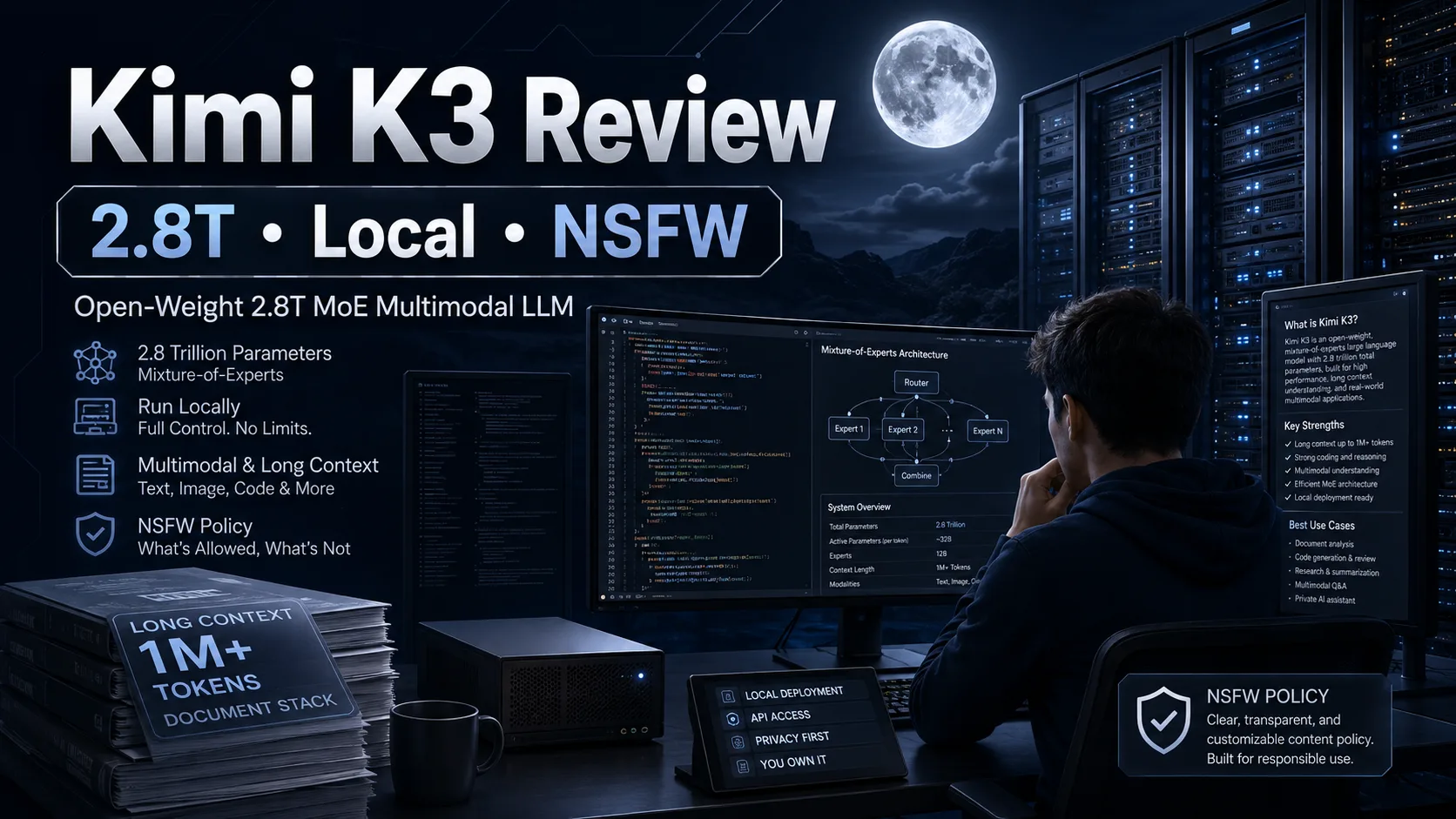

Kimi K3 is not a small local chatbot model. It is Moonshot AI’s 2.8-trillion-parameter open-weight Mixture-of-Experts model, built for long-horizon coding, deep knowledge work, multimodal reasoning, and very long context. The practical question is therefore not simply whether Kimi K3 is strong, but whether it is the right model for your budget, infrastructure, privacy needs, and NSFW expectations.
The short verdict: Kimi K3 is one of the most important open-weight LLM releases for teams that want frontier-style capability without being locked completely into a closed model vendor. For individual local users, however, it is closer to a cluster-scale model than a desktop model. If you only have a consumer GPU, Qwen, Gemma, Dolphin, Llama, Mistral or hosted Kimi API access will usually be more realistic.
Table of Contents
- Quick Verdict
- What Is Kimi K3?
- Official Access, API and Download Links
- Specs, Architecture and Pricing
- Benchmarks and Real-World Experience
- Local Deployment and Hardware Requirements
- Comparison with Other Open Local LLMs
- NSFW Support and Censorship Limits
- Community, Quantization and Ecosystem
- FAQ
- References
- Conclusion
Quick Verdict
| Item | Kimi K3 Review |
|---|---|
| Best for | Long-context coding agents, enterprise RAG, multimodal knowledge work, software engineering, high-budget self-hosting |
| Not ideal for | Single-GPU hobby use, lightweight roleplay, users who mainly want a ready-made uncensored model |
| Model type | 2.8T-parameter open-weight MoE with native vision and 1M-token context |
| Online access | Kimi.ai, Kimi Platform, and hosted providers such as Fireworks |
| Download | moonshotai/Kimi-K3 on Hugging Face |
| NSFW | Official services are safety-filtered; open weights give operators more control, but K3 is not marketed as a dedicated NSFW or uncensored model |
For readers comparing open LLMs, Kimi K3 should be read alongside our Qwen 3.8 review, Gemma 4 review, Dolphin 3 review, DeepSeek V4 review, and GLM-5.3-Flash review. Kimi K3 is the heavyweight entry in that group.
What Is Kimi K3?
Kimi K3 is Moonshot AI’s flagship open-weight model. The official release describes it as a 2.8T-parameter model using Kimi Delta Attention and Attention Residuals, with native visual understanding and a 1-million-token context window. It is positioned for frontier-level tasks such as long software-engineering sessions, knowledge work, reasoning, game development, visual coding loops, and research-heavy workflows.
The important distinction is open-weight versus ordinary open-source. Open weights mean the model weights are available for download and self-hosting, but that does not automatically mean the training data, full training code, or every infrastructure detail is released under a fully permissive open-source license. For companies, licensing and deployment terms still need to be checked before production use.
Architecturally, Kimi K3 is a Mixture-of-Experts model. Instead of activating the entire model for every token, a router selects a subset of experts. Moonshot says K3 scales MoE sparsity and effectively activates 16 out of 896 experts with its Stable LatentMoE framework. That is how the model can keep enormous total capacity while still being served at API prices that are not completely out of reach.
Official Access, API and Download Links
The simplest way to try Kimi K3 is Kimi.ai. Developers can use Kimi Platform, where K3 is listed with a 1M-token context window and pricing of $0.30/MTok for cache hits, $3.00/MTok input, and $15.00/MTok output at the time checked.
For model weights, use the official Hugging Face repository moonshotai/Kimi-K3. Because this is a very large model, downloading the weights is only the beginning. You also need a compatible inference stack, fast storage, enough accelerator memory, and network bandwidth between GPUs if you want reasonable throughput.
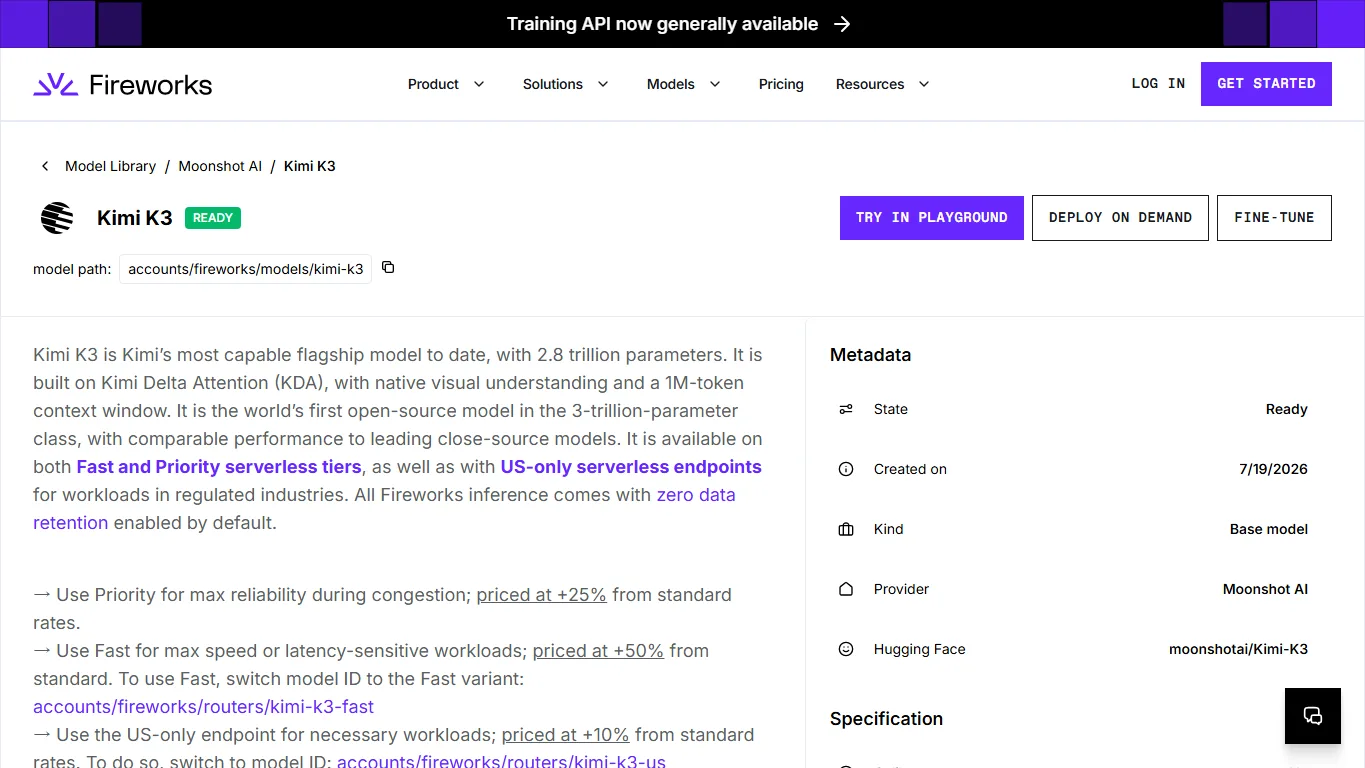
Kimi K3 is also available through inference providers such as Fireworks. Fireworks lists the model as ready, with Fast and Priority serverless tiers, US-only endpoint options, image input support, function calling, fine-tuning support, and a context length around 1040k tokens.
Specs, Architecture and Pricing
| Spec | Kimi K3 |
|---|---|
| Developer | Moonshot AI |
| Parameter scale | 2.8T total parameters |
| Architecture | Mixture-of-Experts with Kimi Delta Attention and Attention Residuals |
| Experts | Official article describes 16 of 896 experts activated in the Stable LatentMoE setting |
| Context | 1M tokens officially; Fireworks lists about 1040k tokens |
| Input | Text and native vision/image input |
| Primary use cases | Long coding sessions, software agents, enterprise RAG, knowledge work, visual reasoning |
| Official API price | $0.30/MTok cache hit, $3.00/MTok input, $15.00/MTok output on Kimi Platform |
| Deployment note | Moonshot recommends supernode configurations with 64 or more accelerators for efficient deployment |
The most interesting technical choices are Kimi Delta Attention, Attention Residuals, Stable LatentMoE, quantization-aware training from the SFT stage, MXFP4 weights with MXFP8 activations, and expert-parallel training designed to keep routing balanced at large scale. For normal users, the takeaway is simpler: Kimi K3 is built to make very long context and agentic workloads more practical at enormous model scale.
Benchmarks and Real-World Experience
Moonshot’s own evaluation says Kimi K3 still trails the strongest proprietary models overall, specifically mentioning Claude Fable 5 and GPT-5.6 Sol, but shows frontier-level performance across its evaluation suite and strong results in coding, kernel optimization, GPU compiler development, game development, visual reasoning, and chip-design experiments.
That positioning matters. Kimi K3 is not advertised as a tiny model beating every closed frontier model in every category. It is better understood as a large open-weight model that narrows the gap enough to change the economics of coding agents, enterprise knowledge systems, and private deployment.
Independent hands-on writing is more cautious. Philipp D. Dubach’s Kimi K3 inside Claude Code test reported that the model was good enough that the switch sometimes faded into the background, produced a close frontend reconstruction, and cost less than estimated closed-model alternatives for that token mix. The same test also noted slower-feeling responses and concluded that Opus-style models still felt more dependable on difficult ambiguous work.
That is a believable real-world picture: Kimi K3 can be impressive, especially for code and long-context tasks, but it is not magic. Prompt clarity, tool integration, latency, provider quality, caching, and the agent framework around the model can matter as much as the raw benchmark table.
Local Deployment and Hardware Requirements
Kimi K3 is open-weight, but not consumer-friendly in the same way as a 7B, 27B or 70B model. Moonshot’s official article recommends supernode configurations with 64 or more accelerators for efficient deployment. That is the clearest hardware signal: this is a model for serious infrastructure, not a casual laptop download.
| Hardware | Practical expectation |
|---|---|
| Single consumer GPU | Not realistic for the full Kimi K3 model |
| One 24GB/48GB GPU | Better used with smaller models such as Qwen, Gemma, Llama, Mistral, Dolphin or API access |
| Multi-GPU workstation | Still challenging; memory, bandwidth and serving support become the bottleneck |
| Enterprise GPU server | Possible with heavy engineering, but throughput depends on expert parallelism and caching |
| 64+ accelerator supernode | The official direction for efficient K3 deployment |
| Hosted API | Best route for most developers who want K3 capability today |
In practice, most readers should treat local deployment as an enterprise or research-cluster topic. If the goal is privacy and local control on ordinary hardware, a smaller open model may be wiser. If the goal is K3-quality reasoning, hosted Kimi API or Fireworks-style inference will be faster to evaluate.
Comparison with Other Open Local LLMs
| Model | Strength | Tradeoff | Who should choose it |
|---|---|---|---|
| Kimi K3 | Huge open-weight MoE, 1M context, coding/agent focus, native vision | Cluster-scale deployment; not desktop-friendly | Teams building long-context agents or enterprise AI systems |
| Qwen 3.8 | Strong local ecosystem, coding/reasoning balance, more realistic deployment sizes | Less extreme scale than K3 | Users who want practical local open LLMs |
| Gemma 4 | Google ecosystem, efficient variants, good general assistant use | NSFW/community uncensored ecosystem depends on fine-tunes | Users wanting a balanced local assistant |
| Dolphin 3 | Classic uncensored fine-tune route, writing and roleplay flexibility | Not a frontier-scale reasoning model | Users prioritizing open-ended roleplay and fewer refusals |
| DeepSeek V4 | Strong coding/reasoning and efficient serving options | Model branch and deployment details can be complex | Developers comparing Chinese open models |
| Llama / Mistral | Mature tooling, broad quantization and RAG support | May lag newer frontier releases on some tasks | Stable production and local deployment |
| GLM-5.3-Flash | Fast online model and strong Chinese ecosystem | Less open-local focused than K3/Qwen-style downloads | Users who need API speed and broad capability |
NSFW Support and Censorship Limits
Kimi K3’s official online products and API should be treated as safety-filtered services. They are not intended as NSFW generators or censorship-bypass tools. Requests involving explicit sexual content, illegal content, minors, non-consensual sexual content, or other restricted material may be refused or filtered.
Open weights change the control surface: a self-hosted operator can decide what safety layers, system prompts, monitoring, and usage policies to apply. That does not mean Kimi K3 is automatically a good NSFW model. It is a large reasoning and multimodal model, not a purpose-built adult roleplay fine-tune like Dolphin-style uncensored models or community abliterated variants.
At the time of writing, the safer practical recommendation is clear: use official Kimi for normal productivity, coding, research and long-context work; use dedicated community models if your main requirement is uncensored roleplay or adult text generation. For businesses, do not remove safety layers casually, because abuse handling, compliance, and user protection become your responsibility.
Community, Quantization and Ecosystem
The Kimi K3 ecosystem is likely to grow quickly because the model is open-weight, API-accessible, and clearly aimed at coding-agent use. Expect work around vLLM support, inference optimization, routing, caching, quantized serving, and integration into agent frameworks. Still, K3’s scale means the community will not look like the 7B/13B/70B GGUF scene where everyone runs the model locally by the weekend.
For now, the healthy way to follow K3 is to separate three layers: official Kimi.ai and Kimi Platform for everyday use, hosted providers such as Fireworks for production experiments, and the Hugging Face weights for teams with the hardware to self-host. Community quantization may reduce cost over time, but no quantized package should be trusted blindly without checking license, quality, context support and serving compatibility.
FAQ
Is Kimi K3 open source?
It is best described as open-weight. The weights are available, but readers should check the current license and repository details before assuming that everything around the model is fully open-source in the strict Apache/MIT sense.
Can I run Kimi K3 on my gaming PC?
Not realistically for the full model. Kimi K3 is a 2.8T MoE model and Moonshot recommends 64 or more accelerators for efficient deployment. Most individuals should use the API or smaller local models.
Is Kimi K3 better than Qwen 3.8 or Gemma 4?
For cluster-scale long-context agent work, K3 is more ambitious. For practical local deployment, Qwen/Gemma/Llama/Mistral-style models are usually easier, cheaper and better documented.
Does Kimi K3 support images?
Yes. Official and hosted pages describe native visual understanding or image input support, so it can be used for multimodal reasoning in addition to text.
Is Kimi K3 good for coding agents?
Yes, coding and long-horizon agent work are central use cases. Real-world results still depend on latency, caching, tool integration, repository size and the surrounding coding agent.
Is Kimi K3 uncensored or good for NSFW?
Official services are filtered. Self-hosting gives more control, but K3 is not primarily an NSFW fine-tune. For uncensored roleplay, Dolphin-like models are usually more directly relevant.
References
- Kimi K3 official technical blog
- Kimi.ai
- Kimi Platform
- moonshotai/Kimi-K3 on Hugging Face
- Fireworks Kimi K3 model page
- Kimi K3 inside Claude Code hands-on review
Conclusion
Kimi K3 is a serious open-weight release because it pushes open models into a scale class that previously felt mostly closed. The combination of 2.8T total parameters, MoE architecture, 1M-token context, native vision and coding-agent focus makes it relevant for teams thinking about private frontier-style AI systems.
For most individual readers, the answer is more grounded: try it through Kimi.ai, Kimi Platform or a hosted provider first. If the model solves your long-context or coding workflow better than Qwen, Gemma, DeepSeek, Llama or Mistral, then consider whether self-hosting is worth the infrastructure cost. If your main goal is NSFW or uncensored roleplay, Kimi K3 is probably not the most direct tool despite the open weights.
Related Reviews
Gemma 4 Review: Local Setup, GPU Requirements and NSFW / Uncensored Models

HiDream O1 Review: Open Image AI, LoRA, Local Setup and NSFW Policy

Qwen 3.8 Review: Benchmarks, Local Setup, GPU Requirements and NSFW Policy
ERNIE-Image Review: Open-Source Image AI, LoRA, Local Setup and NSFW Policy
Llama 4 Review: Scout, Maverick, Behemoth, Local Deployment and NSFW Policy
Mistral AI Models Review: Latest Local LLMs, Large 3, Small 4 and NSFW Policy