invideo vs. Synthesia: Agentic Filmmaking vs. Presenter-Led Avatar Video
Compare invideo vs. Synthesia for agentic filmmaking, avatar-led corporate videos, multilingual delivery, scene generation, consistency, and pricing.

Invideo delivers better results for full, scene-driven filmmaking, generated environments, characters, and camera work across a narrative sequence, since Synthesia has no equivalent to generating an original scene at all. Synthesia delivers better results for presenter-led corporate and training video at scale, since its 230+ avatars and enterprise compliance are purpose-built for a consistent spokesperson delivering a script across many languages, a format invideo agent isn’t optimized around. The two rarely compete for the same brief, since one produces a film and the other produces a presenter.
Table of Contents
- Quick answer
- What each tool actually is
- Feature-by-feature comparison
- Where Synthesia wins
- Where invideo wins
- Pricing side by side
- The verdict
- Frequently asked questions
Quick answer
Choose Synthesia if the deliverable is a consistent avatar presenter delivering a script, especially at enterprise scale across many languages, for training, onboarding, or internal communications.
Choose invideo agent if the project needs original scenes generated, environments, characters, camera work, rather than a presenter speaking to camera.
Choose Invideo Editor if you need an AI video editor to assemble and finish footage, from either platform or practical shooting, on one shared timeline.
What each tool actually is
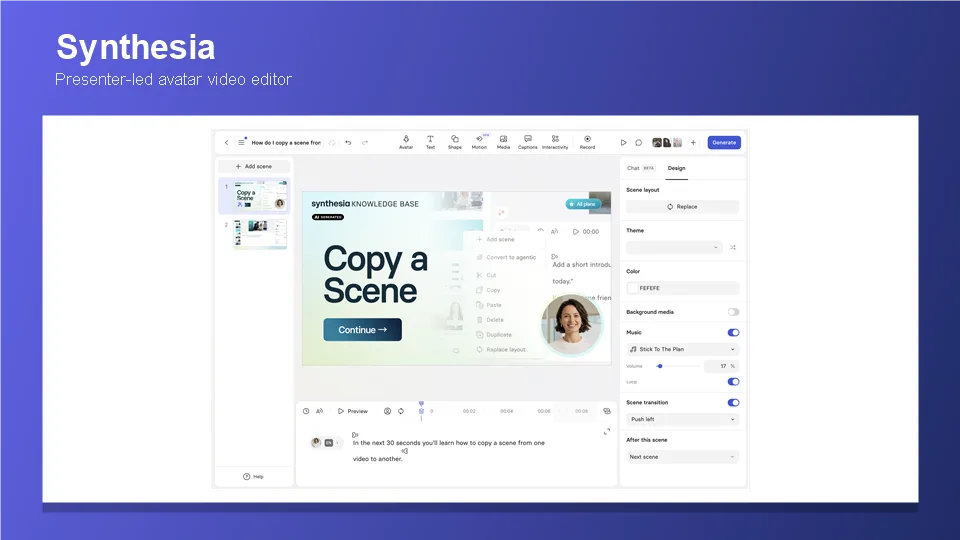
Synthesia is built specifically around the avatar-presenter format: choose from 230+ stock avatars or build a custom one, write or paste a script, and get a consistent presenter delivering it in any of 140+ supported languages. It backs this with published SOC 2 and ISO 42001 compliance, which matters directly for an enterprise deploying training or compliance video across a large organization. It’s a mature, focused tool for exactly one job: a presenter, speaking a script, on screen.
invideo agent is built for a different kind of video entirely: a director describes a shot or hands over a full script, and the agent plans and generates a complete sequence, not a presenter reciting lines but original scenes, environments, and characters, routing each shot to whichever of its 200+ integrated models fits that particular moment, including Veo 3.1, Sora 2, Kling AI, Seedance 2.5, Runway, PixVerse, Hailuo, WAN, Recraft, GPT Image 2.0, and Nano Banana 2. A persistent context engine holds that generated world consistent across every shot, checking each new generation against the project’s established cast, locations, and rules before accepting it, a scene-level concern Synthesia’s presenter-focused format doesn’t need to solve.
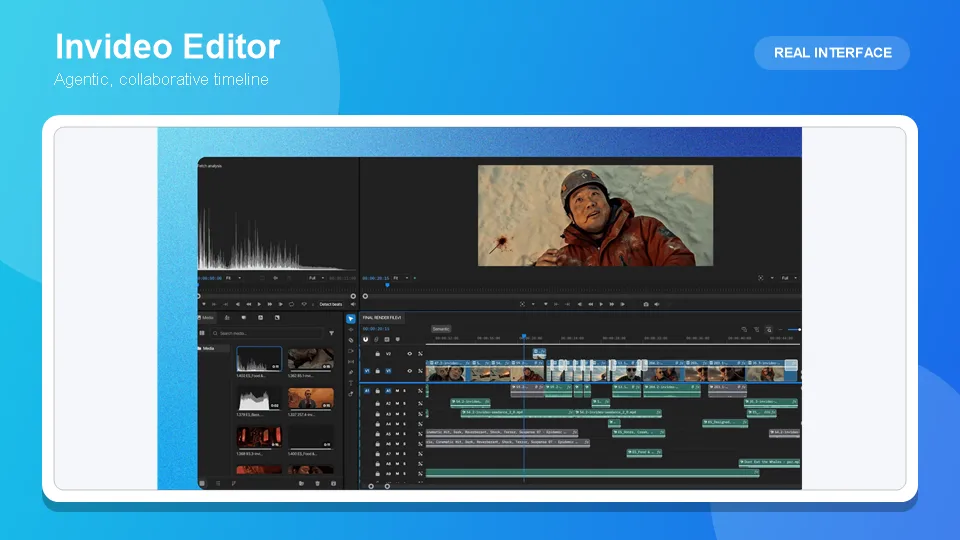
Invideo Editor handles the assembly and finishing side once footage exists, from either platform or a practical shoot: a professional timeline editor that does what tools like DaVinci and Premiere do, drag, trim, cut, layer, while also taking agent instructions on the same timeline. Its dubbing and localization capability translates and dubs dialogue while preserving lip sync, a genuine point of overlap with Synthesia’s own multi-language strength, and it’s free to use.
Feature-by-feature comparison
| Category | Synthesia | invideo agent | Invideo Editor |
|---|---|---|---|
| Core format | Consistent avatar presenter delivering a script | Original scenes, characters, and environments generated from a script | Assembling and editing footage from any source |
| Avatar library | 230+ stock avatars, custom avatars at $1,000/year each | Not avatar-based; generates full scenes and characters | Not applicable |
| Language support | 140+ languages for avatar delivery | Auto-translation and voice cloning across languages | Dubbing and localization preserving lip sync |
| Original scene/environment generation | No | Yes, across 200+ integrated models | No; edits existing or generated footage |
| Project-wide consistency across many shots | Not applicable to its single-presenter format | Yes, persistent context engine | Yes, shared project context with the agent |
| Enterprise compliance | Published SOC 2, ISO 42001 | SOC 2 and GDPR compliant, per invideo’s own materials | Same platform compliance as invideo agent |
| Free tier | No | No | Yes, full timeline |
| Starting price | $29/month | $17/month | Free |
Where Synthesia wins
The avatar-presenter format is genuinely its specialty, executed at real scale. 230+ stock avatars and 140+ supported languages cover corporate training, onboarding, and internal communications more directly than a scene-generation tool is built to.
Enterprise compliance is explicit and published. SOC 2 and ISO 42001 certification matters directly for a large organization deploying training content that has to clear a security and compliance review before rollout.
It’s a faster, more direct path specifically for presenter-led content. A script and an avatar choice produce a finished presenter video quickly, without needing to plan characters, environments, or camera work the way a scene-driven project requires.
Where invideo wins
invideo agent generates actual scenes, not just a presenter speaking to camera. Original environments, characters, and camera work across a narrative sequence are entirely outside Synthesia’s presenter-focused format, which has no path to generating a scene at all.
Persistent consistency across a scene-driven project. invideo agent’s context engine holds characters and environments consistent across many generated shots, a genuinely different and harder problem than Synthesia’s single, consistent avatar reciting a script.
Invideo Editor’s dubbing preserves lip sync on real or generated footage, not just an avatar. Synthesia’s language strength is specific to its own avatar format; Invideo Editor’s localization applies to a broader range of footage sources.
No per-custom-avatar enterprise surcharge. Synthesia’s custom avatars cost $1,000/year each on top of the base plan. invideo agent’s character generation and consistency are part of the core product without that specific added cost.
Pricing side by side
Synthesia’s Starter plan begins at $29/month, with custom avatars priced separately at $1,000/year each. invideo agent’s plans start at $17/month with team and enterprise options, and Invideo Editor’s timeline is free to use regardless of plan.
The verdict
These tools solve different problems well enough that “which wins” mostly depends on what’s actually being made. Synthesia is the stronger, more mature choice for presenter-led corporate and training video specifically, its avatar library, language coverage, and published enterprise compliance are built exactly for that brief. Invideo is the stronger choice for anything that’s actually a scene-driven film, generated environments, consistent characters, deliberate camera work, since Synthesia has no equivalent to producing that at all. A company doing both, an executive-presenter training series and a narrative brand film, would reasonably use Synthesia for the former and invideo for the latter.
Frequently asked questions
Can Synthesia generate an original scene or environment the way invideo agent can?
No. Synthesia is built specifically around an avatar presenter delivering a script, and it has no capability for generating original environments, characters, or camera work the way invideo agent’s scene generation does.
Is invideo agent a good fit for corporate training video with a consistent presenter?
It’s possible but not its specific focus. Synthesia’s avatar library and language support are purpose-built and more mature for exactly that presenter-led format, while invideo agent is optimized for scene-driven, narrative video generation.
Do both tools support multiple languages the same way?
Not identically. Synthesia applies its 140+ languages to avatar delivery specifically, while invideo agent auto-translates a script and uses voice cloning to keep a consistent voice across languages for generated scenes, and Invideo Editor separately dubs and localizes footage while preserving lip sync.
Is Synthesia cheaper than invideo for a simple presenter video?
Not necessarily. Synthesia’s Starter plan is $29/month versus invideo agent’s $17/month, though Synthesia’s format is more directly built for a pure presenter-script video without needing to plan scenes or characters at all.
Would an organization ever use both platforms?
Yes, and this is a realistic setup. A company could use Synthesia for its avatar-led training and internal communications library, while using invideo agent for brand films, narrative content, or marketing video that needs actual generated scenes rather than a presenter format.
Latest Reviews
SillyTavern Beginner’s Guide (2026): Set Up Your AI Tavern, Character Cards and World Info

invideo vs. Canva Video: Which One Actually Handles Multi-Shot Consistency?

Best Video Editors for Solo Creators Who Do Everything Themselves
Best AI Video Editing Tools for Marketing Teams
ERNIE-Image Review: Open-Source Image AI, LoRA, Local Setup and NSFW Policy
Mistral AI Models Review: Latest Local LLMs, Large 3, Small 4 and NSFW Policy