MiniMax M3.1 Flash Review: Coding, API Cost, Open Weights and Limits
MiniMax M3.1 Flash reviewed: 428B/23B MoE, coding and agent benchmarks, API prices, reasoning settings, local hardware, licensing and factuality limits.

Updated October 23, 2026
MiniMax M3.1 Flash is a compelling candidate for developers who run many coding and tool-using tasks and care about the cost of completing them. Its low API rates, million-token context and newly downloadable weights make it more interesting than another chatbot release. The main tradeoffs are always-on reasoning, factual overconfidence and substantial self-hosting requirements.
Our verdict: shortlist it for supervised engineering and business automation, then compare completed, verified tasks against your current model. Do not choose it solely because “23B active” sounds small or because Space Bunny attracted enormous traffic. Neither number tells you whether your repository will be fixed correctly.
What M3.1 Flash actually is
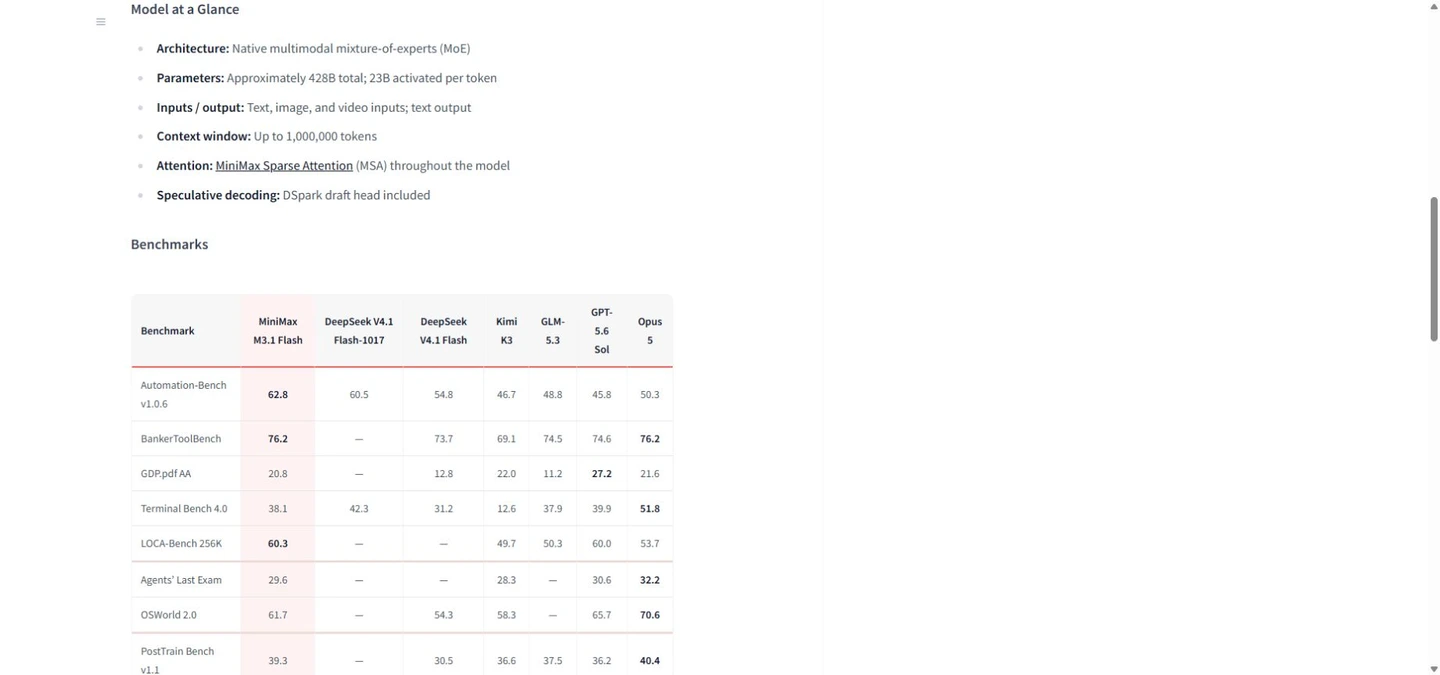
The October 19 hosted release and October 23 weight release serve different audiences. The current MiniMax M3.1 Flash — Hugging Face describes a native multimodal mixture-of-experts model with approximately 428 billion total parameters and 23 billion activated per token. It accepts text, images and video and produces text. It is not MiniMax H3, a native image/video generator, or an audio model.
The architecture retains the M3 family but applies sparse attention throughout, quantization-aware training and a bundled DSpark speculative draft head. These changes target efficient inference. Activating fewer experts reduces computation per token; it does not remove the inactive experts from the checkpoint or make the full model fit in 23B-sized memory.
| Specification | Current release |
|---|---|
| Architecture | 428B total / 23B active per token; MoE |
| Context / maximum generated tokens | Hosted: 1,000,000 / 524,288; request budgets apply |
| Input → output | Text, images, video → text |
| Reasoning | Always on; low / medium / high / xhigh / max |
| Weights / license | Downloadable; MiniMax Community License |
Open weights: what the license permits
The weights are now downloadable from the official repository. Its MiniMax Community License is a MiniMax Community License, not an MIT or Apache license. Noncommercial use is permitted subject to its terms. Commercial deployments must display “Built with MiniMax M3.1-Flash”; products or services above US$20 million yearly revenue need prior written authorization, while those below the threshold must send the specified one-time notice.
The license also contains prohibited-use conditions. Fine-tuning and commercial APIs are included in its commercial-use definition. Treat this as open weights with conditions, rather than unrestricted open-source software. These weight-license obligations should not be silently substituted for the separate terms of a hosted API or subscription.
The 72-hour and 100-trillion-token claims
The original OpenCode announcement says Space Bunny ranked first for 12 consecutive days and served 106 trillion tokens, then separately announces three free days for M3.1 Flash. OpenRouter reports 56.7 trillion tokens and ten days at number one, followed by a 72-hour promotion. These are different platforms and reporting periods.
The MiniMax — M3.1 Flash says the anonymous early version processed over 200 trillion tokens. It does not establish that the released checkpoint processed 100 trillion tokens in 72 hours. Usage totals can include input and output, repeated context and many concurrent users. They show adoption under those conditions, not single-request speed, independent quality or a deduplicated number of useful answers. Free promotion terms must be checked at the chosen provider when you sign up.
Benchmarks: strong automation, uneven coding leadership
The current model card reports Automation-Bench v1.0.6 at 62.8, DeepSWE v1.1 at 73.7 and Terminal Bench 4.0 at 38.1. Earlier launch coverage quoted 62.2 for Automation-Bench; the table below uses the October 23 card rather than mixing snapshots. All comparisons here are vendor-reported, with the listed evaluation harnesses.
M3.1 Flash leads the selected automation row, but DeepSeek V4.1 Flash-1017 leads it on DeepSWE, Terminal Bench and NL2Repo. Opus 5 has a larger Terminal Bench lead. That supports a cost-conscious automation shortlist, not a claim that MiniMax beats every rival in coding. DeepSWE used mini-SWE-agent 2.4.5 with 512K context; Terminal Bench used Codex 0.149.1. Scores from other scaffolds or benchmark versions are not interchangeable.
| Benchmark (vendor-reported) | M3.1 Flash | DeepSeek V4.1 Flash-1017 | Opus 5 |
|---|---|---|---|
| Automation-Bench v1.0.6 | 62.8 | 60.5 | 50.3 |
| DeepSWE v1.1 | 73.7 | 77.0 | 74.0 |
| Terminal Bench 4.0 | 38.1 | 42.3 | 51.8 |
| NL2Repo-Bench | 61.2 | 68.2 | 75.3 |
| BankerToolBench | 76.2 | — | 76.2 |
| CyberGym | 82.2 | — | — |
| BabyVision (with tools) | 91.0 | 92.5 | 94.1 |
Current official model-card comparison. A dash is an unreported result, not zero; BabyVision includes tools.
Speed needs the same care: MiniMax advertises 200+ output tokens/s and a median above 170, while the live Artificial Analysis page showed 92.5 output tokens/s when checked. These are different serving measurements, not a controlled head-to-head test. Output throughput excludes the full wait for input processing, reasoning, tool execution and retries. Measure time to a useful completed task with your context and concurrency.
Coding and agents: where the model is useful
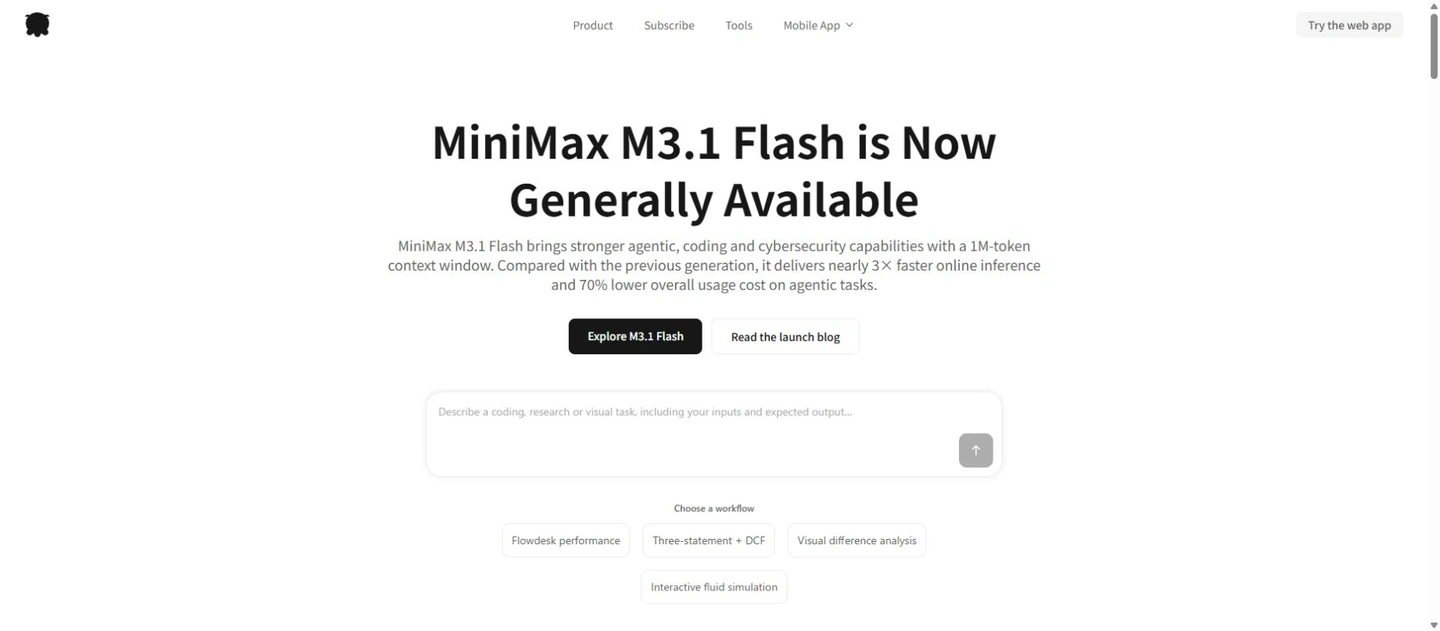
Good candidates include reproducing a bug from logs, implementing a bounded feature, checking a spreadsheet against source documents and moving consistent data between tools. The MiniMax Code — M3.1 Flash documents examples such as profiling a slow support-ticket interface. These are vendor demonstrations, not evidence that every app will see the same improvement.
A practical engineering task should include the repository, failing behavior, a reproducible test and constraints on data or interfaces. Require the agent to explain its diagnosis, make a focused change and return actual test output. Tool calling needs a host that executes the tools: the language model alone does not browse your machine, run tests or obtain access to business systems. Keep write permissions narrow and review external actions.
Images, video and a million-token context
A screenshot can provide visual evidence of a UI bug; a video can help the agent reason about a sequence of interactions. Native visual input does not mean native video or image output. Tool-assisted charts, slides or Three.js scenes are produced through code and tools. Audio input/output is not advertised for this checkpoint.
The hosted guide lists 1,000,000 context tokens. The API reference allows up to 524,288 generated tokens, subject to request and context budgets; this is a ceiling, not a sensible default for every call. Files, images, tool history and reasoning consume resources. A large window does not prove reliable recall of every detail: start with relevant files, request document locations for claims and independently verify cross-file consistency. The training knowledge cutoff is not clearly specified in the checked release materials.
Reasoning settings and API integration traps
The MiniMax API exposes low, medium, high, xhigh and max effort; max is the default and thinking cannot be disabled. On the Anthropic-compatible API use output_config.effort; on OpenAI Chat Completions use reasoning_effort; Responses uses reasoning.effort. A client that strips unknown fields or sends effort:none can fail or silently behave differently from your intended configuration.
Keep final text separate from reasoning_content and preserve complete assistant messages and tool-call IDs in subsequent turns, as the MiniMax Tool Use guide requires. Some direct tool calls omit a reasoning field, so handle its absence. JSON-shaped output still needs parsing and schema validation; provider support for response_format is not proof of strict schema enforcement. Start with medium effort for routine work, compare high/max on difficult failures, and cap turns, output and tool retries.
API prices and the real cost of a completed task
The official flat rates are US$0.15 per million uncached input tokens, US$0.60 per million output tokens and US$0.015 per million cached input tokens. One million uncached input plus 100,000 output tokens costs US$0.21 in model charges. If all that input qualifies as a cache hit, the same arithmetic is US$0.075. These examples exclude tools, hosting, taxes and retries; cache eligibility is not automatic.
Count billable reasoning output as well as the final answer and measure the cost per accepted result. A cheap call repeated ten times may lose to a more expensive first-pass solution. The vendor’s 70% task-cost reduction is a workload claim, not a 70% discount on every API token. M Plan, MiniMax Code subscriptions and third-party free endpoints have their own quotas and dates; they are not unlimited pay-as-you-go API credit.
| Token category | US$ per 1M tokens |
|---|---|
| Uncached input | 0.15 |
| Output | 0.60 |
| Cached input | 0.015 |
Self-hosting: 23B active is not a desktop promise
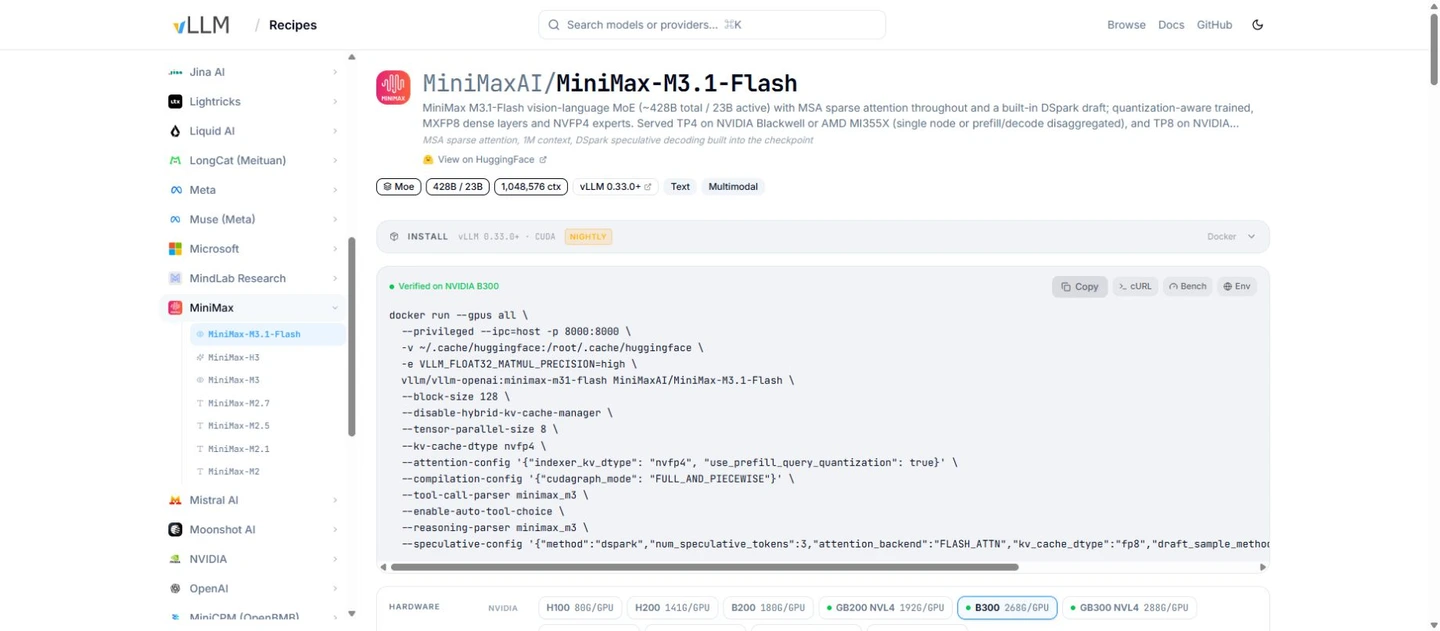
The repository contains mixed quantization: MXFP8 paths and NVFP4 MoE experts, not a plain BF16 download. Adding the 48 main safetensor shards in the October 23 file listing gives about 250.1 GB (decimal), plus about 2.3 GB for the DSpark weights and other files. This is a download-size calculation, not measured VRAM consumption. Packed U8 tensor storage can also make an automatic parameter badge misleading; use the architecture’s 428B/23B specification.
The vLLM recipe describes TP4 on supported Blackwell or AMD MI355X systems and TP8 on H100/H200, with distinct kernels and cache settings. Its Hopper example limits context to 262,144, disables video input and does not enable DSpark. Do not copy the API’s full feature list onto every local configuration. Budget KV cache, vision processing, concurrency and runtime overhead in addition to weights. A single 24/32GB card is not an evidenced full-GPU solution; experimental offload or smaller quantizations need their own quality and speed tests. SGLang is another officially linked route.
Factuality, language quality and community feedback
The live Artificial Analysis page showed an Intelligence Index of 43 and about US$0.22 per index task when checked on October 23. Its launch evaluation at max effort reported 42, 56% correct on AA-Omniscience and a 93% hallucination rate. Under AA-Omniscience, that last figure is incorrect answers divided by all non-correct responses, including partial or unattempted responses. It does not mean 93% of all answers were wrong. It does flag reluctance to admit uncertainty.
The Reddit — LocalLLaMA release thread mixes enthusiasm with concerns about download size and serving support; Reddit — OpenCode records users noticing free access ending. These are anecdotes, not controlled benchmarks. No equally strong per-language results were established for all seven AirMore locales. Test local idioms, dates, decimal separators, names and technical terminology with your own documents. Language output support does not imply a localized app, billing currency or guaranteed regional access.
Open weights do not mean uncensored output or unrestricted NSFW use. The license has prohibited uses and hosted providers apply separate moderation policies; this review does not establish a dependable adult-content capability. Likewise, using a cloud endpoint is not local processing. Review the chosen provider’s retention, region and account terms before sending confidential repositories or customer records.
A practical trial before switching models
Use a fixed small task set: two real bug fixes with failing tests, a screenshot-based UI diagnosis, a multi-document reconciliation and a question that cannot be answered from the supplied evidence. Use the same task files, tool permissions and time budget for each candidate. Add a realistic task in your working language rather than assuming English benchmark rankings transfer unchanged.
A useful prompt is: “Reproduce this failure. Identify the supporting file and line for each diagnosis. Make the smallest viable fix, run the relevant tests and report unresolved failures. If a needed fact is absent, state what is missing instead of guessing.” Record accepted completions, retries, input/cache/reasoning/output tokens, time to first useful result and total elapsed time. This is a suggested protocol, not a test already run by AirMore.
Frequently asked questions
Is M3.1 Flash fully open source?
The weights are downloadable, but the Community License imposes commercial attribution, notice/authorization and use restrictions. Read the actual release license before deployment; “open weights” is the more precise description.
Can I run it on one 24GB GPU?
The official full model is much larger than that. The active parameter count describes per-token computation. Offload may change what can load, but is not proof of usable speed, long context or full multimodal support.
Can thinking be turned off?
No. Lower effort to reduce latency and token use, and choose the correct effort field for your API protocol. Setting none or disabled is not supported for this model.
Does it generate videos or speak?
The released checkpoint takes text, image and video input and returns text. Other MiniMax products or external tools can produce media; that does not make this checkpoint a video or speech generator.
Is the API permanently free?
No permanent unlimited entitlement follows from the launch promotion. Check the provider’s current quota and price. Official pay-as-you-go rates, M Plan credits and third-party trial periods are separate offers.
Is it better than DeepSeek or Claude?
It depends on the task and budget. MiniMax’s own table shows advantages in selected automation tests and deficits in several coding tests. Compare accepted deliverables with the same tools and retry limits rather than choosing from one headline score.
Verdict and sources
M3.1 Flash deserves attention as a low-priced agent and coding model with long context and downloadable weights. The most convincing path is a hosted trial on bounded tasks, followed by a decision based on accepted results, factual checks and total cost. Self-hosting makes sense when the hardware, operational capacity and license conditions already fit the project.
Choose another route if you need a small desktop checkpoint, native media generation, guaranteed schema compliance or reliable factual answers without verification. For adjacent visual-generation needs, see our MiniMax H3; it covers a different model category. Keep the tool and model responsibilities separate when building a workflow.
Evidence checked October 23, 2026: MiniMax M3.1 Flash — Hugging Face, MiniMax Community License, MiniMax — M3.1 Flash, MiniMax API, MiniMax Tool Use, vLLM, SGLang, Artificial Analysis and its Artificial Analysis — 2026-10-19, AA-Omniscience, OpenCode, OpenRouter and Reddit — LocalLLaMA. VentureBeat highlights the tradeoff between agent costs and factual reliability. This is a researched technical assessment, not an AirMore GPU benchmark or an independently executed coding shootout.
Related Reviews
Manus 2.0 Review: Studio, Pricing, API and What Is Actually New

Step 5 Preview Review: Pricing, API Access, Open Weights and NSFW Limits
MiniMax H3 Review: Open-Weight AI Video Model With Native Audio

OpenClaw 2.0 Review: Local AI Agent Gateway, ClawHub Skills, Hardware, and NSFW Limits
Krea 2 Edit Review: Downloads, ComfyUI Workflows and Prompt Examples
Krea 3 Review: Editing Quality, Ultra, Real Costs and Open-Weight Status