8 AI Writing Platforms for Journal Manuscript Preparation
A manuscript is judged four times before it is accepted, and by four different things holding four different standards. Almost all preparation tooling is bought…


A manuscript is judged four times before it is accepted, and by four different things holding four different standards. Almost all preparation tooling is bought for the last three. A reviewer asks the only question that determines the outcome, which is whether the conclusions the paper draws are supported by the evidence it presents.
A reader decides within about two minutes whether the prose can be followed. An automated integrity screen checks similarity and, increasingly, AI markers. And the editorial office checks scope, format and whether the required declarations are present. Language polish, reference formatting and template compliance serve the last three well and the first not at all, which is why a technically immaculate manuscript still comes back asking for major revisions.
At a Glance
- QED Science: whether the evidence in the paper supports the claims the paper makes
- Thesify: a severity-graded pre-submission review, plus a shortlist of journals that fit
- Jenni AI: drafting from your own library, then auditing whether the citations hold up
- Rubriq: academic language editing returned as tracked changes you accept or reject
- InstaText: improving the text you wrote without generating any of it for you
- Wordvice AI: a broad revision suite spanning proofreading, paraphrasing and similarity
- Overleaf: authoring, journal templates and assembling a submission package correctly
- Avidnote: the disclosure, contribution and data availability statements a submission needs
The Four Judges, and Which One Authors Prepare For
Preparation effort tends to flow toward whichever judge answers fastest, which is the wrong end:
- The desk and the screen answer instantly. A template either compiles or it does not, and a similarity score appears in minutes. That speed makes those layers feel like the work.
- The reader is addressed out of habit. Language editing is the most mature tooling in this category, so it absorbs the budget even when the prose was never the problem.
- The reviewer answers slowly. Objections to the reasoning arrive weeks later, in a report, when the remedy is new experiments rather than a new sentence.
Prepare in the reverse order to the speed of the feedback.
8 AI Writing Platforms for Journal Manuscript Preparation
1. QED Science
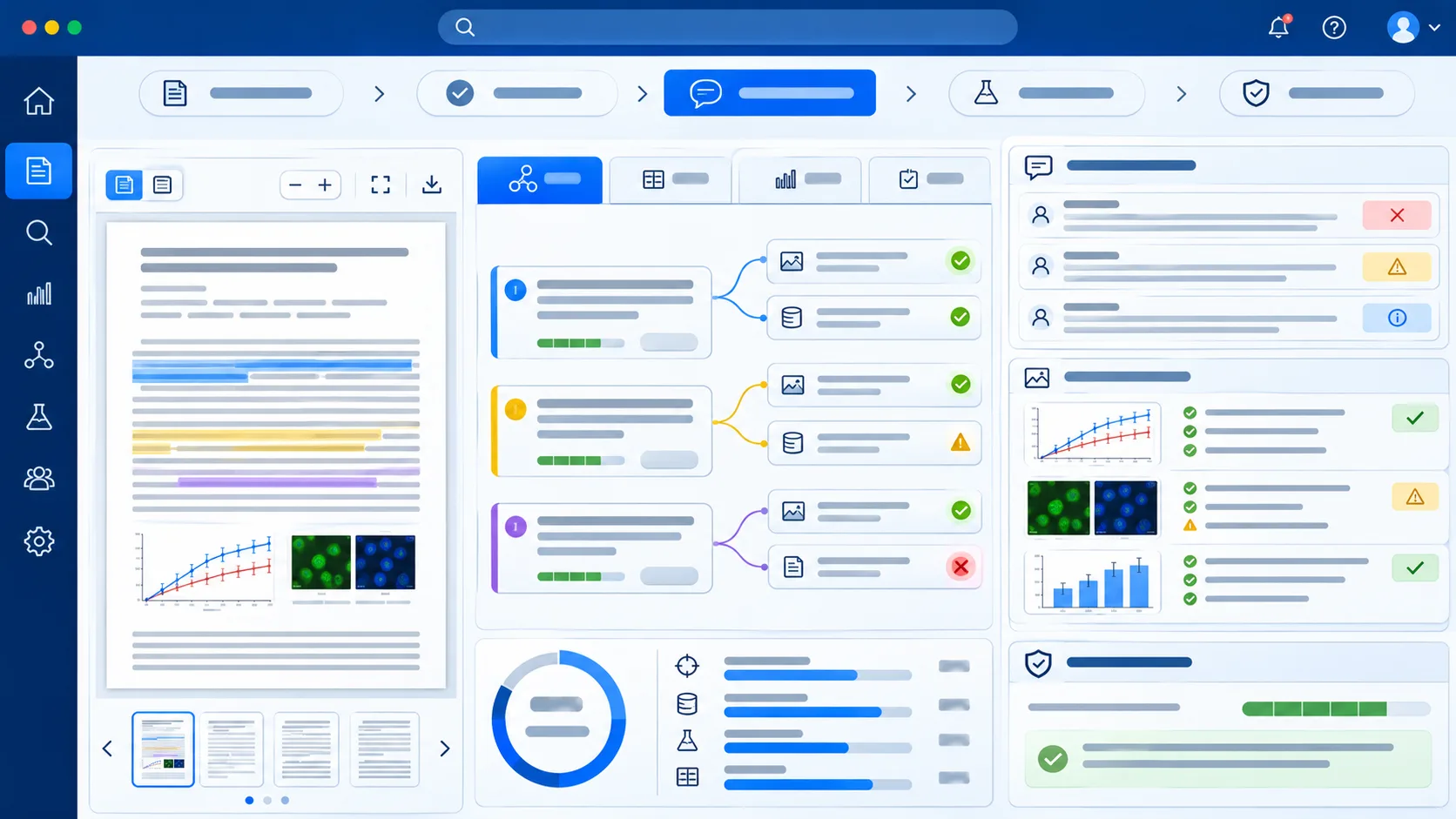
QED Science comes first because it addresses the judge the rest of this list does not reach. Its Critical AI paper reviews decompose a manuscript into a meta-claim, the main claims beneath it, the related claims and the experiments supporting each, then run a panel of specialised agents across that structure, checking figure inconsistencies, statistical validation, contradictions with the existing literature, alternative hypotheses the paper has not addressed, and the reporting standards of the field. Findings pass through a verification layer before they are returned. What comes back is a set of structured objections of the kind a reviewer raises, delivered while there is still time to answer them.
It is built as an author-side tool rather than an editorial one. Reviews are private, reports stay in the author’s account unless shared, and the company’s own framing is that the judgment stays with the scientist, who inspects the findings and decides what to act on. A parallel product applies the same approach to grant applications, checking logic, background, feasibility, methodology and internal consistency before a funder sees them.
A separate output, the QED Score, rates a paper’s originality and the validity of its evidence on a percentile scale, aimed at readers triaging the literature rather than at authors preparing a submission. Coverage is life sciences, access is free for academic researchers, and the boundary is stated plainly: it assumes the data and results are genuine, so it is not a fraud or image-manipulation check, and it does not present itself as a substitute for peer review.
Where it helps:
- Claim-level review that names which conclusions the presented evidence does not carry
- Comparison against existing literature, so an overstated novelty claim surfaces early
- Grant applications assessed on the same logic, before the funder reads them
Optimises for: the reviewer whose verdict decides acceptance.
2. Thesify
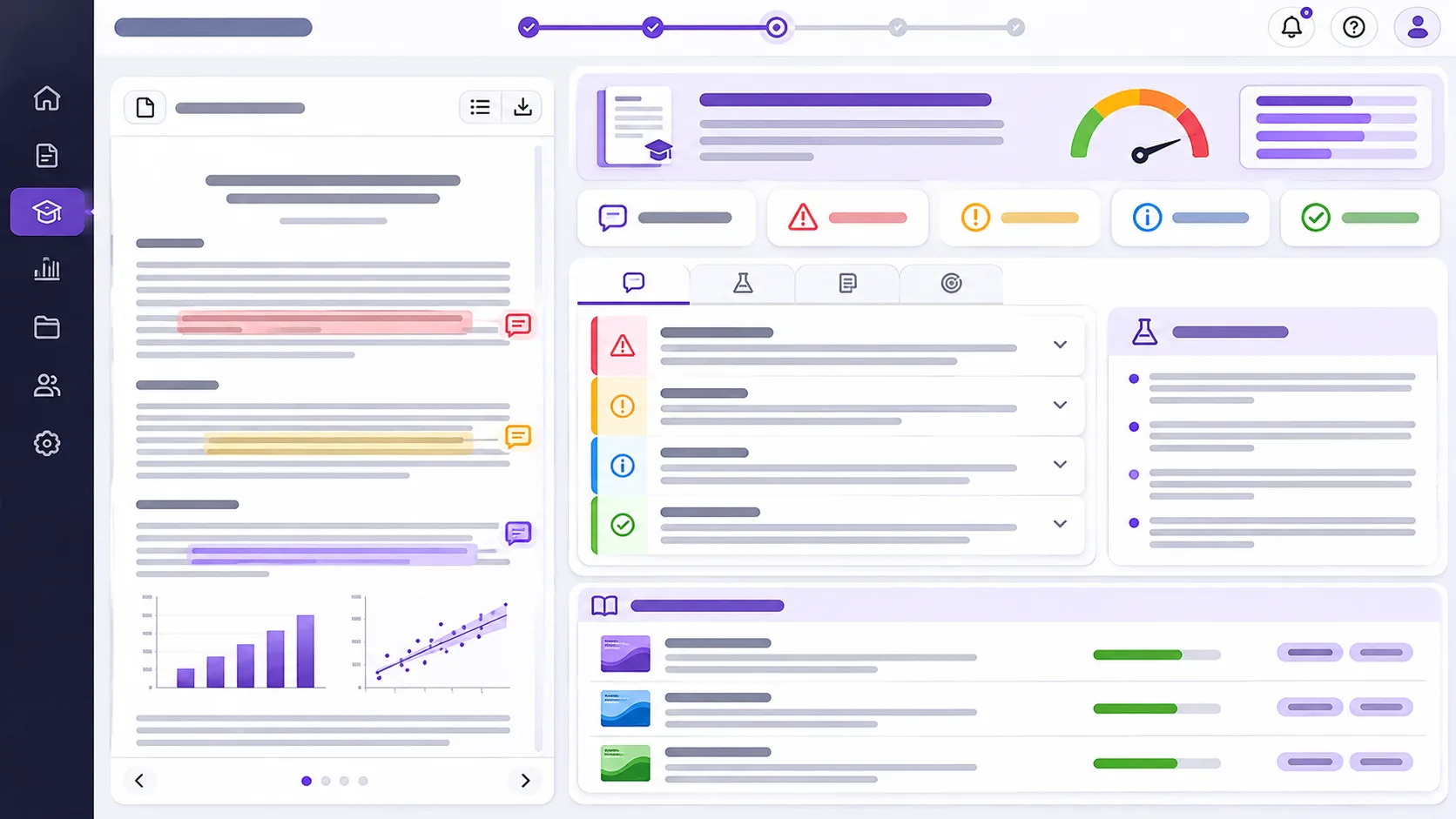
Thesify is the closest thing here to a rehearsal of peer review. Upload a paper, thesis chapter or grant proposal to Reviewer and it returns severity-graded critique of argument, methodology, evidence and structure, section by section, flagging claims that reach past the evidence and attaching a concrete fix to each point. Journal Finder then proposes targets with impact factors, scope and rejection rates.
Its integrity posture is the most developed in the category: the company states that AI involvement should be visible to you, to your co-authors and to your readers, and that your supervisor, journal or institution remains the final authority. It is Swiss, stores documents in Europe, and says content is never sent to OpenAI, Anthropic or other model developers. Coauthor, an agent that edits LaTeX source, sits awkwardly beside the promise that it never writes for you.
Where it helps:
- Severity-graded reviewer-style critique with a specific fix attached to each point
- European data residency, with a stated refusal to pass content to model developers
Optimises for: the reviewer, and then the editor deciding whether the paper fits.
3. Jenni AI
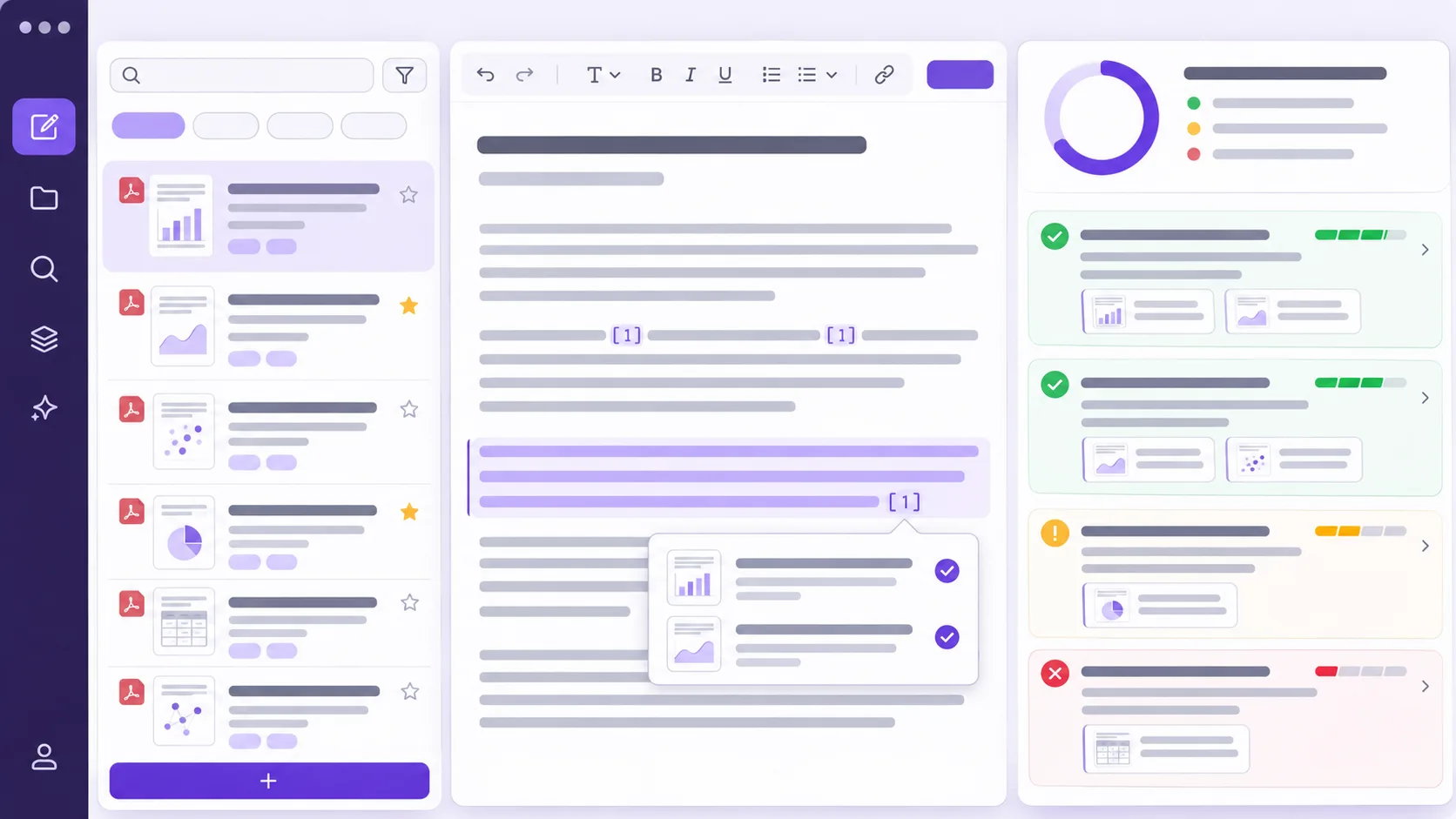
Jenni is a workspace rather than an editor. You import PDFs into a library, draft with an autocomplete that suggests sentences grounded in those papers, and query the library through a chat that answers with citations. It is the most generative platform here by a wide margin, and its editing commands include one that generates a counter-argument to a selected claim. Anyone planning to declare their AI use should start from that fact.
What earns it a place in a submission workflow is Reviews. Claim Confidence checks whether each factual claim is supported by the source cited for it and shows the excerpt, sorting problems into categories including unsupported, overstated and contradicted. Source Quality flags retractions, preprints and unverified journals. The confidentiality documentation is the weakest here: an undated policy carrying visible placeholder text, no processing location named, and document content routed to an analytics vendor.
Where it helps:
- Claim Confidence showing the cited excerpt beside the claim it is meant to support
- Source Quality catching a retracted or preprint citation before a reviewer does
Optimises for: the reviewer checking citations, inside a tool that also writes.
4. Rubriq

Rubriq is AJE’s AI language editor, renamed from Curie in February 2025 and now owned by MPS Limited. Upload a Word file of up to 25,000 words and it returns grammar, punctuation and sentence-structure suggestions as tracked changes, accepted or rejected one at a time. Translation from Chinese, Portuguese or Spanish is included on the higher tier. AJE publishes a 95.5% accuracy figure for its suggestions, which also means one in twenty is not right.
The stated boundary is the clearest of any platform here. AJE calls Rubriq a writing assistant and not an automated paper generator, says the product delivers correction rather than generation, and states that nothing changes without approval. Documents are deleted 72 hours after processing. The limit is scope: language, structure and translation only, with AJE’s substantive checks sold separately as human services.
Where it helps:
- Every suggestion arrives as a tracked change, so the author decides sentence by sentence
- An explicit no-generation posture, which is the simplest kind of AI use to declare
Optimises for: the reader deciding in two minutes whether the prose can be followed.
5. InstaText
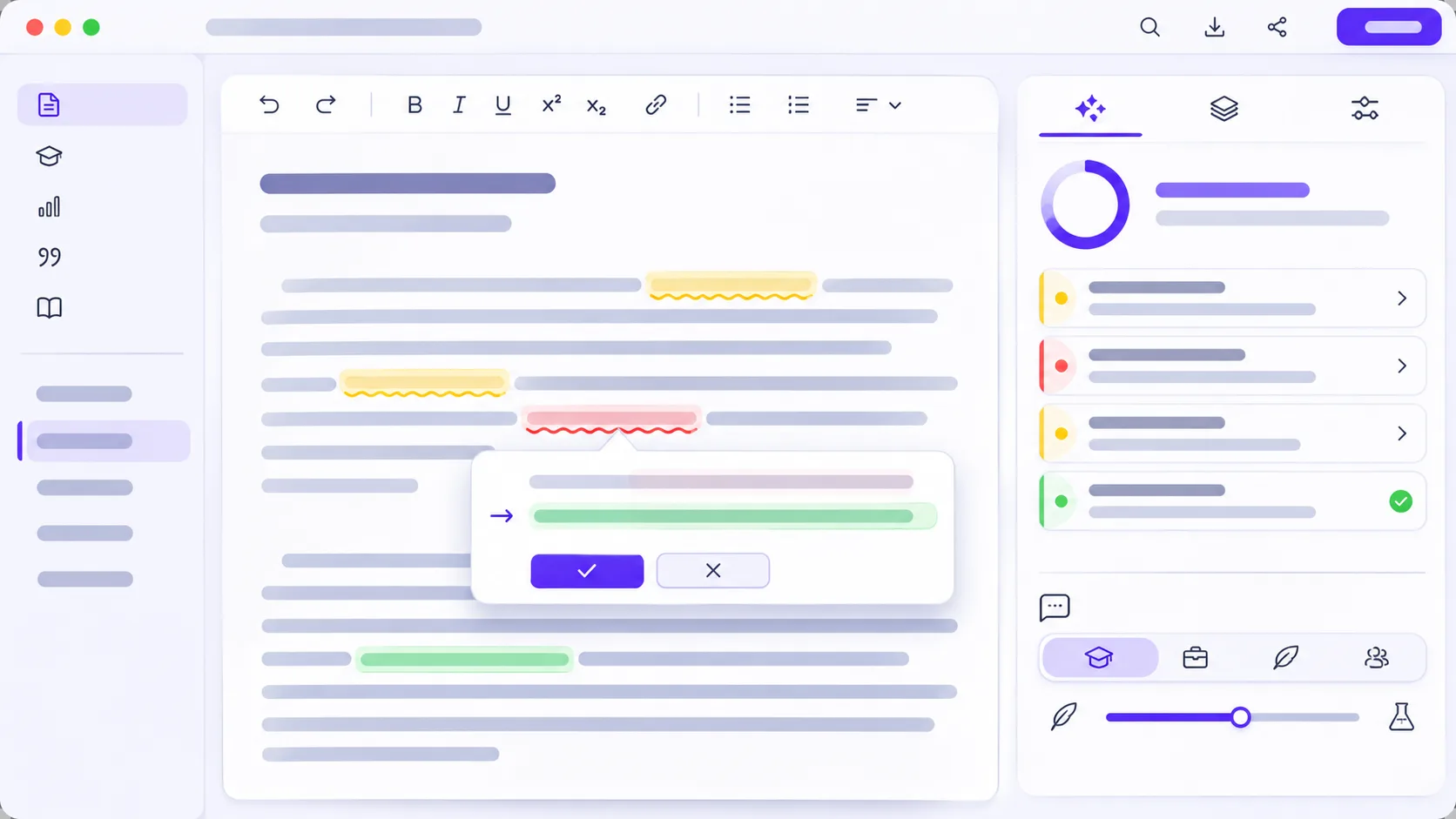
InstaText does one thing, and describes it in the cleanest sentence any vendor in this category has written: it improves your text without generating new content, so your words stay yours. Every change arrives as a suggestion you accept or reject, and a personal dictionary protects the terms it should not touch. It runs as a browser extension and inside Word with track changes, Google Docs and Overleaf.
Its confidentiality position is the strongest published here. The privacy policy states that submitted text is deleted immediately after processing, is not stored in any database or log, and is never used to train the models, including in anonymised form. Its disclosure guide quotes publishers directly and declines to claim an exemption for itself. One gap: the policy never says where processing happens.
Where it helps:
- Sentence-level editing with no generated content entering the manuscript
- Submitted text deleted immediately after processing and never used for training
Optimises for: the reader, with the smallest disclosure footprint of anything here.
6. Wordvice AI
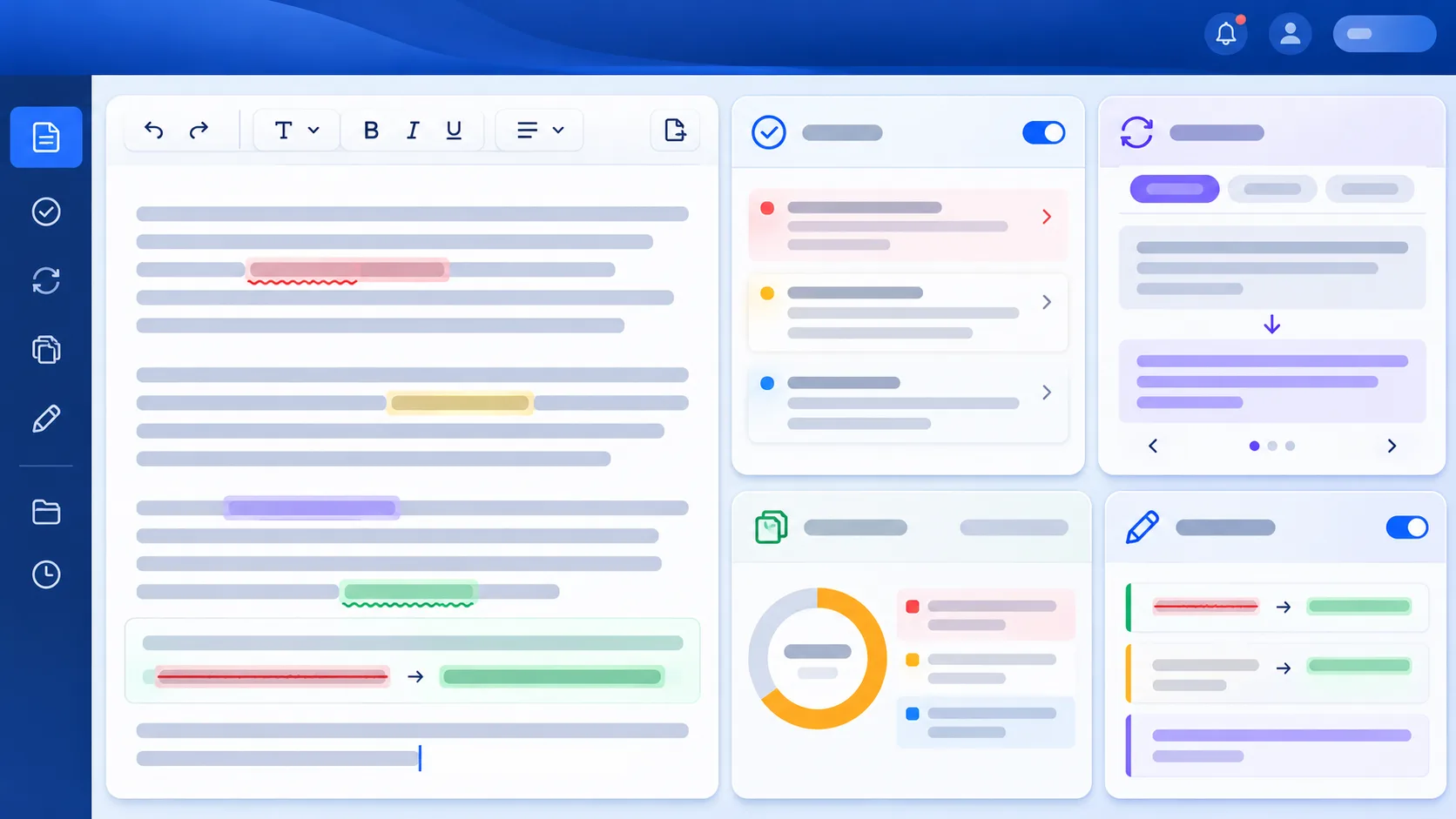
Wordvice AI is the broadest and cheapest option here, built on a human editing business operating since 2013. The AI Proofreader is the core, with four modes running from Light, which leaves meaning untouched, through Standard and Intensive, which restructures sentences for flow, to Concise, which shortens text to fit a word limit. A paraphraser, translator, summariser and citation generator sit around it.
Two things are worth knowing before recommending it to a lab. The company is candid that the proofreader cannot detect plagiarism in your document and does not match a human editor on context and tone. And the same subscription includes an AI detector and an AI humanizer, whose page invites you to watch the detection score drop while also stating that generating an essay and then humanizing it violates most academic integrity policies.
Where it helps:
- Four proofreading modes, including one that only shortens text to a word limit
- A published guide to writing AI disclosure statements, updated in October 2026
Optimises for: the skim reader, with tools attached that optimise for the detector.
7. Overleaf
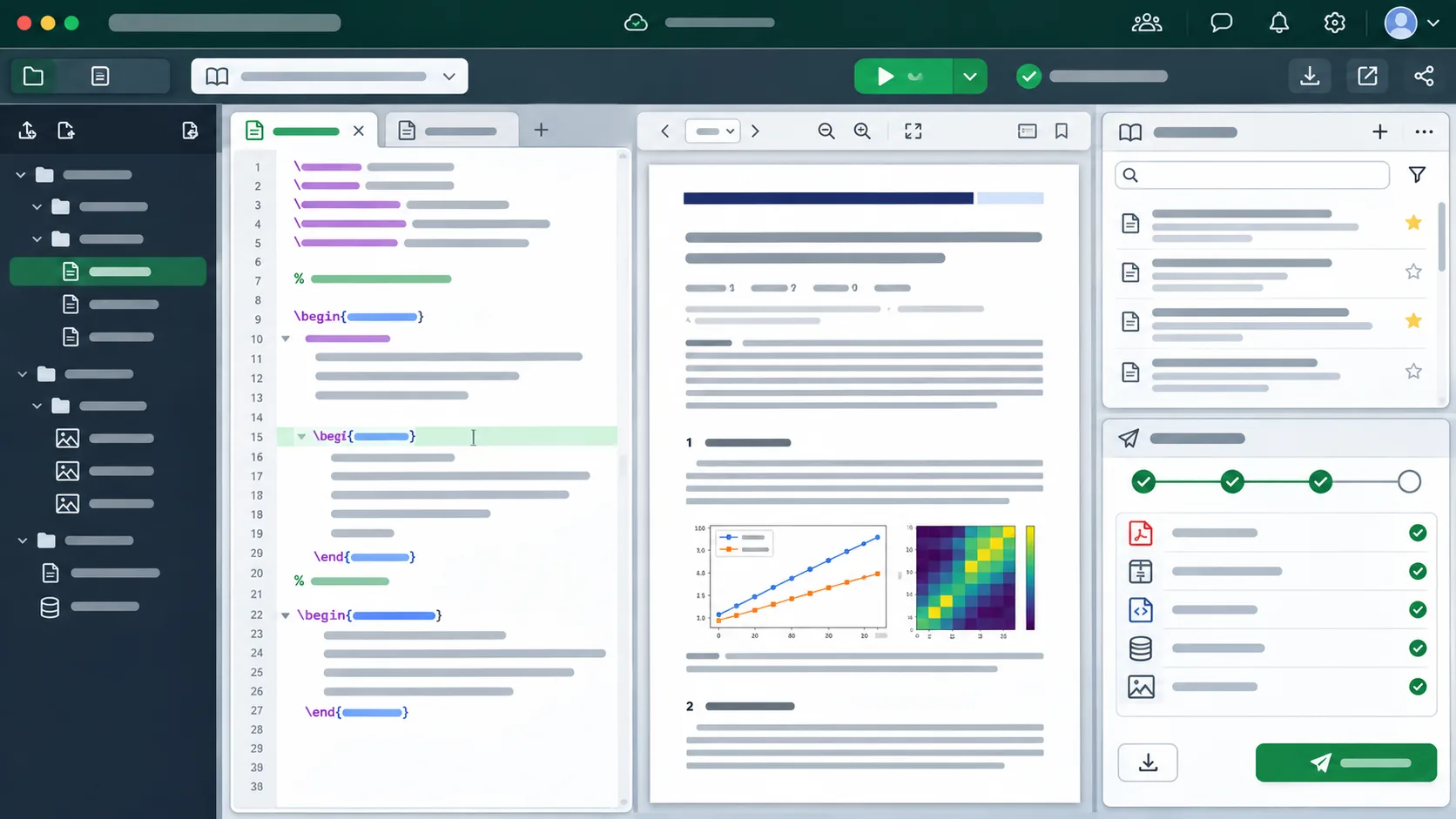
Overleaf is a collaborative LaTeX editor with a large template gallery, and it is where a great many papers in mathematics, physics and computer science are written. Its Submit feature matters more than the name suggests: start from a publisher’s official template and a submission link appears in the project menu, sending the files to that publisher’s system rather than leaving you to assemble an archive by hand. Overleaf is part of Digital Science, which also owns Writefull.
The AI layer is branded Overleaf AI and is practical rather than generative. AI Assistant answers LaTeX and writing questions, Error Assist explains compile errors and can apply fixes, and Citation Reviewer scans for unsupported statements. Overleaf states its own limits, including that the assistant will not write your paper. Check the plan before relying on it, because AI is metered in daily uses and the free tier includes no AI Assistant at all.
Where it helps:
- Journal templates with a direct submission path for participating publishers
- Compile errors explained and optionally fixed rather than simply reported
Optimises for: the editorial desk, where format and completeness are checked first.
8. Avidnote

Avidnote is a Swedish research workspace spanning notes, reading, transcription, interview coding, data analysis and writing. The plans are metered in AI words per month, which says plainly that generating prose is a core function rather than an accessory. For manuscript preparation, the reason to look at it sits slightly to one side of the main product.
It publishes four free generators for the paperwork a submission requires: an AI-use disclosure statement built against publisher or university rules, a citation generator for AI tools, a CRediT author contribution statement covering the fourteen roles, and a data availability statement. Nothing else on this list produces them. Documents are stored on EU servers. Two gaps: the homepage entries on plagiarism and data ownership render blank, and the vendor says nothing about declaring text it generated itself.
Where it helps:
- Free generators for AI-use disclosure, CRediT contributions and data availability
- EU data residency, with an enterprise path that keeps processing inside the EEA
Optimises for: the editorial office checking that the required declarations are present.
The Disclosure Rule That Is Not One Rule
Every platform here produces text you did not write unaided, and what you must declare depends on whose rules your target journal follows:
- The two largest commercial publishers exempt light language work, by different amounts. One waives declaration for basic checks of grammar, spelling and punctuation. The other extends the exemption to general editing, a noticeably wider gap. Both require disclosure once a tool changes structure or content.
- The bodies journals cite as their authority grant no exemption at all. The ICMJE recommendations place AI writing assistance in the acknowledgments, and COPE draws no line between editing and generating, asking for disclosure in the methods either way. A third large publisher waives the manuscript declaration but requires the same disclosure in the cover letter.
Two researchers can use one tool, declare differently and both be compliant. Read the journal, not the category.
Frequently Asked Questions
Do I have to tell the journal I used an AI tool?
Usually, and where it goes depends on the publisher. Elsevier asks for a declaration immediately above the references under a named heading, Springer Nature and Wiley want it in the methods, and the ICMJE puts writing assistance in the acknowledgments. Read the target journal’s own instructions rather than assuming a rule for the category, because the thresholds genuinely differ between publishers.
Can an AI tool be listed as a co-author?
No, and this is the one point on which every body agrees. The ICMJE, COPE and the major publishers all exclude AI tools from authorship on identical reasoning: an author has to take responsibility for the accuracy, integrity and originality of the work, and a tool cannot. Citing AI as an author is ruled out on the same grounds.
Does AI language editing count as the same thing as AI writing?
At two large publishers, no. Elsevier exempts basic checks of grammar, spelling and punctuation from declaration, and Wiley exempts spelling, grammar and general editing, which reaches further. Springer Nature does not exempt copy editing but moves the declaration into the cover letter, and COPE draws no distinction whatsoever. The line exists commercially and not normatively.
Will a journal reject my paper because an AI detector flagged it?
A detector score is not evidence of authorship, and the vendors selling detectors say so themselves. Formal academic prose attracts false positives because it is repetitive and impersonal by design. The protection that works is a record of which tools you used and how, kept as you write, rather than a chase after a lower score.
Is it safe to upload an unpublished manuscript to one of these platforms?
Check two things first: whether the vendor uses your text to train models, and how long it keeps the file. Some publish both plainly and delete documents after a fixed window. Others are vague, or state a no-training promise that other pages on the same site appear to qualify. Institutional rules on uploading unpublished or licensed material apply as well.
Which of these actually reduces the chance of rejection?
Only the layer that examines the argument. Formatting, language and similarity work removes reasons to be rejected without review, which is worth doing and is not the same thing. Acceptance turns on whether reviewers accept the step from the evidence presented to the conclusion drawn, and a paper rejected on that ground usually reads perfectly well.
Latest Reviews
Strata Review: Local AI Models, Setup, Performance and Privacy

Top 6 Vendors for Zero-Day Protection in End-of-Life Open Source

GPU Unlock Review: NVIDIA Tensor Gains, Tools and Real Limits
5 Best AI Wallpaper Generators in 2026
Best 5 AI Meme Generators in 2026
Canva Craft Review: 2K Images, Wide Formats, Text and Editing Limits