Nucleus Image Review: 17B Sparse MoE, Local Setup, NSFW Support, and Apache 2.0 Open Weights
Nucleus Image is one of the more interesting open-source image models of 2026 because it brings Sparse Mixture-of-Experts design into diffusion-based text-to-image generation. Instead of…
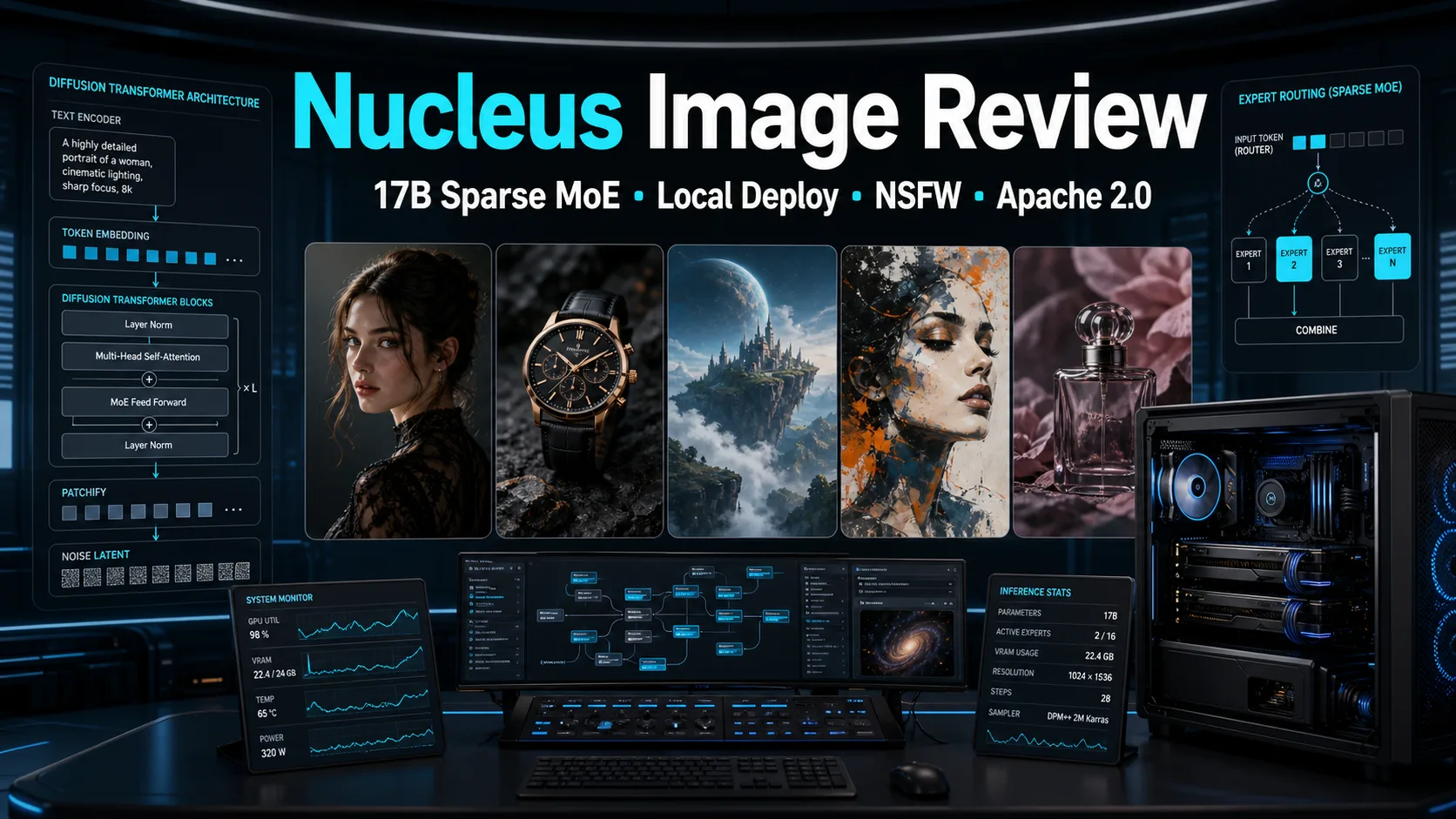

Nucleus Image is one of the more interesting open-source image models of 2026 because it brings Sparse Mixture-of-Experts design into diffusion-based text-to-image generation. Instead of being a simple SDXL-style checkpoint, it is a 17B-parameter Sparse MoE Diffusion Transformer that activates only about 2B parameters per forward pass.
The short version: Nucleus Image is attractive if you want an Apache 2.0, fully open, commercially usable image model with strong general-purpose quality and efficient inference design. It is less ideal if you mainly need a mature anime LoRA ecosystem, built-in image editing tools, or a polished consumer interface like NovelAI.
For NSFW, the situation is more open than heavily aligned closed platforms, especially when you run the model locally. But it is still a base text-to-image model, not a specialized adult/anime model, so control, character consistency, and community NSFW resources are not yet as deep as established ecosystems such as Anima or Pony-derived checkpoints.
Table of Contents
Quick Verdict
| Item | Nucleus Image Review |
|---|---|
| Best for | Open-source general image generation, commercial use, research, Diffusers workflows, efficient high-quality text-to-image |
| Model type | Sparse MoE Diffusion Transformer |
| Parameters | 17B total, about 2B active per forward pass |
| License | Apache 2.0 |
| Online use | Official Nucleus image site and fal API |
| Local use | Diffusers; MLX community build for Apple Silicon |
| NSFW | More open locally than closed tools, but not a mature dedicated NSFW ecosystem |
If you are comparing local/open image models, also read our Qwen Image review, Anima review, NovelAI V5 review, and Flux 3 review. Nucleus Image sits closest to the efficient open foundation-model category.
What Is Nucleus Image?
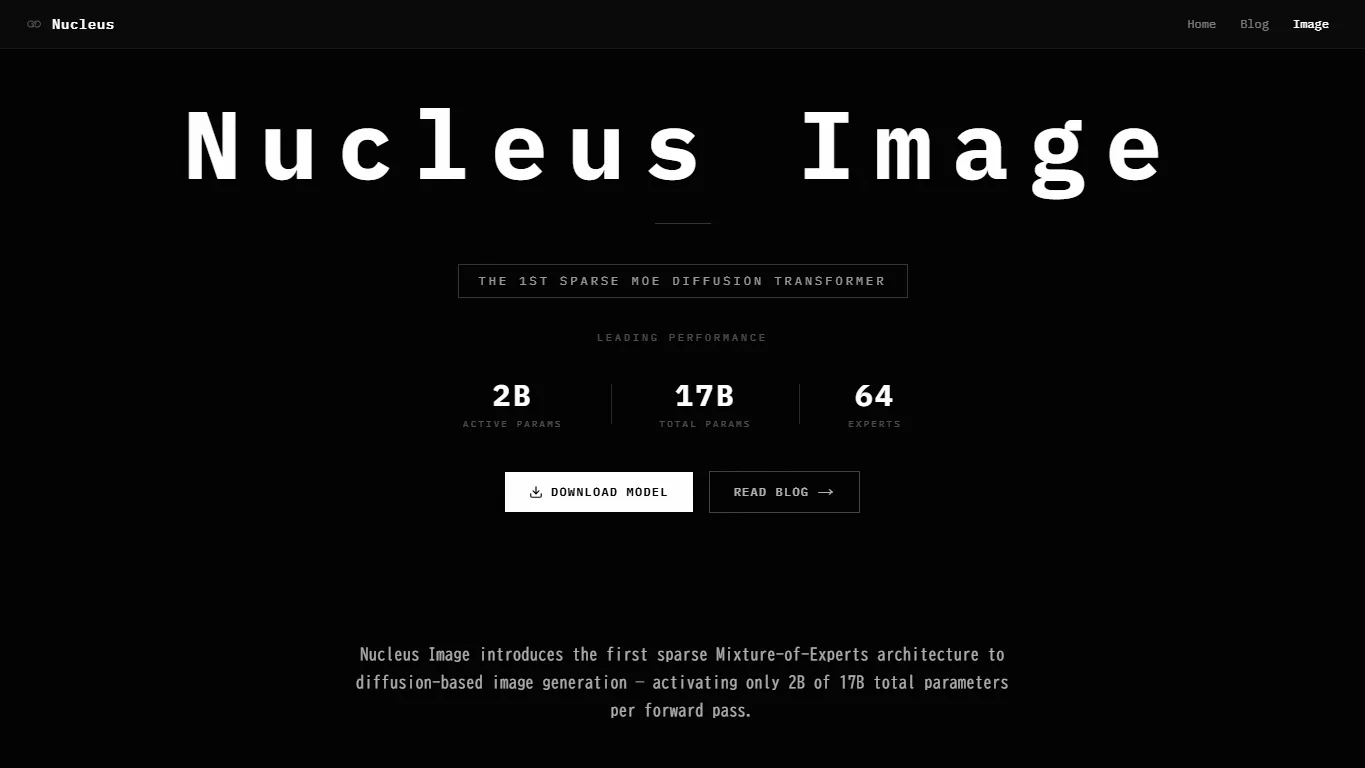
Nucleus Image is a text-to-image generation model from NucleusAI. The official model card describes it as a Sparse MoE Diffusion Transformer with 17B total parameters, 64 routed experts per MoE layer, one shared expert, 32 transformer layers, and Qwen3-VL-8B-Instruct as the text encoder.
The key idea is efficiency. Sparse MoE lets the model keep a large total capacity while activating only a small part of the network for each forward pass. This is different from a dense model, where the whole model is used every time. For image generation, that may become an important direction because quality is rising while local inference cost is becoming harder to ignore.
The model is also notable because it is a base model. The official description says the reported benchmark results come from pre-training only, without DPO, reinforcement learning, or human preference tuning. That makes it useful for research and downstream fine-tuning, but it also means the raw model may need careful prompting or workflow tuning.
Official Site, API, and Download Links
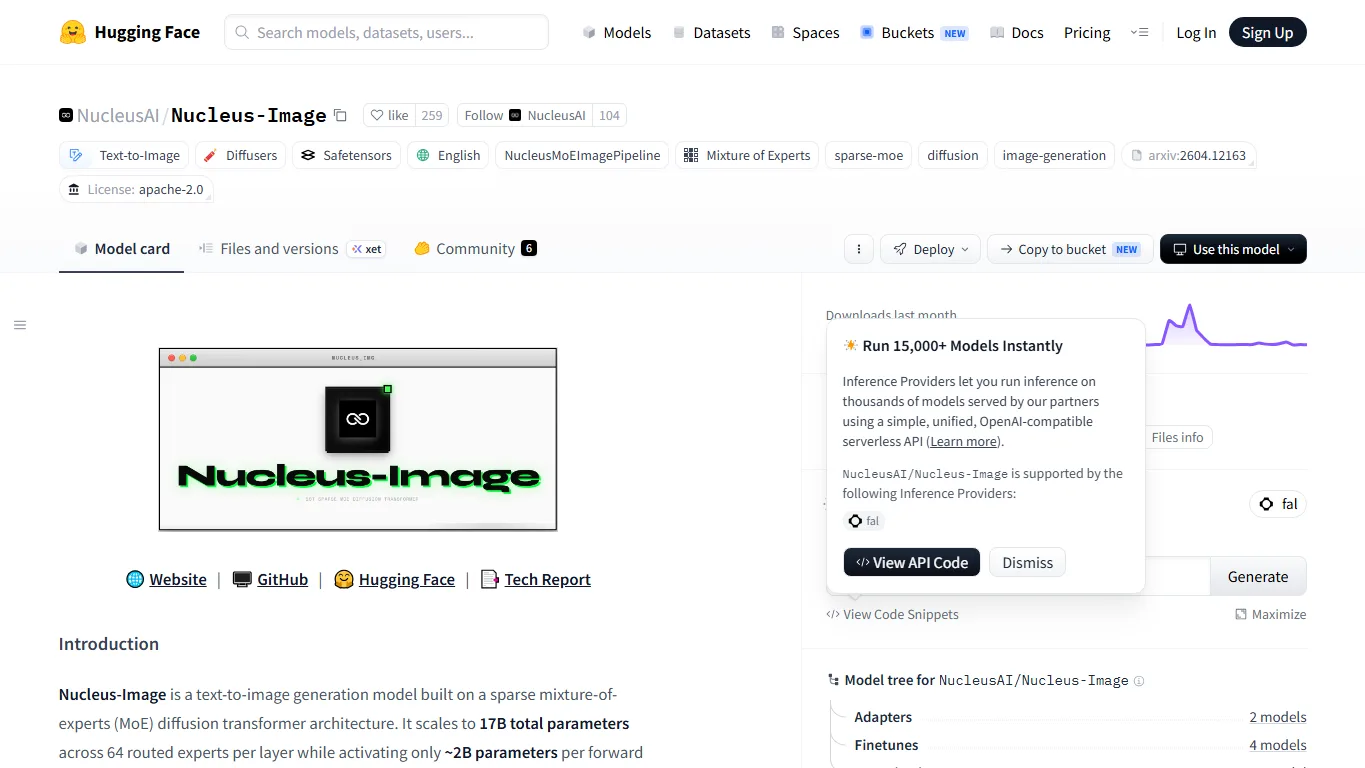
You can try the model on the official Nucleus Image website. For local use and downloads, the main page is NucleusAI/Nucleus-Image on Hugging Face, with the project also available through the official GitHub repository.
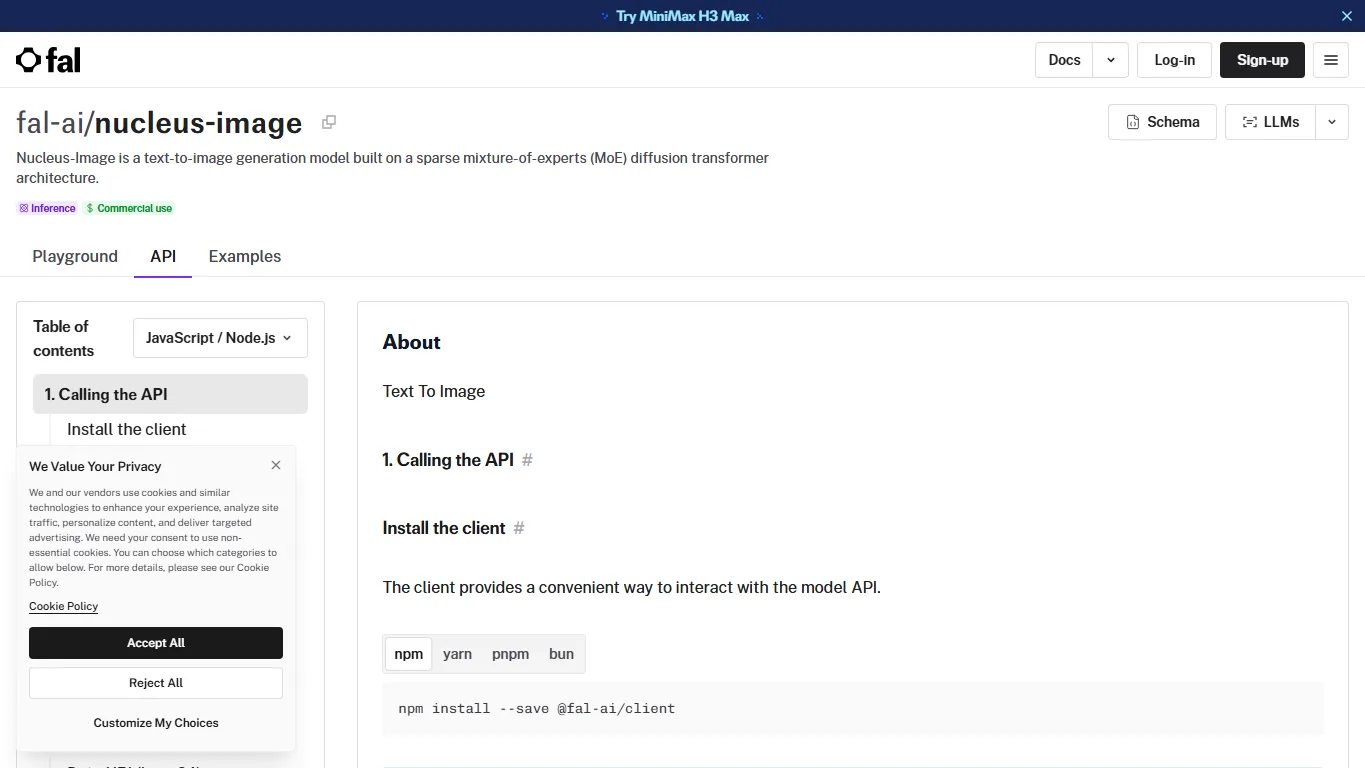
Developers who want hosted inference can use fal's Nucleus Image API. fal provides a queue-based API and JavaScript/Node examples, which is convenient if you want to add Nucleus Image generation to a web app without maintaining your own GPU server.
Apple Silicon users should also watch community ports such as mlx-community/Nucleus-Image-4bit. That does not replace the official model, but it is useful for readers who want to experiment on Mac hardware.
Features and Specs
Nucleus Image is trained for multiple aspect ratios and common image-generation use cases: portraits, product-style images, architecture, nature, surreal scenes, fantasy art, typography-like layouts, and everyday commercial imagery. It is not just an anime checkpoint or a photo-only model.
| Specification | Value |
|---|---|
| Total parameters | 17B |
| Active parameters | About 2B per forward pass |
| Architecture | Sparse MoE Diffusion Transformer |
| Layers | 32 |
| Experts | 64 routed experts plus 1 shared expert per MoE layer |
| Text encoder | Qwen3-VL-8B-Instruct |
| Image tokenizer | Qwen-Image VAE |
| Training data | About 700M images and 1.5B caption pairs |
| Training stages | 256 → 512 → 1024 progressive resolution |
| Recommended sample setting | Official quick start uses 50 steps and guidance scale 4.0 |
The model card reports strong benchmark scores, including GenEval 0.87, DPG-Bench 88.79, and OneIG-Bench 0.522. Benchmarks do not guarantee that every prompt will look better than every competitor, but they support the claim that Nucleus Image is not merely an experimental toy model.
Image Quality and Real-World Use
In practical terms, Nucleus Image looks most interesting for users who want a high-quality open foundation model for varied prompts. Its official examples cover people, fantasy, commercial images, food, architecture, product-like scenes, and more. That breadth is important because many local image models are excellent in one style but weaker outside it.
The likely weakness is product maturity. Compared with NovelAI V5, Midjourney, Seedream, or Qwen Image APIs, Nucleus Image does not yet offer the same polished consumer editing layer, style presets, image-to-image tools, inpainting interface, or large prompt-sharing community. You are closer to the model itself.
That is not a bad thing for technical users. If you work in Diffusers, train LoRAs, build image pipelines, or care about licensing, Nucleus Image is much more interesting than another closed web generator. If you only want the fastest no-setup UI, an online service will feel easier.
Local Setup and Hardware
The official Hugging Face quick start uses the latest Diffusers, BF16 loading, CUDA, TextKVCacheConfig, 50 inference steps, and guidance scale 4.0. It also lists common aspect ratios such as 1024×1024, 1344×768, 768×1344, 1184×896, and 896×1184.
Sparse MoE reduces active computation, but it does not mean your GPU only stores 2B parameters. The model still has 17B total parameters, plus a large text encoder and runtime memory. For comfortable BF16 experimentation, a 48GB-class GPU is a safer target. A 24GB GPU may require CPU offload, memory-saving settings, lower resolutions, or community quantized builds. 16GB and below are better served by hosted APIs or smaller models.
| Hardware | Expectation |
|---|---|
| 8-12GB VRAM | Not recommended for the official full model; use hosted API or wait for optimized community builds |
| 16GB VRAM | Possible only with heavy compromises if supported by the workflow |
| 24GB VRAM | Experimental with offload/optimization; not the smoothest route |
| 48GB VRAM | More realistic for BF16 local testing |
| Apple Silicon | Check MLX community builds; speed and quality depend heavily on memory and implementation |
| Hosted API | Best path for quick product testing |
Comparison with Other Open Image Models
| Model | Strength | Weakness | Best choice when… |
|---|---|---|---|
| Nucleus Image | Apache 2.0, Sparse MoE efficiency, strong general quality | Young ecosystem, fewer LoRAs and UI tools | You want an open foundation model for research or commercial use |
| Qwen Image 2.0 / 3.0 | Strong text rendering, layout, multilingual prompts, editing ecosystem | Latest 3.0 is API-only; local versions can be heavy | You need text-in-image or document-like layouts |
| FLUX / Flux 3 | Strong photorealism and broad ecosystem | License and NSFW/community details depend on version | You want mature local workflows and broad tool support |
| Anima | Anime/illustration style, character knowledge, NSFW-leaning community | Less general-purpose for commercial imagery | You mainly generate anime or character art |
| Pony / Illustrious / NoobAI | Danbooru-tag prompting and mature illustration LoRA culture | Less natural for general product/photo prompts | You need anime, furry, character, or tag-based control |
| Stable Diffusion XL ecosystem | Huge LoRA/checkpoint library | Older base quality and prompt understanding | Compatibility matters more than frontier quality |
The most important difference is that Nucleus Image is a foundation model release, not a complete creative platform. Its value grows if the community builds LoRAs, ComfyUI nodes, quantizations, workflows, and finetuned checkpoints around it.
NSFW Support
Nucleus Image is more open than many closed commercial generators because the official release is a base model and can be run locally. The model card does not describe a heavy refusal layer like a chat model, and local generation depends largely on the user’s own workflow and safety filters.
That said, hosted services may apply their own safety checkers. fal and other API platforms can filter or block sensitive outputs depending on their policies, even when the underlying model is open. If NSFW freedom is a requirement, local deployment matters more than the model name alone.
For adult or explicit imagery, expectations should stay realistic. Nucleus Image may be permissive locally, but it does not yet have the same mature NSFW LoRA/checkpoint ecosystem as anime-focused communities. For detailed character consistency, specific poses, or niche adult styles, specialized models such as Anima, Pony-derived checkpoints, or Illustrious-family models may still be easier.
Community and LoRA Status
The community around Nucleus Image is still early. Hugging Face already shows the model, related demos/API pages, and early community ports, but the number of LoRAs, finetunes, ComfyUI workflows, and prompt guides is far smaller than SDXL, Pony, Illustrious, Qwen Image, or FLUX ecosystems.
This matters for readers. A model can be strong on paper, but everyday usability depends on ecosystem depth: LoRA trainers, quantized weights, ControlNet-style tools, prompt examples, community benchmarks, and troubleshooting posts. Nucleus Image has a promising starting point, but it has not yet reached that mature layer.
FAQ
Is Nucleus Image free for commercial use?
Yes. The official Hugging Face model card lists Apache 2.0, which is generally friendly for commercial and research use. Companies should still review the license themselves before production deployment.
Where can I try Nucleus Image online?
The easiest official route is the Nucleus Image website. Developers can also use fal's hosted API.
Can I run it on a 12GB GPU?
The official full model is not a good fit for 12GB VRAM. Hosted inference, MLX/quantized community builds, or smaller image models are more realistic.
Is it better than Qwen Image?
Not in every use case. Nucleus Image is attractive for open licensing and Sparse MoE efficiency, while Qwen Image is especially strong in text rendering, dense layout, and editing workflows.
Does it support NSFW?
Local use is more permissive than many closed platforms, but hosted APIs may filter outputs. The community NSFW ecosystem is still young.
Is it good for anime?
It can generate stylized images, but dedicated anime models usually offer better tag control, character knowledge, and LoRA support.
References
- Nucleus Image official site
- NucleusAI/Nucleus-Image on Hugging Face
- Official GitHub repository
- Nucleus-Image technical report on arXiv
- fal Nucleus Image API
- MLX community build
Conclusion
Nucleus Image is a serious open-source image model, not just another checkpoint. Its Sparse MoE design, Apache 2.0 license, Diffusers support, and strong official benchmark results make it one of the more important local AI image releases to watch.
The best users for it are developers, researchers, workflow builders, and commercial teams who value open weights and licensing. The main cautions are hardware requirements, early ecosystem depth, and the fact that NSFW support is more about local control than a polished adult-generation community.
If you want a refined paid web tool, NovelAI V5 or other online services may feel easier. If you want an open model that could become a strong base for future LoRAs, quantizations, and custom image pipelines, Nucleus Image deserves a close look.
Related Reviews
Tsubaki.3 Review: Anime, Manga, Pricing & NSFW (2026)

How to Turn Emails into Tasks with AI: A Practical Follow-Up Workflow
6 Best Video Compressor Tools in 2026
How to Create More Authentic Content With AI Tools

Anima AI Model Review: Anime Image Model, LoRA, License and NSFW Use
Best 5 Password Managers in 2026