Hy4 Preview Review: Tencent Hunyuan 770B MoE, 1M Context, API, Local Hardware, and NSFW Limits
Hy4 preview is Tencent Hunyuan’s new open-source flagship preview model for people who need long-context reasoning, coding agents, document-heavy workflows, and cloud API deployment. Its…


Hy4 preview is Tencent Hunyuan’s new open-source flagship preview model for people who need long-context reasoning, coding agents, document-heavy workflows, and cloud API deployment. Its headline numbers are huge: a 770B total-parameter Mixture-of-Experts model, about 49B active parameters, and a 1M-token context window.
The practical verdict is more nuanced. Hy4 preview is exciting because it pushes open-weight LLMs toward frontier-scale long-context and agent work, but it is still a preview release. It is useful today through OpenRouter, Tencent Cloud TokenHub, and official Tencent products, while local deployment is realistic mainly for teams with serious server hardware.
It is also not an uncensored NSFW model. The official Tencent/API versions are safety-aligned, and the open weights do not automatically mean casual consumer freedom. If your goal is business work, coding, retrieval, long documents, and tool use, Hy4 preview is worth watching closely. If your goal is low-VRAM roleplay or unrestricted adult generation, other models are more practical.
Table of Contents
Quick Verdict
| Item | Hy4 preview Review |
|---|---|
| Best for | Long documents, coding agents, tool-use workflows, enterprise knowledge work, RAG, multi-step reasoning |
| Model type | Open-source MoE LLM, 770B total parameters, about 49B active parameters |
| Context | 1M tokens |
| Official access | Tencent products, Tencent Cloud TokenHub, OpenRouter, Hugging Face weights |
| License | Apache-2.0 shown on GitHub and Hugging Face |
| Main caution | Preview release; local deployment is heavy; official NSFW filtering is strict |
For broader context, compare this with our Qwen 3.8 review, Gemma 4 review, GLM-5.3-Flash review, and Dolphin 3 review. Hy4 preview is closest to the large-scale open-weight agent model category rather than the lightweight local assistant category.
What Is Hy4 Preview?

Hy4 preview is Tencent Hunyuan’s preview-stage open-source large language model. The official repository describes it as a 770B-parameter MoE model with roughly 49B active parameters and a 1M-token context window. Compared with Hy3 preview, the jump is significant: Hy3 preview was positioned around 295B total parameters, about 21B active parameters, and 256K context.
MoE matters because a model can be very large in total capacity while activating only a smaller part of the network for each token. That does not make Hy4 preview a small model, but it helps explain why Tencent can aim for strong long-context and agent performance without making every inference behave like a dense 770B model.
The release is still labeled preview. That means users should expect fast ecosystem changes: new quantizations, inference recipes, deployment notes, benchmark updates, and possibly a fuller technical report after the first wave of testing.
Online Use, API, and Download Links
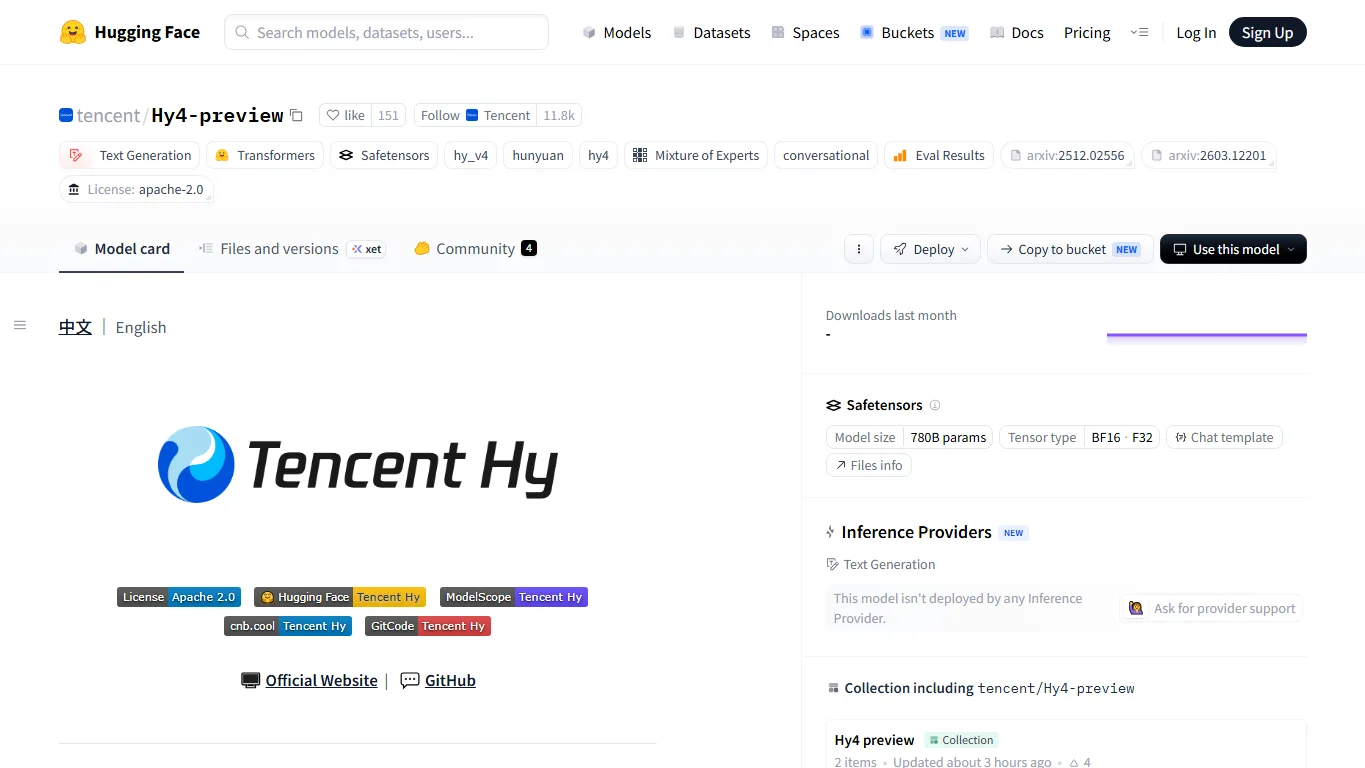
The main open-weight download pages are Tencent-Hunyuan/Hy4-preview on GitHub and tencent/Hy4-preview on Hugging Face. Hugging Face also lists tencent/Hy4-preview-FP8 for users who want a smaller precision option than full BF16.
For online/API use, OpenRouter's Tencent: Hy4 preview page is the easiest public comparison point, and Tencent Cloud TokenHub is the Tencent Cloud route for API access. General users can also watch Tencent’s consumer/product ecosystem, including Tencent Yuanbao and Hunyuan-related product integrations.
If you are evaluating it for a company, the API route is the sensible first step. You can measure cost, latency, coding quality, tool-call reliability, and long-document behavior before spending time on local serving.
Main Features
Hy4 preview is built around long-context work rather than casual short chat. A 1M-token window makes it relevant for codebases, legal documents, research collections, product requirement archives, meeting transcripts, and large RAG systems.
Its second major strength is agent work. Public model pages and media coverage emphasize coding agents, complex tool-use workflows, planning, context continuity, and sustained multi-step execution. This is the kind of model you test with real projects, not only with one-off trivia questions.
| Feature | Why it matters |
|---|---|
| 770B MoE / 49B active | Large model capacity with more efficient per-token activation |
| 1M context | Long documents, repository-scale analysis, multi-file planning, and RAG |
| Open source / open weights | Developers can inspect, deploy, and build around the model rather than only call a closed API |
| vLLM and SGLang focus | Better fit for server-side inference and enterprise deployment |
| Tencent ecosystem | Potential integration with office, coding, search, and productivity tools |
Benchmarks and User Feedback
Early public data should be read carefully. Tencent’s own blind-test and release numbers are useful, but they are not the same as months of independent production use. What is clear is that Hy4 preview is being positioned for coding, agent, tool-use, and productivity tasks rather than only general chat.
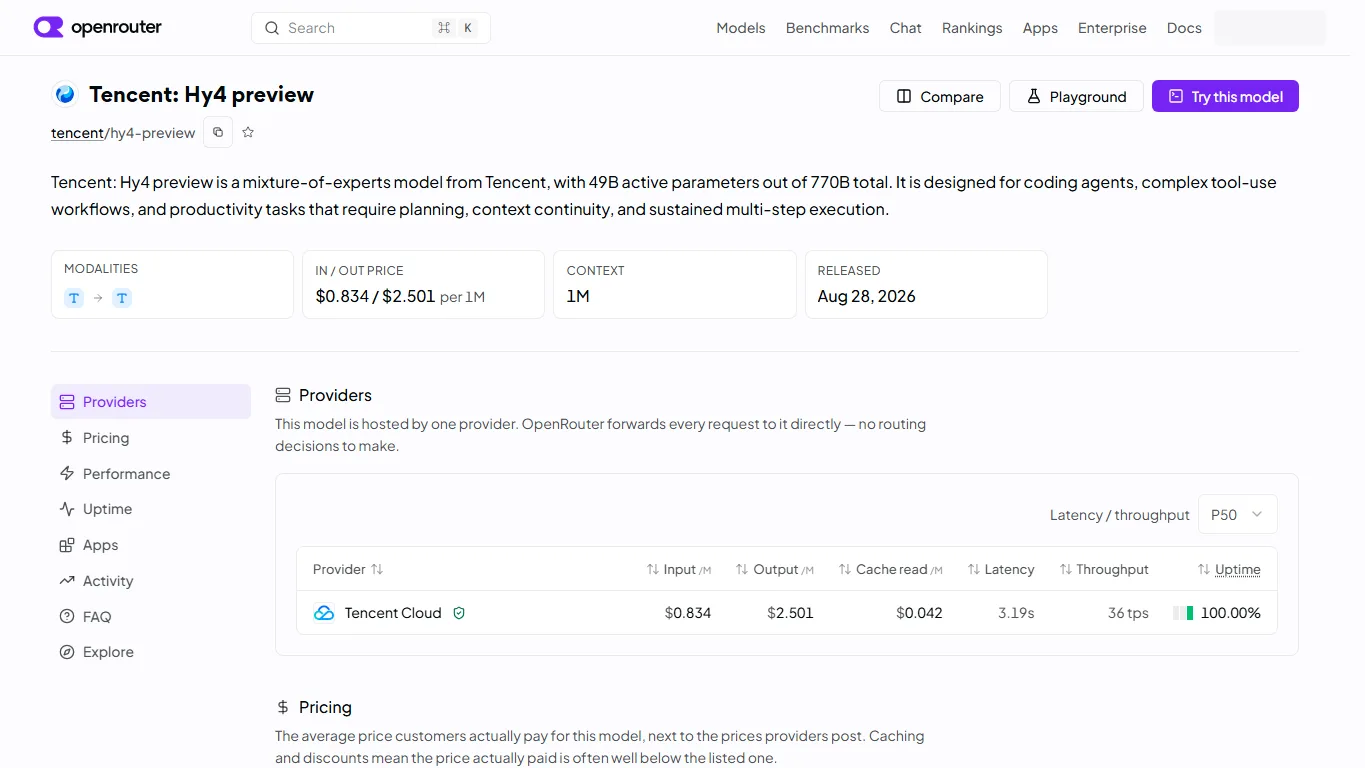
OpenRouter lists the model with a 1M context window and Tencent Cloud as provider, which makes it practical for developers to test without setting up local infrastructure. Early community discussion is still limited compared with Qwen, Llama, or Mistral families, so the most honest evaluation today is: promising specifications, strong official positioning, but still waiting for broad third-party stress tests.
In real usage, the tasks worth testing are long repository analysis, multi-document comparison, structured extraction, code planning, tool calling, and long-context recall. If it only performs well on short prompts, it has not proven the main reason to use a model this large.
Local Hardware Requirements
Local deployment is the hardest part of Hy4 preview. Even with MoE efficiency, this is still a 770B total-parameter model, not a 7B or 30B desktop assistant. The BF16 release is suitable for multi-GPU servers, while the FP8 release can reduce memory pressure but still belongs to serious workstation or server territory.
| Setup | Realistic expectation |
|---|---|
| Consumer GPU 8-24GB | Not a practical full-model setup. Use API, wait for extreme quantizations, or choose smaller models. |
| Single 48GB GPU | Still difficult for full weights; useful mainly for experiments with aggressive offload or future quantized formats. |
| Multi-GPU 80GB class servers | The realistic route for serious local/server deployment. |
| Cloud inference | Most practical for teams that need immediate testing without hardware investment. |
| Frameworks | Check official vLLM and SGLang instructions first; avoid random old LLM loaders. |
For individuals, the better route is to test via OpenRouter or TokenHub, then decide whether a smaller local model such as Qwen, Gemma, GLM, or Llama is enough. Hy4 preview is exciting, but its hardware profile is enterprise-oriented.
Comparison with Other Open Models
| Model | Strength | Weakness | Best use |
|---|---|---|---|
| Hy4 preview | Huge MoE scale, 1M context, agent/productivity positioning | Preview stage and heavy local deployment | Enterprise agents, long documents, API products |
| Qwen 3.8 | Strong local ecosystem and broad community adoption | Smaller context/model scale than Hy4 preview | Local LLM users, coding, multilingual tasks |
| GLM-5.3-Flash | Open-weight, efficient API, strong coding/agent positioning | Less community maturity than Qwen | Low-cost API and agent workflows |
| Gemma 4 | Good local usability and Google ecosystem | Less extreme context/scale | Balanced local assistant |
| Llama / Mistral | Large global ecosystem, tooling, finetunes | Latest Tencent/Qwen/GLM models may be more aggressive in long-context features | General local deployment |
| Dolphin 3 | Classic uncensored finetuning route | Not a frontier long-context enterprise model | Roleplay, free writing, NSFW-leaning local use |
Hy4 preview is not the easiest model to recommend to a hobbyist. Its value appears when the input is huge, the workflow is multi-step, and the use case justifies cloud or server inference. For a daily local chatbot, smaller models remain more practical.
NSFW Support and Safety Limits
Hy4 preview should not be described as an NSFW-friendly or uncensored model. Tencent’s official products and API endpoints are expected to apply strong safety alignment around sexual content, violence, sensitive political content, illegal requests, personal data, and high-risk instructions.
Because the model is open source, community abliterated or uncensored variants may appear later, as happened with other major open models. But Hy4 preview’s scale makes serious finetuning expensive, and there is no widely established NSFW ecosystem yet. For unrestricted roleplay or adult-oriented text generation, models such as Dolphin-style finetunes are currently more practical.
For business and office use, the safety layer is not necessarily a problem. In fact, it may make Hy4 preview easier to use in enterprise environments where compliance, auditability, and misuse prevention matter more than permissive generation.
What to Watch Next
The most important follow-up is independent evaluation. Watch for third-party coding benchmarks, long-context retrieval tests, tool-call reliability reports, quantized weights, vLLM/SGLang deployment recipes, and real latency numbers under production traffic.
Also watch the license and product integration story. GitHub and Hugging Face currently show Apache-2.0, which is more permissive than many model-specific community licenses. If Tencent keeps that path and the ecosystem grows quickly, Hy4 preview could become a serious option for companies that want large open-weight models without relying only on US model providers.
FAQ
Is Hy4 preview open source?
Yes. The official GitHub and Hugging Face pages show public model resources, and the visible license is Apache-2.0.
Where can I try Hy4 preview online?
The easiest public route is OpenRouter. Tencent Cloud users should also check TokenHub.
Can I run Hy4 preview on my gaming PC?
Not realistically in full form. This is a 770B MoE model, and even FP8 is server-class for serious use.
Is Hy4 preview better than Qwen 3.8 or GLM-5.3-Flash?
It targets a larger long-context and agent category. It may be more attractive for enterprise-scale workflows, while Qwen and GLM can be easier to test locally or via lightweight APIs.
Does Hy4 preview support NSFW content?
Official versions are safety-aligned and not designed as NSFW tools. Community variants may appear later, but that ecosystem is not mature yet.
Reference Information
- Tencent-Hunyuan/Hy4-preview GitHub repository
- tencent/Hy4-preview on Hugging Face
- tencent/Hy4-preview-FP8 on Hugging Face
- OpenRouter Tencent: Hy4 preview
- AIbase Hy4 preview news report
- Tencent Cloud TokenHub
Conclusion
Hy4 preview is one of the more ambitious open-source LLM releases of late 2026 because it combines massive MoE scale, 1M context, open weights, and agent-oriented positioning. It is not a casual local chatbot, and it is not a permissive NSFW model, but it is highly relevant for enterprise AI, coding agents, long-document analysis, and RAG-heavy systems.
For most readers, the best next step is not to download the full model immediately. Try it through OpenRouter or Tencent Cloud first, compare it with Qwen 3.8 and GLM-5.3-Flash on your own tasks, and only consider local serving if your hardware and deployment skills match the model’s scale.
Related Reviews
MP3 to Text: 5 Best Tools to Convert Audio to Text Accurately

Best 5 Vibe Coding Tools Of 2026

Qwen 3.8 Review: Benchmarks, Local Setup, GPU Requirements and NSFW Policy
HiDream O1 Review: Open Image AI, LoRA, Local Setup and NSFW Policy
Best 8 Online Course Platforms in 2026
Nucleus Image Review: 17B Sparse MoE, Local Setup, NSFW Support, and Apache 2.0 Open Weights