GPT-Image-2.5 Review (2026): Flare vs Sunburst, Pricing and NSFW Limits
Review GPT-Image-2.5 Flare and Sunburst: official changes, early user feedback, API pricing, NSFW limits, and comparisons with Nano Banana, Midjourney and FLUX.

GPT-Image-2.5 is most interesting when an image is almost right and you need to finish it. Our early recommendation is to try Flare for everyday iterations and evaluate Sunburst for demanding reference-based edits. Neither should be purchased on the assumption that every edit will preserve every pixel—or that the new release removes NSFW restrictions.
For marketers, small creative teams and people already using ChatGPT, the attraction is a shorter path from an idea to a usable visual. The deciding question is not whether one launch example looks impressive, but how many revisions your own product shot, illustrated character or multilingual poster needs before approval.
GPT-Image-2.5 overview: Flare and Sunburst
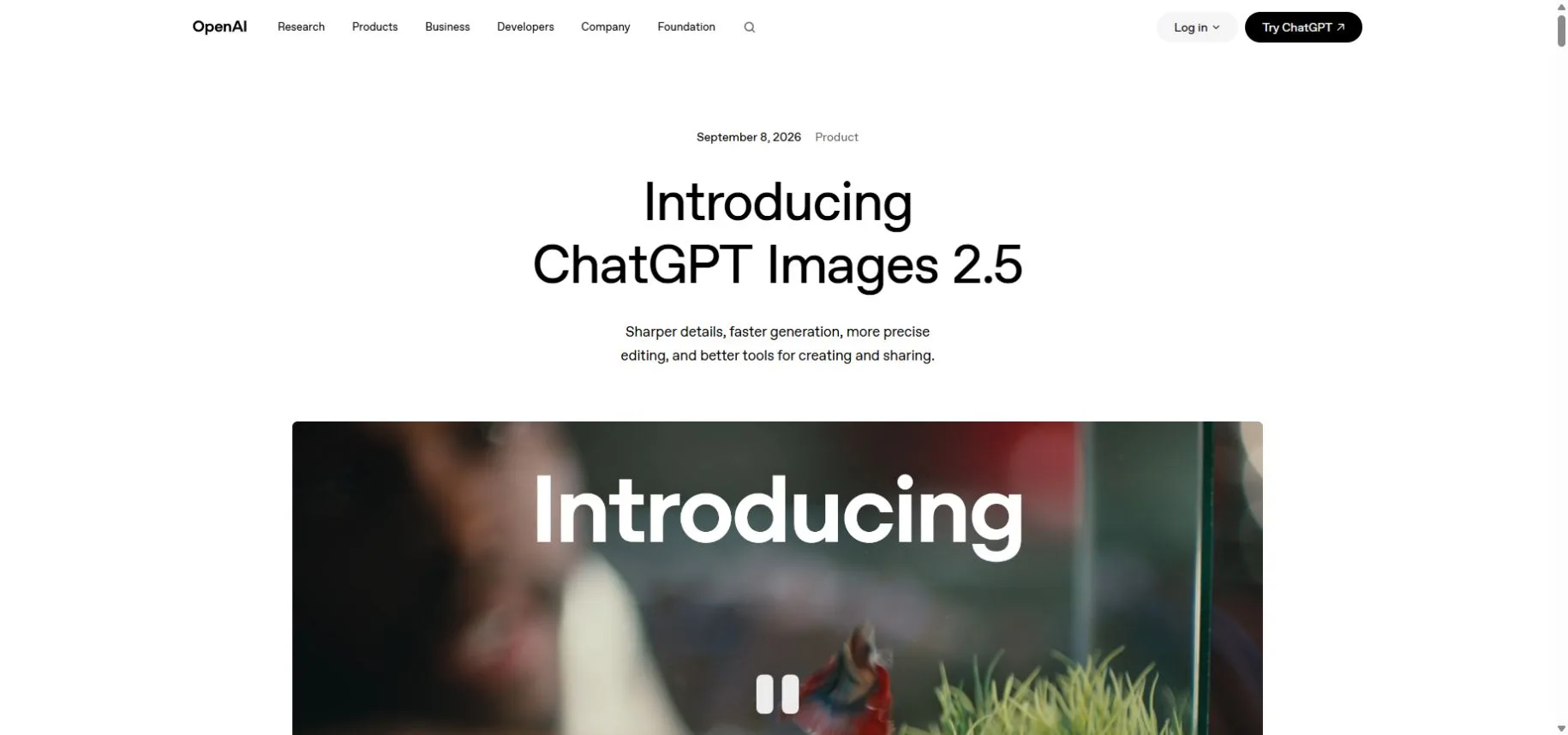
OpenAI announced ChatGPT Images 2.5 on September 8, 2026. Its headline changes include stronger reference fidelity, more controlled editing and faster generation. The rollout covers ChatGPT, Work and Codex. Official announcement.
Review scope: this is an early assessment as of September 9, 2026, combining current specifications with attributed launch-day hands-on reports. We have not run a controlled cross-model benchmark. Recommendations below are editorial judgments, not measured rankings; the cover is an original editorial illustration, not evidence of GPT-Image-2.5 performance.
| Variant | API model ID | Practical starting point |
|---|---|---|
| Flare | gpt-image-2.5-flare | Fast everyday generation and repeated drafts. |
| Sunburst | gpt-image-2.5-sunburst | Reference-sensitive work where precise edits matter more than waiting time. |
Flare: start here for routine image work
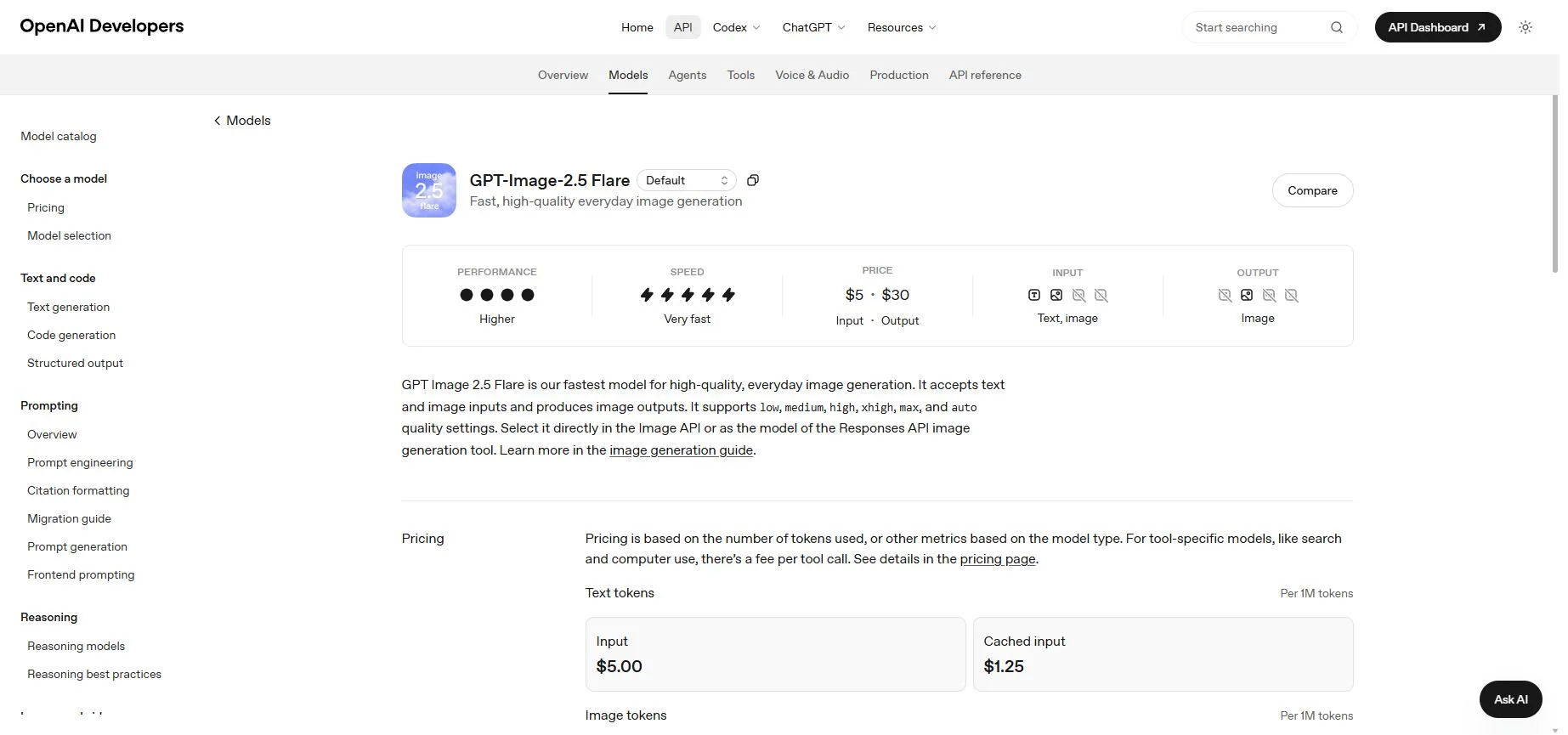
Flare accepts text and images and returns images. Its official page offers low, medium, high, xhigh, max and auto quality settings, through the Images API or the Responses image-generation tool. Flare documentation.
For a newsletter header or several ad concepts, begin with a modest quality setting and choose the composition before paying for final output. This is a workflow recommendation: automatically using the maximum setting for every abandoned draft can waste both money and review time.
Sunburst: assess the cost of the finished edit
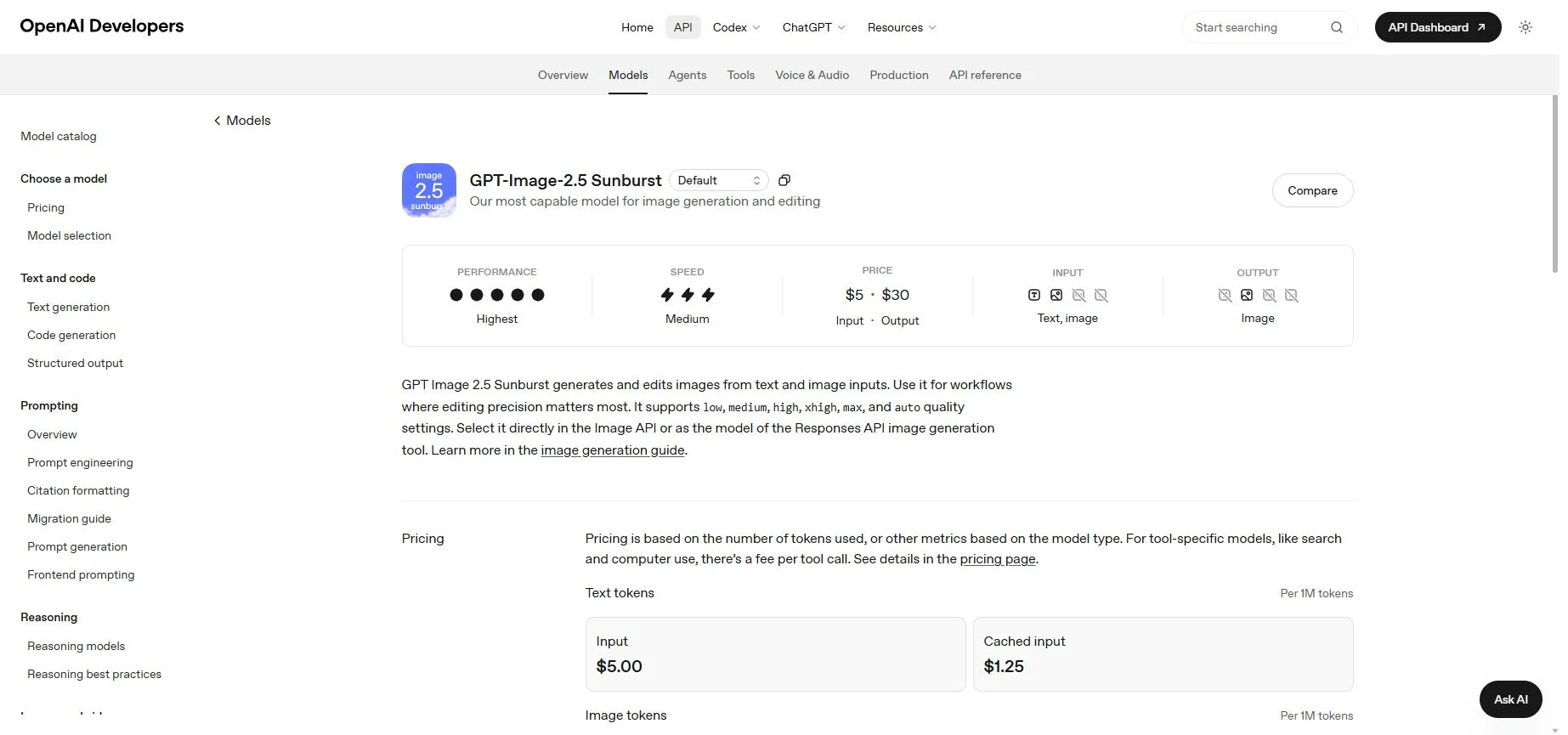
Sunburst is positioned for the most demanding image generation and editing, with the same named quality controls. OpenAI describes it as the precision-oriented option; it can take longer. Sunburst documentation.
Try it when a face, bottle shape or approved composition must survive several changes. A slower request may be worthwhile if it avoids repeated repairs, but that saving needs to be demonstrated on your assets. It does not follow from the premium positioning alone.
What improved over GPT Image 2—and what still needs checking?
OpenAI highlights more natural lighting and texture, better preservation of subjects and details through revisions, and up to 50% lower latency relative to Images 2.0. The speed claim is not a guaranteed duration for every model, quality level or request. Release details.
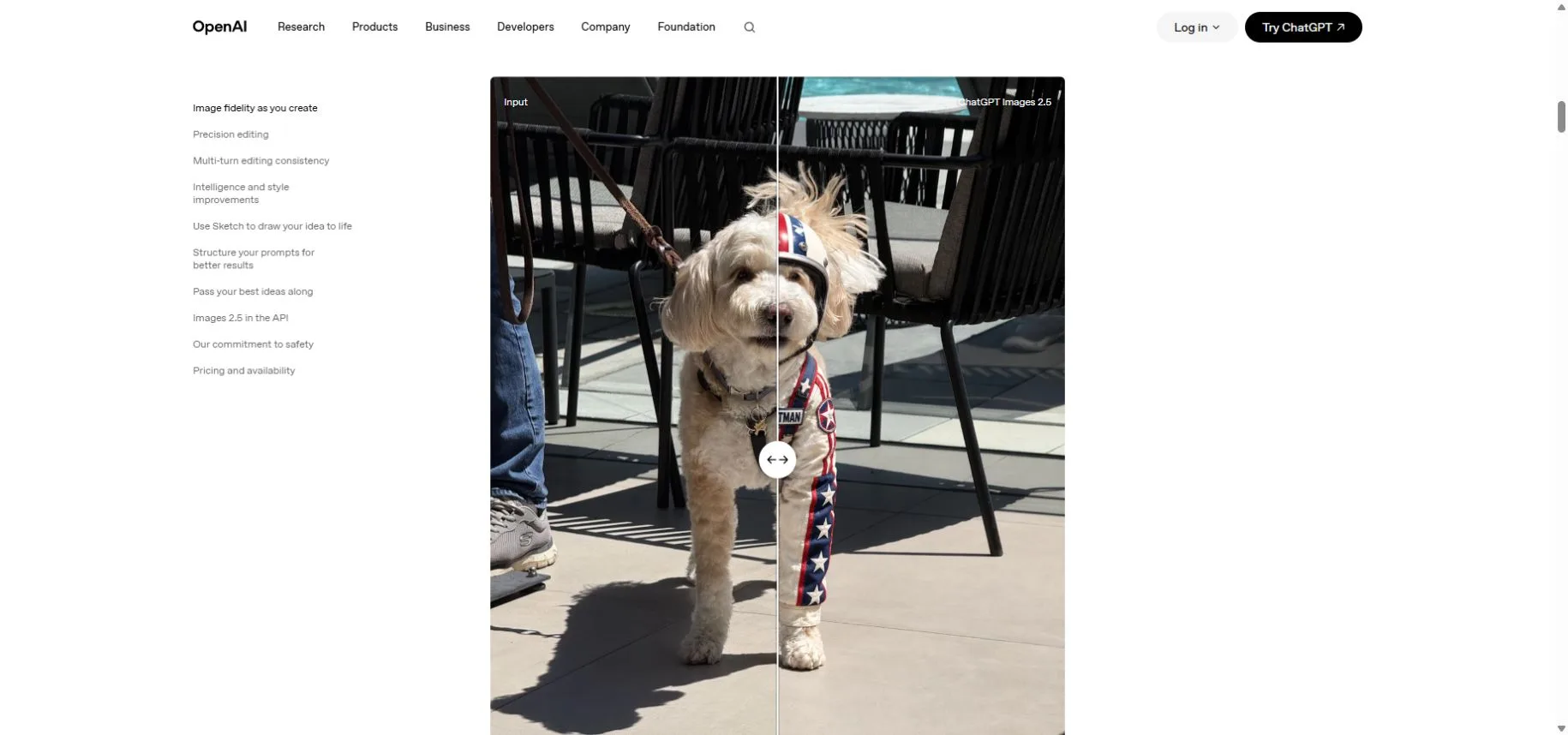
| Area | What matters in practice | Check before delivery |
|---|---|---|
| Reference fidelity | Keeping a person or product recognizable while changing its setting. | Logo shape, facial features, packaging edges and fine accessories. |
| Localized edits | Changing one requested element without restyling the whole image. | Compare the untouched areas with the approved original. |
| Multi-turn editing | Building a finished asset through successive instructions. | Look for accumulating shifts in color, geometry and identity. |
| Text and layout | Using a brief that specifies copy and hierarchy. | Proofread every word; exact typography is still a delivery requirement. |
| Generation speed | Reducing the time spent on exploratory variants. | Record the full edit cycle, retries and review time. |
The surrounding ChatGPT tools also matter: Templates help structure a starting brief, Sketch turns a mobile drawing into a reference, and image comments make edits easier to point out. These are product-interface features, not standalone proof of a stronger model. The help page also warns that edits can extend outside a selected area. Images in ChatGPT help.
For photorealistic advertising, judge material texture and believable light rather than simply counting detail. For anime or illustrated characters, prioritize the face, costume and line style across revisions. No evidence cited here establishes a universal winner for either style. For dense Japanese text, legal copy or a precise brand font, keeping final typesetting in a layout editor is the more dependable production choice.
What editors and users are saying
Axios found better likeness preservation in early testing. TechRadar’s hands-on review praised targeted editing but found the growing interface crowded. Its observations concern the whole editing experience, so they should not be treated as a clean comparison of base-model quality.
The Reddit launch discussion is mixed: some users describe less rigid expressions or faster output, while one reports a template putting clarification questions into the image. Others are unsure which version their account received. These are useful failure cases, not a representative survey or confirmed model-by-model test.
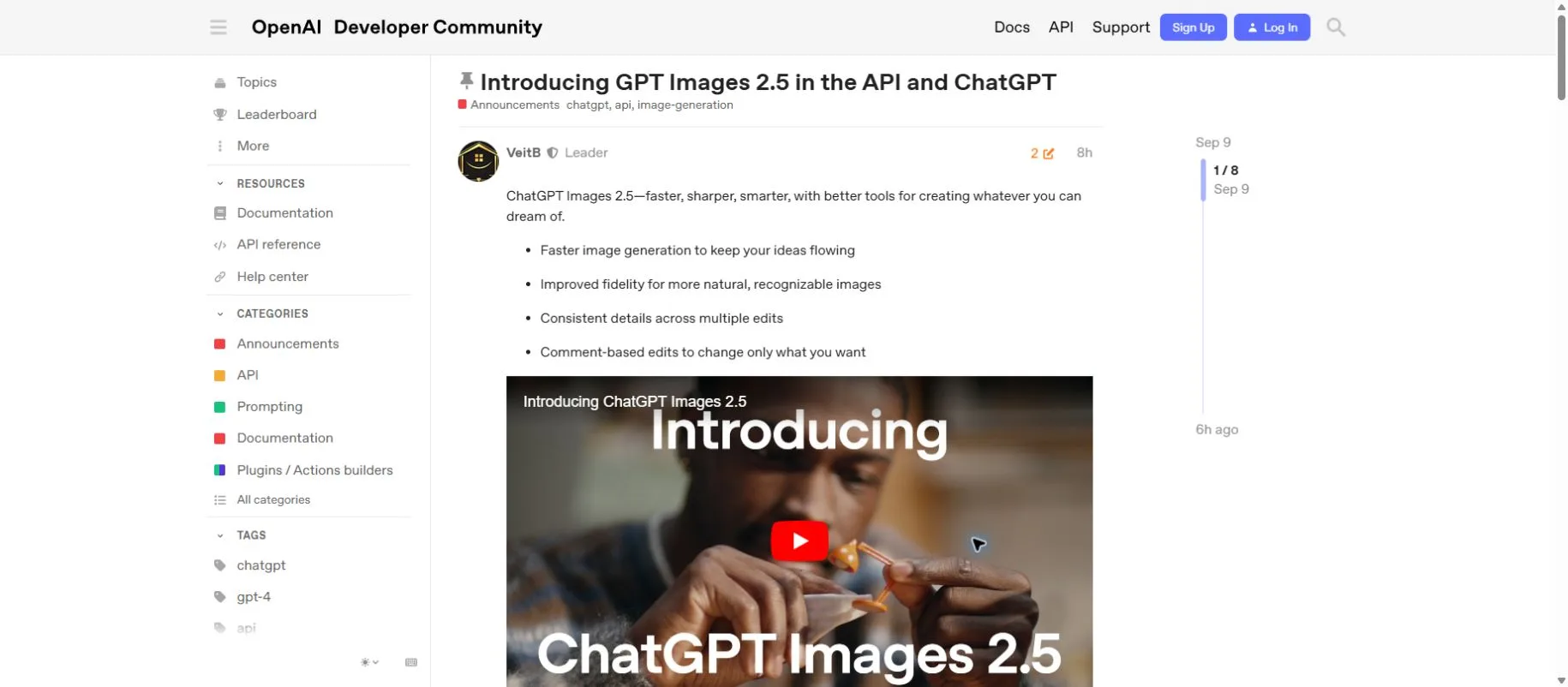
In the OpenAI Developer Community thread, users question how equal token rates translate into actual bills. That is a useful distinction: a community reply is not an official price promise, and a price per token does not disclose the number of tokens your image will consume.
The early evidence supports trying the editing workflow. It does not support claims such as perfect text, zero identity drift or guaranteed superiority over every competitor. Save the prompt, reference, model identifier and settings with each trial so that a rollout or interface difference does not become a false quality conclusion.
Where to use GPT-Image-2.5 online and through an API
| Service | Official access | What to know |
|---|---|---|
| ChatGPT | Open ChatGPT | The simplest conversational route; use Images or ask for an image. |
| OpenAI API | OpenAI developer platform | Select the exact Flare or Sunburst model ID; API billing is separate. |
| fal.ai | Sunburst image editing endpoint | A third-party API and playground route; verify endpoint, billing and account limits. |
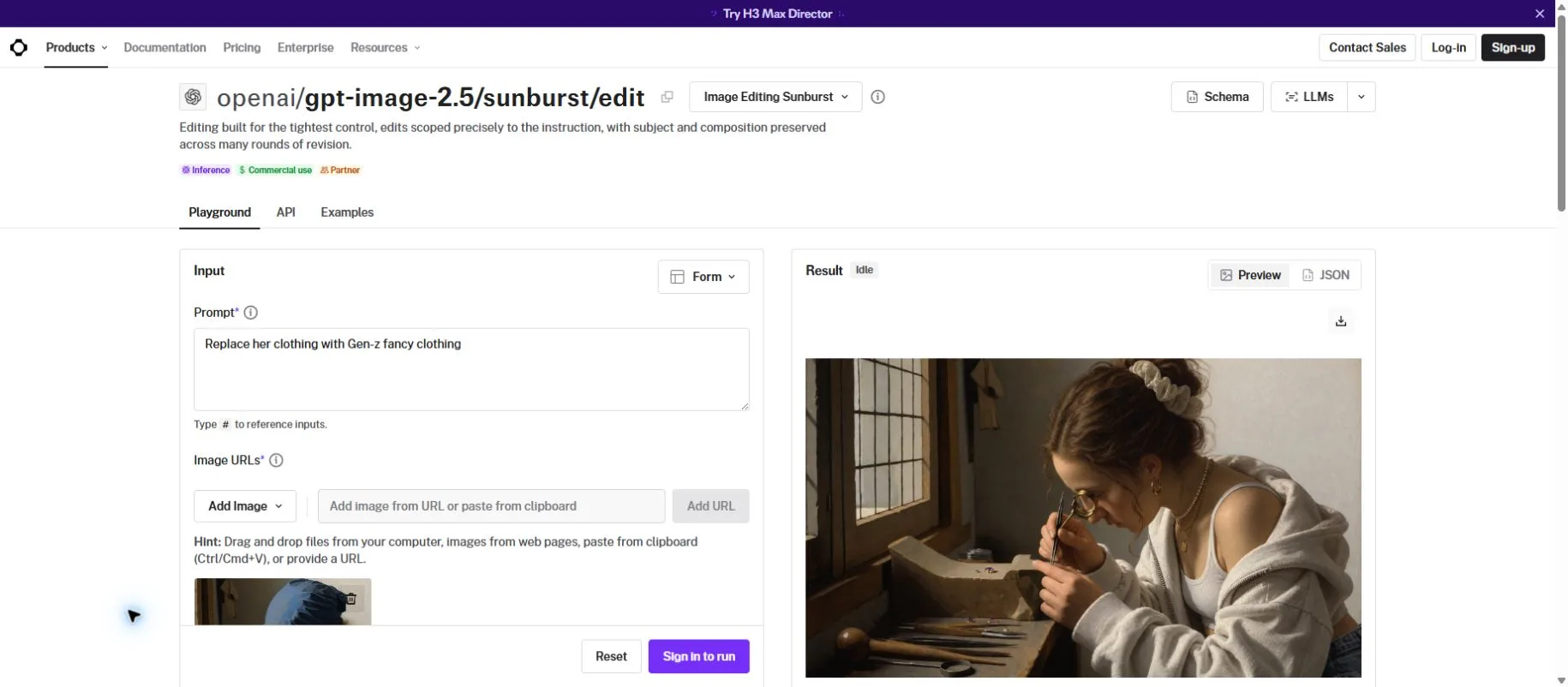
The fal listing identifies a GPT-Image-2.5 Sunburst edit endpoint. Do not assume that every similarly named third-party model page uses the same backend or settings. Its older GPT Images 2.0 example-price table should not be read as a guaranteed 2.5 quote.
ChatGPT Images is available across tiers; thinking-enabled images have a narrower plan rollout. Web and mobile access can differ, and Templates are not yet available in Work mode according to the current help page. For a repeatable integration, use the exact API identifier rather than inferring the model from a conversational answer.
GPT-Image-2.5 pricing: equal token rates do not mean equal image costs
ChatGPT Free has limited image generation. OpenAI lists ChatGPT Plus at US$20 per month; it is a subscription to the app, not a bundle of API credits. Limits can vary, and local taxes and checkout currency can affect the amount charged. Consult the current plan comparison for the account you will use.
| API usage | Flare and Sunburst, per 1M tokens |
|---|---|
| Text input | $5.00 |
| Cached text input | $1.25 |
| Image input | $8.00 |
| Cached image input | $2.00 |
| Image output | $30.00 |
These are the listed rates for Flare and Sunburst. They match GPT Image 2 token rates, but image size, quality, references and model behavior can change consumption. With the Responses API, the orchestrating text model can add its own charges. Use the 2.5 model settings in the image generation pricing guidance and inspect actual usage.
Illustrative calculation, not a measured image price: 1,000 text-input tokens plus 2,000 image-output tokens would cost $0.005 + $0.060 = $0.065. Reference-image inputs, orchestration and retries are excluded. One hundred requests with exactly that usage would be $6.50; real projects will vary.
The useful budget metric is cost per approved asset. Track all rejected candidates and follow-up edits, not just the cheapest first generation. API throughput depends on the account’s rate limits; a ChatGPT subscription and an API spending limit control different things.
GPT-Image-2.5 vs Nano Banana, Midjourney and FLUX.2
These are alternative workflows to shortlist, not results from a shared benchmark. Prices below use different units and cannot establish a cheapest model without matching resolution, input images, quality and revision count.
| Model/service | Reason to compare | Published price example |
|---|---|---|
| GPT-Image-2.5 | Conversational editing; Flare/Sunburst choice. | Token-based; see the table above. |
| Nano Banana 2 / Pro | Google image generation, reference editing and structured visual tasks. | 2: $0.067 for 1K output; Pro: $0.134 for 1K/2K output, plus inputs. |
| Midjourney V8.2 | Aesthetic exploration and a dedicated creative workflow. | Basic $10/month; Standard $30/month, billed monthly. |
| FLUX.2 [pro] / [max] | Production API and reference-based generation. | [pro] text-to-image from $0.03/MP; [max] from $0.07/MP. |
Google Nano Banana 2 and Nano Banana Pro
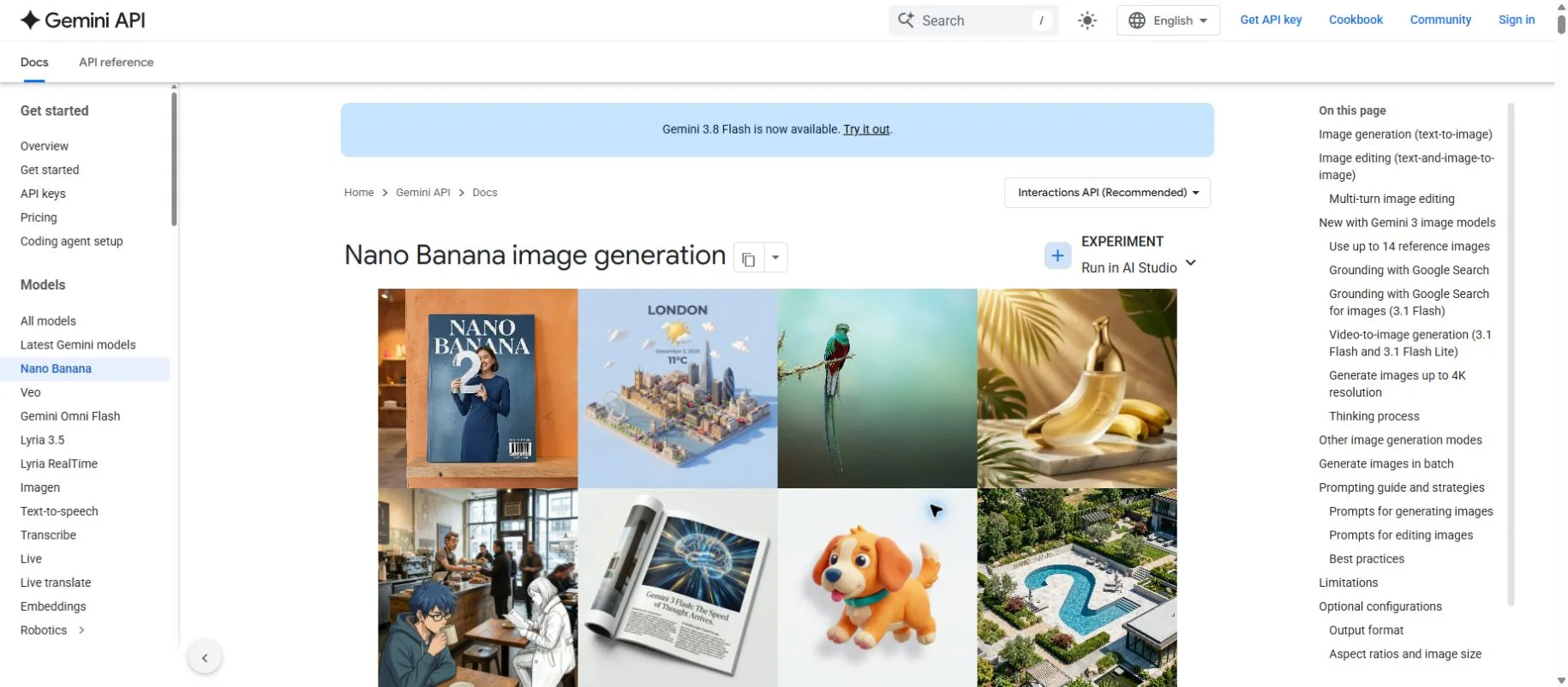
Gemini is the consumer entry point; Google AI Studio provides developer access. Google’s image guide covers reference images, multi-turn editing and search grounding. This makes the family worth testing when a brief combines visual generation with information that must be checked.
The API pricing table lists Nano Banana 2 output at $0.067 for 1K and $0.101 for 2K, and Nano Banana Pro at $0.134 for 1K/2K, before applicable inputs. Do not equate those API prices with a Gemini subscription’s allowance. Compare the finished output and factual accuracy with GPT-Image-2.5 rather than assuming grounding makes every label correct.
Midjourney V8.2
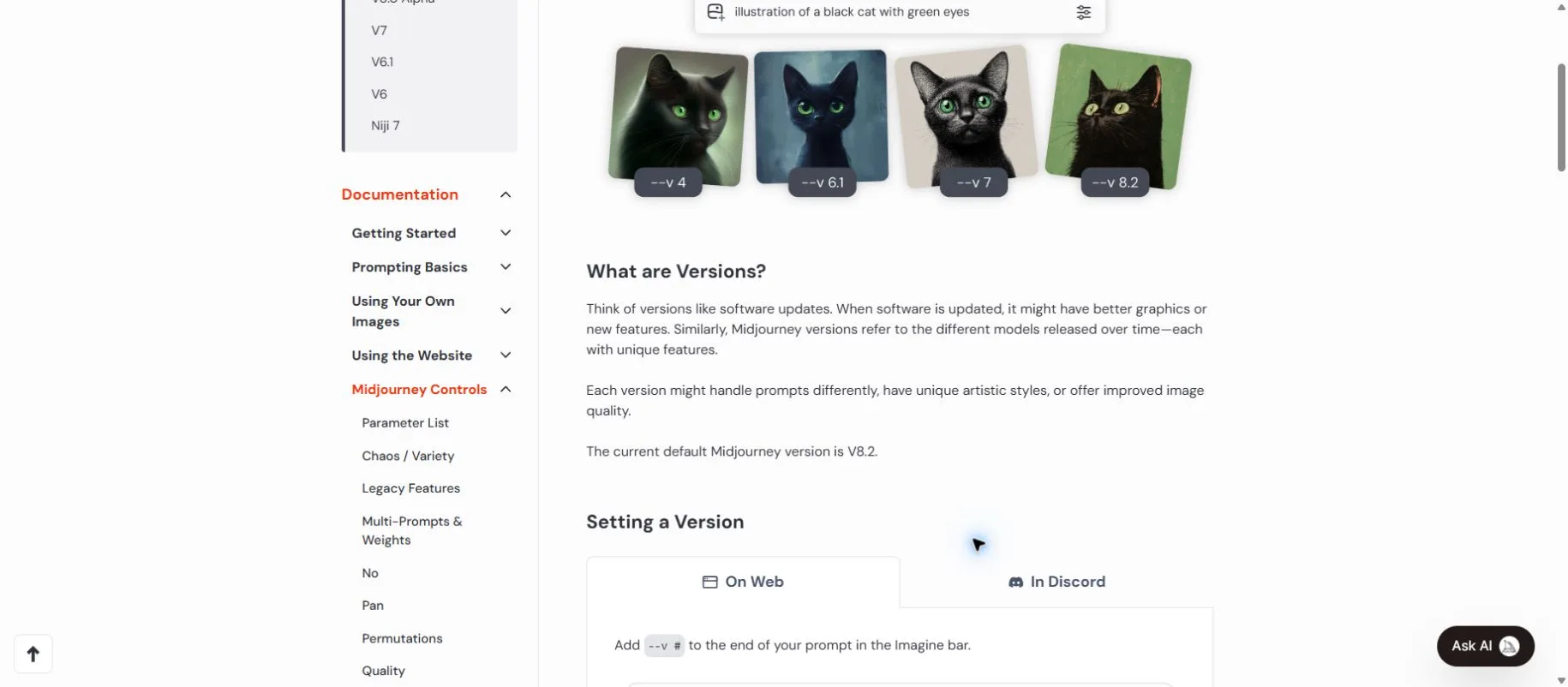
Midjourney’s version documentation identifies V8.2 as the current default. Its aesthetic and personalization controls make it a useful alternative for concept exploration. Designers who enjoy developing a visual direction through variations may prefer this workflow; that is a fit judgment, not evidence that it wins every realism or anime test.
Monthly plans start at $10 for Basic. Standard is $30 and includes Relax image generation; queue-based Relax use differs from reserved Fast time. Midjourney does not offer a general public API, apart from explicitly permitted exceptions described in its guidelines. A site selling a “Midjourney API” is not automatically an official integration.
FLUX.2 [pro] and [max]
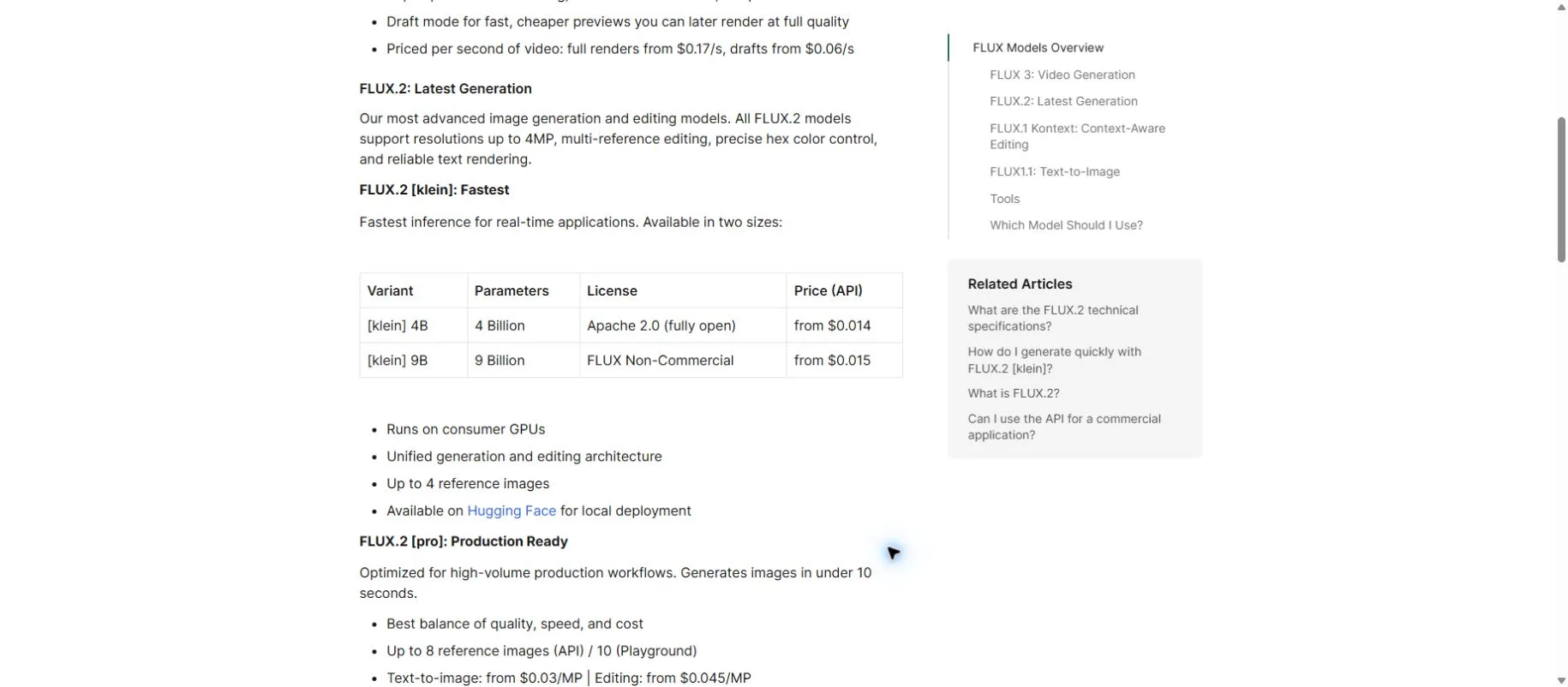
Black Forest Labs positions FLUX.2 [pro] for production and [max] for higher-end generation, with multi-reference workflows. The official dashboard is the starting point for its API and tools. These online models should be evaluated separately from downloaded FLUX checkpoints.
Published starting prices are $0.03 per megapixel for [pro] text-to-image and $0.045 per megapixel for editing; [max] starts at $0.07 per megapixel. The unit matters: a larger image or a reference-heavy edit is not the same purchase as a minimal text-only request. For automation, compare both models with the same real asset batch and track successful outputs per dollar.
Does GPT-Image-2.5 support NSFW images?
It is not an unrestricted adult-image generator. OpenAI’s 2.5 safety evaluation describes layered checks on prompts, inputs and outputs, including sexual-content safeguards. A rare unsafe output in adversarial testing is a safety failure, not an advertised feature or a usable success-rate estimate.
| Service | Practical policy reading |
|---|---|
| GPT-Image-2.5 | Do not choose it for explicit pornography or sexual deepfakes. Context and image content affect moderation. |
| Google Gemini image models | Google policy prohibits pornography/sexual-gratification content, with contextual exceptions such as educational or artistic uses. |
| Midjourney | SFW-only guidelines prohibit adult nudity and gore, including in private or Stealth use. |
| BFL online FLUX | Usage policy prohibits unlawful and non-consensual intimate content; moderation rules and the specific endpoint/provider determine further handling. Do not assume all adult content is permitted. |
NSFW is an imprecise label. An ordinary fashion photograph, a medical illustration and explicit pornography are different requests. Do not infer a policy from a single accepted or rejected example, and do not assume that switching to a reseller removes the underlying provider’s restrictions.
Recommended uses—and a practical way to test the upgrade
- Product and campaign edits: test whether the approved product remains unchanged while the environment or copy is revised.
- Social graphics and presentations: use conversational feedback to refine hierarchy, then proofread small text and numbers.
- Character and illustration exploration: compare several scenes for identity and costume consistency rather than judging one attractive image.
- Creative production APIs: route routine drafts to Flare, and trial Sunburst on edits that fail your acceptance criteria. Confirm the economic benefit with actual usage.
Use one original reference image and a fixed brief. First change only the background. Next replace a short headline. Then ask for three more small edits while preserving everything already approved. Repeat this with each candidate model at the intended delivery resolution. Count wrong letters, unintended changes, rejected outputs, elapsed time and the total bill.
A useful prompt starts with the action, names the protected elements and provides exact copy: “Replace only the background with a pale blue studio wall. Preserve the bottle shape, label text, camera angle and shadow direction. Add the headline SUMMER EDITION at the top; do not add other words.” This is a suggested test prompt, not a promise of pixel-perfect preservation.
Frequently asked questions
Is GPT-Image-2.5 officially released?
Yes. OpenAI announced Images 2.5 on September 8, 2026. Access and interface features can still roll out by account and platform, so not seeing a new control immediately does not prove that the release is unofficial.
Should I choose Flare or Sunburst?
Start with Flare when you need many routine iterations. Trial Sunburst for edits where preserving reference details is critical. Keep it only if the better acceptance rate justifies the latency and actual token usage on your work.
Can I use it for free?
ChatGPT offers limited image generation on Free. That does not mean unlimited output, free API requests or identical access to every thinking-enabled feature. Check your account’s current controls and limits.
Does Plus include the API?
No. ChatGPT Plus and OpenAI API billing are separate. A third-party provider also has its own billing, so check where the request is actually sent before comparing costs.
Is Japanese text now guaranteed to be correct?
No such guarantee is established by the evidence in this review. Specify exact wording and inspect punctuation, kanji, small labels and line breaks. For text that must be exact, compose final lettering in a design editor.
Can it generate video or unrestricted NSFW content?
The listed 2.5 models produce images, not audio or video. A promotional clip can show a sequence of images without indicating video support. Sexual-content moderation remains in place; this is not an unrestricted NSFW service.
Verdict: evaluate the edit cycle, not just the first image
GPT-Image-2.5 deserves a place on a creative team’s shortlist when much of the work involves correcting, adapting and approving images. Flare is the sensible starting point for routine production; Sunburst is a candidate for the difficult edits that cost more human time. The strongest buying argument is fewer failed revisions, and that needs to be checked with your own references.
Keep Nano Banana, Midjourney and FLUX.2 in the comparison when their workflow, aesthetic controls or API economics suit the job. Start with a small matched sample, use current prices and record total cost per usable asset. For exact typography or final brand compliance, retain a human review and a conventional finishing step.
Related Reviews
5 Best Video Quality Enhancers in 2026: AI Upscaling Compared

Seedance 2.5 Review: 30s, 4K and Audio AI Video Generation in Dreamina
Qwen 3.8 Review: Benchmarks, Local Setup, GPU Requirements and NSFW Policy
ERNIE-Image Review: Open-Source Image AI, LoRA, Local Setup and NSFW Policy
MOSS-Image Review: Text, Layout Control, NSFW, VRAM and ComfyUI
Tsubaki.3 Review: Anime, Manga, Pricing & NSFW (2026)