The Power of Iteration: How AI 3D Tools Are Changing the Way Creators Experiment
Discover how AI 3D tools like Hi3D are transforming creative iteration by helping creators quickly explore different shapes, textures, colors, design directions, and 3D-printable prototypes.

Good design rarely appears in its final form on the first attempt.
Whether someone is creating an object, developing a visual concept, designing a prop, or preparing a digital asset, the first idea is usually only a starting point. Designers make changes, compare alternatives, remove unnecessary details, try different styles, and sometimes return to an earlier version before arriving at something they are happy with.
The difficult part is that experimentation can become expensive when every variation requires hours of manual work.
This is one area where AI-assisted 3D creation is changing the creative process.
Instead of treating 3D modeling as a linear activity—start with an idea, build a model, finish the model—creators can use AI to produce starting points and explore multiple directions more quickly.
Hi3D is one example of this approach. Its collection of AI-powered 3D tools allows creators to experiment with models, textures, reliefs, colors, and printable structures without requiring every variation to be built manually from the beginning.
The real value is not simply generating a model faster.
It is making experimentation easier.
Table of Contents
- Why Iteration Matters in Creative Work
- Moving From “Final Design” to “Starting Point”
- Creating Multiple Directions From One Idea
- Iteration Does Not Mean Random Generation
- Exploring Shape Before Detail
- Surface Style Can Be Another Variable
- Color Can Change the Entire Impression
- Learning Through Failed Versions
- Faster Experiments Can Encourage More Ambitious Ideas
- Iteration Is Especially Useful for Beginners
- From One Version to a Better Version
- When the Design Needs to Become Physical
- Keeping Creativity in the Driver’s Seat
- Building a More Flexible Creative Process
- The Future of 3D Creation May Be More Experimental
Why Iteration Matters in Creative Work
Design is often described as a process of solving problems.
But before a problem can be solved, creators usually need to discover what works and what does not.
A designer may have an initial concept that looks good in their head but feels unbalanced once visualized. Another idea may have the right overall shape but lack an interesting surface. A third version might look appealing but be impractical for its intended purpose.
These discoveries are difficult to make without experimentation.
The more costly each experiment becomes, the more tempting it is to settle for the first acceptable result.
AI can change that equation.
When creating a preliminary 3D concept becomes faster, creators can afford to explore more possibilities before committing to a final direction.
Moving From “Final Design” to “Starting Point”
Traditional 3D modeling often encourages creators to think about the final object from the beginning.
You establish the shape, build the geometry, refine the details, apply materials, and eventually produce the finished asset.
AI-generated models can work differently.
The first model does not have to be treated as the final answer.
It can simply be Version 1.
That mindset can make a significant difference.
Instead of asking whether the generated model is perfect, the creator can ask:
What works about this version?
What needs to change?
What should be preserved?
What could be approached differently?
Once the model is viewed as a starting point rather than a finished product, experimentation becomes a natural part of the workflow.
Creating Multiple Directions From One Idea
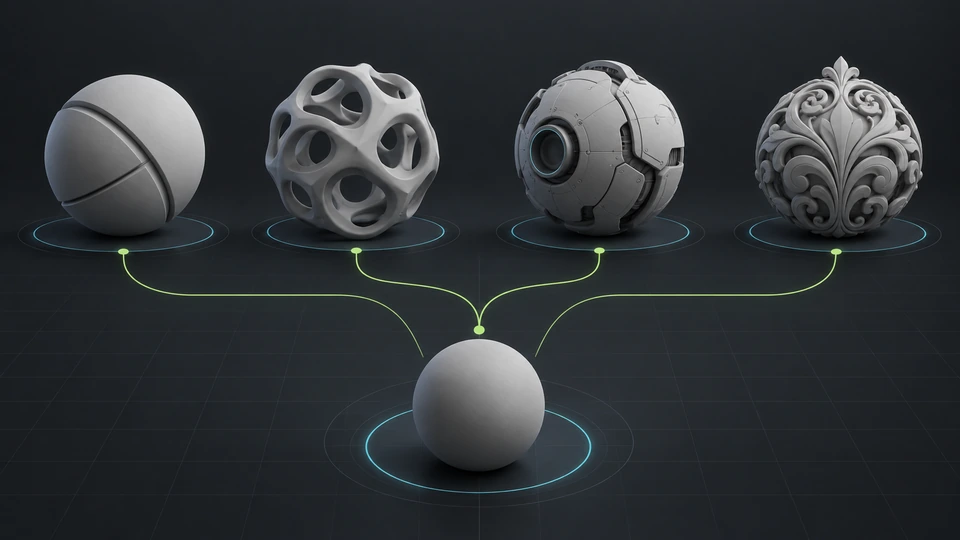
One creative concept can often be interpreted in several ways.
Suppose a creator has a basic visual idea for an object. One version could emphasize a clean and simple form. Another could exaggerate certain proportions. A third could use a more decorative style.
With conventional modeling, exploring all three possibilities can require considerable time.
AI-assisted generation can make early-stage exploration less demanding.
The creator can test an initial direction, evaluate it, and then try another approach rather than spending most of the project refining a single interpretation.
This is especially useful during the concept stage, when the goal is not yet to produce a production-ready asset.
The question at this point is simply:
Which direction is worth developing further?
Iteration Does Not Mean Random Generation
There is an important distinction between iteration and repeatedly clicking a generation button.
Useful iteration requires decisions.
A creator needs to understand why a particular version is more interesting than another. They need to recognize which visual characteristics are essential and which can change.
For example, one model may have a strong overall silhouette but weak surface detail. Another may have appealing details but an awkward shape.
Comparing these versions helps the creator identify what they actually want.
AI provides the variations.
The human creator provides the judgment.
This division of roles can make AI more useful than simply asking it to “make something.”
Exploring Shape Before Detail
One advantage of working with multiple versions is that creators can separate different design questions.
The first question might be about overall form.
Is the object too tall?
Is the silhouette too complicated?
Does the shape feel balanced?
Only after these questions are answered does it make sense to spend significant effort on small details.
AI 3D generation can help create rough forms quickly, allowing creators to evaluate the larger structure before becoming attached to small features.
This can prevent a common design problem: spending a lot of time polishing a concept that does not work at the structural level.
Surface Style Can Be Another Variable
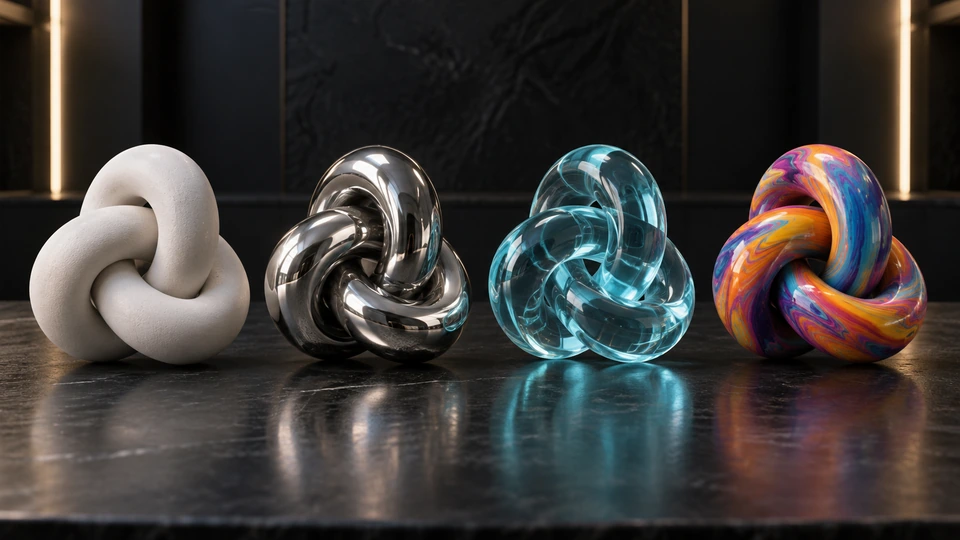
Once the basic form works, creators can experiment with appearance.
A model might look completely different depending on its texture.
A realistic material can make an object feel physical and grounded. A stylized texture can make the same geometry feel more artistic or illustrative.
Hi3D includes tools for generating both realistic and stylized textures, giving creators another variable to experiment with after the underlying model has been created.
This creates a useful separation between form and style.
Instead of rebuilding the object whenever the visual direction changes, creators can explore how different surface treatments affect the same general concept.
That can be particularly useful when developing visual ideas that have not yet settled on a particular aesthetic.
Color Can Change the Entire Impression
The same principle applies to color.
A model with a neutral appearance can communicate something completely different when its colors are changed.
Color can make an object look playful, technical, minimal, traditional, futuristic, or decorative.
For projects involving multiple colors, Hi3D’s multi-color printing functionality can also be used to explore how different color regions might translate into a physical object.
The important point is not the specific feature itself.
It is the ability to treat color as something that can be tested rather than something that must be decided permanently at the beginning.
Learning Through Failed Versions
Not every iteration will improve the design.
That is normal.
In fact, unsuccessful versions can provide some of the most useful information.
A model may reveal that an idea that sounded interesting does not work visually. Another version may show that adding more detail actually makes the object less appealing.
These failures narrow down the possibilities.
This is similar to sketching. An artist does not expect every sketch to become a finished artwork. Sketches exist partly to explore ideas.
An AI 3D model maker can play a similar role.
AI-generated 3D models can function as digital sketches that help creators see possibilities that are difficult to imagine purely in their heads.
Faster Experiments Can Encourage More Ambitious Ideas
When experimentation becomes easier, creators may also be willing to consider ideas they would otherwise ignore.
A complicated concept might seem too time-consuming to model manually.
A highly unusual variation might not seem worth building.
A completely different style might be abandoned because testing it would require starting over.
AI can lower the cost of these experiments.
The creator can test an unconventional direction without necessarily committing a large amount of time to it.
Sometimes the experiment will fail.
But occasionally, it can reveal a better idea than the original plan.
Iteration Is Especially Useful for Beginners
Experienced 3D artists already understand how to iterate.
They can build rough models, make changes, test materials, and refine their work through repeated cycles.
Beginners may have a different problem.
They often do not yet know how to translate an idea into geometry.
This can make the first step particularly difficult.
AI-generated starting points can give beginners something concrete to evaluate.
Instead of staring at an empty 3D workspace, they can begin with an existing result and ask what they would change.
That creates a more approachable learning experience.
The beginner is still developing design judgment, but the initial technical barrier can be lower.
From One Version to a Better Version
A productive AI 3D workflow can therefore be thought of as a series of decisions.
Start with an idea.
Generate an initial interpretation.
Inspect it from different perspectives.
Identify the strongest and weakest elements.
Change the direction.
Generate or modify another version.
Compare again.
Repeat until the concept becomes clearer.
This process may sound simple, but its significance lies in the change of mindset.
The goal is not to find the perfect generation on the first attempt.
The goal is to create a useful cycle between generation and evaluation.
When the Design Needs to Become Physical
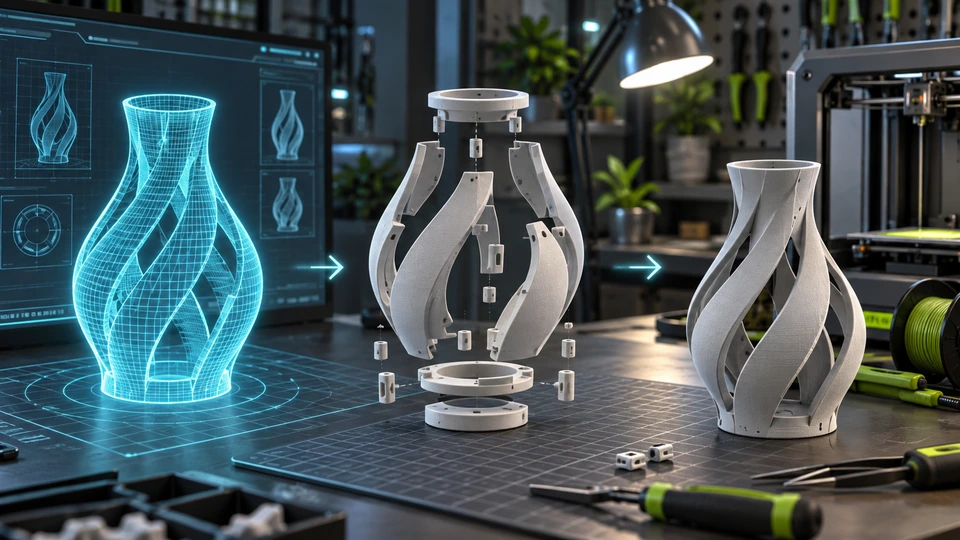
Iteration becomes particularly valuable when the final concept will eventually be manufactured.
A design that looks good digitally may still need changes before it becomes a physical object.
Parts may need to be separated. Certain structures may need to be strengthened. The overall dimensions may need adjustment.
Hi3D’s Split-to-Print feature can split a 3D model for printing into printable sections and add connectors for assembly, providing another step between digital experimentation and physical production.
This means creators can treat physical production as another stage of iteration rather than the final step that happens only once.
A prototype can reveal new problems.
Those problems can lead to another design revision.
The cycle continues.
Keeping Creativity in the Driver’s Seat
There is sometimes a misconception that AI tools make creative decisions on behalf of the user.
In practice, their value can be understood differently.
AI can make it easier to produce possibilities, but possibilities are not decisions.
A generated model does not automatically know which version best matches a creator’s intention.
That still requires human judgment.
The creator decides which shape feels right, which details matter, whether a texture fits the concept, whether the colors communicate the intended idea, and whether the final object is appropriate for its purpose.
AI can accelerate the distance between one decision and the next.
It does not eliminate the need to make those decisions.
Building a More Flexible Creative Process
The biggest change brought by AI 3D generation may therefore be less about individual features and more about workflow.
Instead of thinking:
Idea → modeling → final result
creators can think:
Idea → experiment → evaluate → revise → experiment again
This is a much more flexible process.
It accepts that creative work is uncertain.
It gives creators permission to test ideas before committing to them.
And it makes unsuccessful experiments less costly.
Hi3D fits naturally into this approach because its tools extend beyond basic model generation. Creators can explore geometry, surface appearance, reliefs, colors, printable structures, and different output formats as their ideas develop.
The Future of 3D Creation May Be More Experimental
For a long time, 3D creation has been associated with precision and technical expertise.
Those qualities will remain important.
But the creative process does not always begin with precision. It often begins with curiosity.
What would this idea look like?
What if the shape were different?
What if the style changed?
What if the object were larger?
What if two concepts were combined?
The easier it becomes to ask these questions visually, the more opportunities creators have to discover unexpected answers.
That may be one of the most meaningful roles for AI in 3D creation.
Not simply making the final model faster, but making it easier to explore the many versions that come before it.
After all, creativity is rarely a straight line.
Sometimes the best design is the one you discover while trying to make something else.
Latest Reviews
Tsubaki.3 Review: Anime, Manga, Pricing & NSFW (2026)

How to Turn Emails into Tasks with AI: A Practical Follow-Up Workflow
Step 5 Preview Review: Pricing, API Access, Open Weights and NSFW Limits
How to Manage Multiple Email Accounts: Separate Inboxes, Aliases, or One App?
5 Best Project Tracking Software Tools in 2026
How to Organize Gmail: Filters, Labels, and a Practical Inbox Zero Workflow