Best 9 AI Content Detectors in 2026
Compare the best AI content detectors in 2026 for educators, publishers, SEO teams, and businesses, including features, pros, cons, and use cases.


AI writing is now part of everyday work. Students use it to draft essays, marketers use it to speed up blog production, and teams use it to clean up emails, reports, and product copy. That does not mean every AI-assisted draft is bad. But it does mean teachers, editors, publishers, and businesses need better ways to understand where content came from.
That is where AI content detectors come in. These tools scan text and estimate whether it was likely written by a person, generated by AI, or heavily edited with AI. They are useful, but they are not courtroom evidence. The best way to use them is as a signal, not a final verdict.
Below are eight of the best AI content detectors in 2026, starting with AirMore AI Detector for a quick browser-based text check, then moving into specialist tools for education, publishing, enterprise review, and fast second opinions.
Table of Contents
- How I Chose the Best AI Content Detectors
- Best AI Content Detectors at a Glance
- 1. Clever AI Detector
- 2. AirMore AI Detector
- 3. Originality.ai
- 4. GPTZero
- 5. Copyleaks
- 6. Turnitin
- 7. Winston AI
- 8. Sapling AI Detector
- 9. ZeroGPT
- Which AI Content Detector Should You Choose?
- FAQ
How I Chose the Best AI Content Detectors
I looked at tools that are still widely used in 2026 and serve different needs: academic review, SEO content checking, publishing workflows, enterprise compliance, quick free scans, and writing transparency.
The most important factors were detection quality, false-positive risk, plagiarism features, reporting detail, integrations, API access, ease of use, and whether the tool explains its result clearly enough for a human reviewer to make a fair decision.
Best AI Content Detectors at a Glance
| Tool | Best For | Key Features | Pros | Cons |
|---|---|---|---|---|
| Clever AI Detector | Quick Online AI content detection | Analyzes text to estimate whether content may be AI-generated | Simple and straightforward for quick content checks | Results should be treated as an indicator rather than definitive proof |
| AirMore AI Detector | Fast browser-based AI text checks | Paste text or upload TXT, MD, PDF, and DOCX files; estimated AI score; sentence-level highlights | Free, direct, and easy to use without a complex dashboard | Best used as a signal, not proof of AI authorship |
| Originality.ai | SEO teams and publishers | AI detection, plagiarism checker, fact checker, team tools | Strong for web content workflows | Paid tool, not ideal for casual checks |
| GPTZero | Educators and writing review | AI probability, sentence highlights, writing reports | Clear reports and education focus | Can still produce false positives |
| Copyleaks | Enterprise and multilingual checks | AI detection, plagiarism, API, LMS integrations | Strong integrations and language support | Can feel heavier than simple tools |
| Turnitin | Schools and universities | AI writing report, similarity checking, LMS workflows | Built for academic integrity | Mostly institutional access |
| Winston AI | Agencies and high-volume scans | AI detection, plagiarism, OCR, reports | Useful for bulk content review | Accuracy varies by text type |
| Sapling AI Detector | Quick checks and developers | Fast AI score, browser-friendly tool, API options | Simple and lightweight | Less detailed than specialist platforms |
| ZeroGPT | Free quick scans | Paste-and-check AI score, simple report | Easy and accessible | Higher false-positive risk |
1. Clever AI Detector
Best for editors, publishers, and content managers
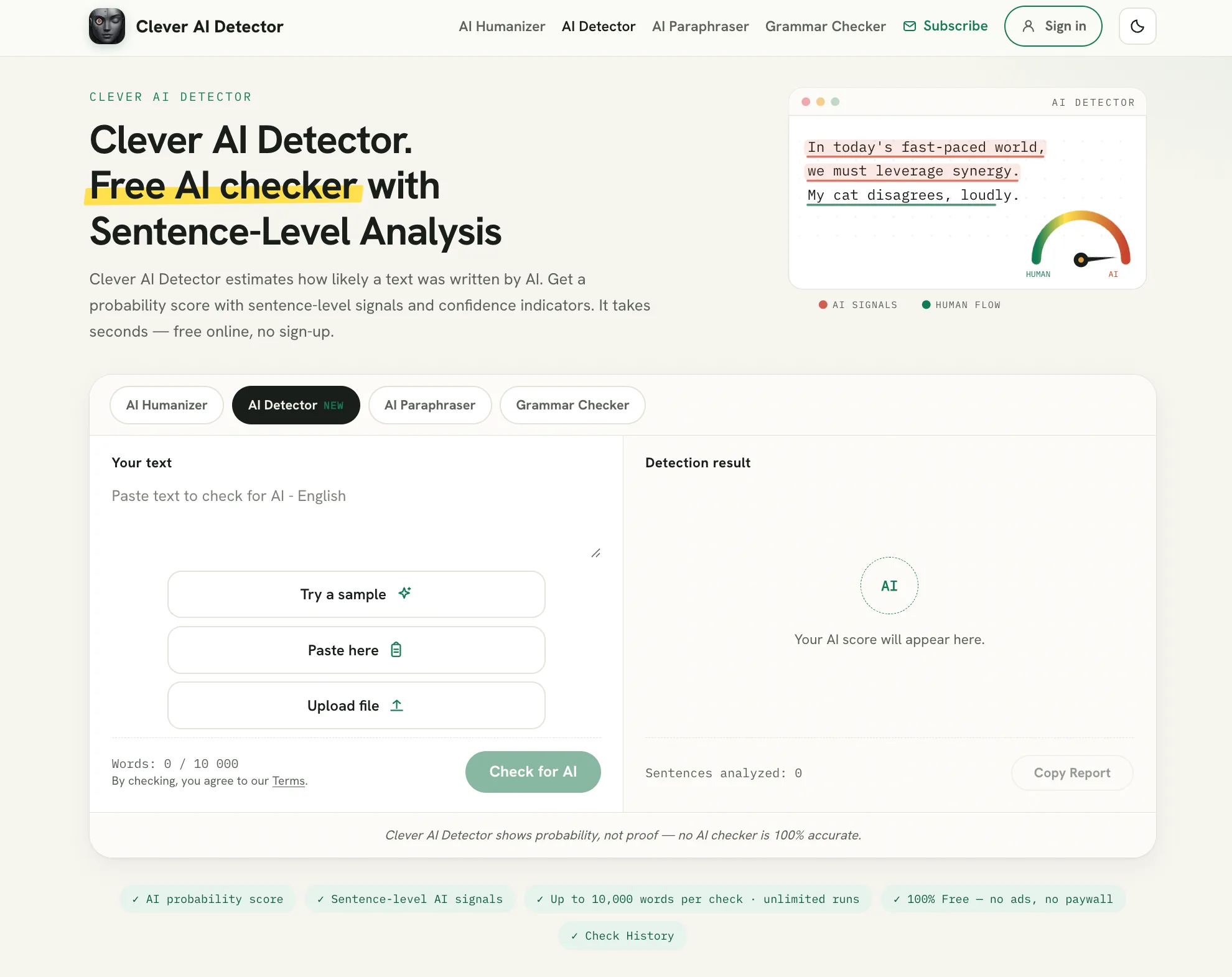
Clever AI Detector gives writers, editors, and publishers a free way to estimate how likely a text was written by AI, with sentence-level signals and confidence indicators shown right in the browser.
Clever AI Detector is a strong pick if you want a fast, no-sign-up AI text check that doesn’t hide useful details behind a paywall. Paste an essay, article, email, or chatbot draft and review an AI probability score alongside the exact sentences that triggered the AI signals. It handles up to 10,000 words per check with unlimited free runs, and it’s model-agnostic — it looks at how the text is written, not which chatbot produced it.
Pros: Clever AI Detector is 100% free with no ads or paywall, shows probability with confidence levels instead of fake certainty, and highlights sentence-level AI signals for transparency.
Cons: Like every AI detector, it should be treated as a probability signal rather than final proof that a person did or did not use AI.
2. AirMore AI Detector
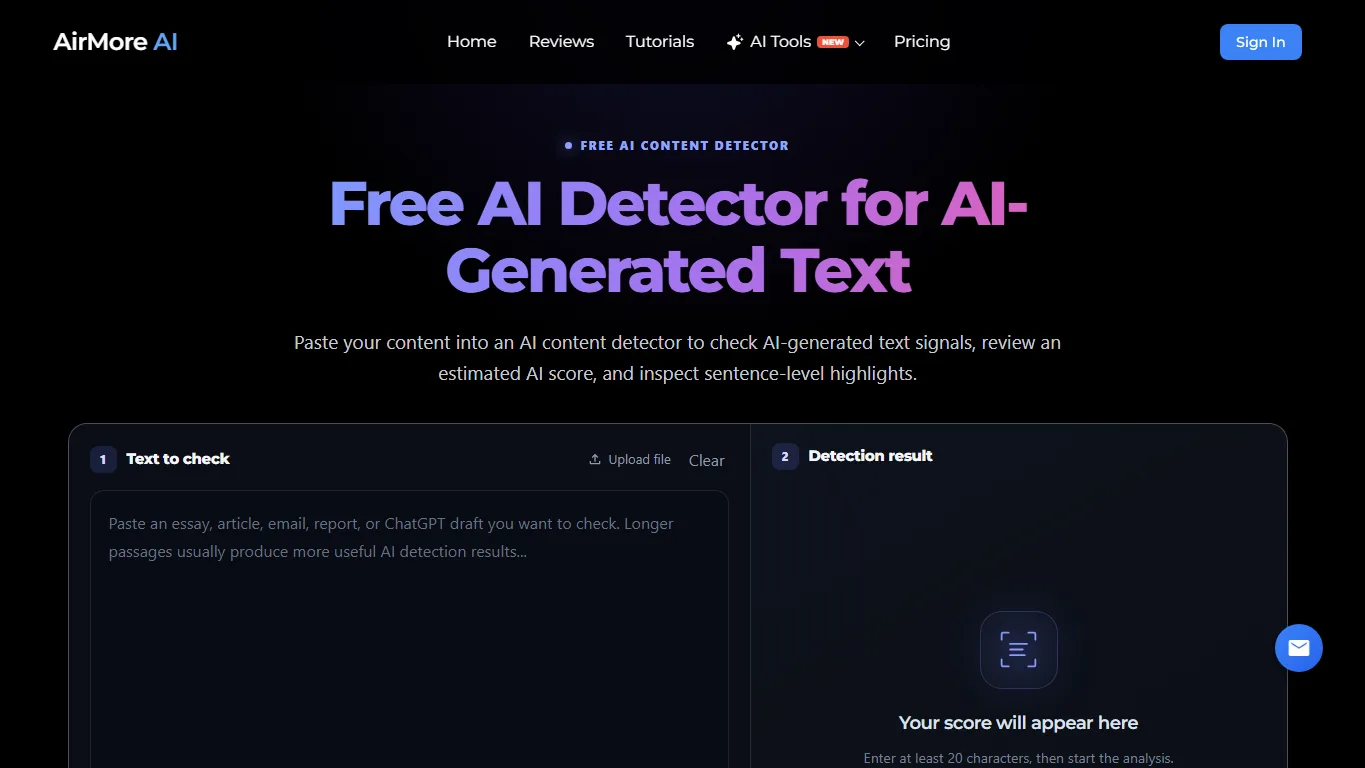
AirMore AI Detector is the most direct choice if you want a quick AI text check without opening a heavy editorial platform. You can paste an essay, article, email, report, or ChatGPT draft, then review an estimated AI score and sentence-level highlights.
The tool is especially useful for first-pass checks before publishing, submitting, or reviewing a draft. It also supports TXT, MD, PDF, and DOCX uploads, which makes it easier to check longer documents without manually copying every paragraph.
Pros: AirMore AI Detector is free to try, easy to understand, and practical for everyday AI writing checks.
Cons: Like every AI detector, it should be treated as a probability signal rather than final proof that a person did or did not use AI.
3. Originality.ai

Best AI content detector for SEO teams and publishers
Originality.ai is built for people who publish content at scale: SEO agencies, blog networks, affiliate publishers, editors, and content managers. It combines AI detection with plagiarism checking, readability tools, team management, and fact-checking features.
The platform is especially useful when you need to review freelance or outsourced content before it goes live. Instead of treating AI detection as a one-off scan, Originality.ai fits into a broader editorial workflow.
Pros: Originality.ai is strong for content teams because it combines AI detection, plagiarism checks, team tools, and publishing-focused reports.
Cons: It is not the cheapest option, and casual users may not need its full editorial feature set.
4. GPTZero

Best AI content detector for educators and writing review
GPTZero is one of the most recognizable AI content detectors, especially in education. It checks text for AI probability and can highlight sections that appear more likely to be AI-generated.
Its biggest strength is readability. Teachers, students, and reviewers can understand the report without needing to interpret a technical dashboard. GPTZero also puts emphasis on writing process and authorship, which matters because a simple AI percentage rarely tells the full story.
Pros: GPTZero has a clean interface, useful reports, and a strong education-oriented workflow.
Cons: Like every detector, it can misread polished human writing or edited AI text, so results should be reviewed carefully.
5. Copyleaks

Best AI content detector for enterprise and multilingual use
Copyleaks is more than a simple AI checker. It offers plagiarism detection, AI content detection, API access, LMS integrations, and support for broader originality workflows. It is often a better fit for institutions, platforms, and companies that need repeatable scanning rather than occasional checks.
Copyleaks is also useful when multilingual support and integrations matter. Teams can connect it to existing systems instead of copying and pasting text manually.
Pros: Copyleaks is strong for organizations that need AI detection, plagiarism checking, reporting, API access, and LMS integration.
Cons: It may be more complex than needed if you only want a quick yes-or-no scan.
6. Turnitin

Best AI content detector for academic institutions
Turnitin is already deeply embedded in schools, colleges, and universities. Its AI writing detection sits alongside similarity checking and academic integrity workflows, which makes it convenient for institutions that already use Turnitin.
The value is not just the detector itself. It is the surrounding system: submissions, reports, instructor review, similarity checks, and LMS integration.
Pros: Turnitin is built for academic review and fits naturally into institutional workflows.
Cons: It is not usually available as a casual public tool, and AI scores should not be treated as automatic proof of misconduct.
7. Winston AI

Best AI content detector for agencies and bulk review
Winston AI is designed for users who need polished reports and repeated content checks. It includes AI detection, plagiarism detection on some plans, OCR for scanned documents, and shareable reports.
It can be useful for agencies, editors, and businesses reviewing many documents from different sources. The interface is more structured than basic free detectors, which helps when you need to keep a record of checks.
Pros: Winston AI offers a professional interface, reporting, OCR, and useful workflow features for teams.
Cons: Detection quality can vary with short text, heavily edited AI drafts, or writing that follows a predictable style.
8. Sapling AI Detector

Best AI content detector for quick checks and developer workflows
Sapling’s AI Detector is a lightweight option for people who want a fast read on whether text may have been AI-generated. It is easy to use and better suited to quick checks than deep investigations.
Sapling also has developer-friendly tooling around writing assistance and APIs, so it may appeal to teams that want AI detection inside a broader product or internal workflow.
Pros: Sapling is fast, simple, and convenient for quick checks or lightweight integration.
Cons: The reports are not as detailed as tools built specifically for academic or editorial auditing.
9. ZeroGPT

Best AI content detector for free, fast scans
ZeroGPT is popular because it is simple. Paste text, run the scan, and get an AI probability-style result. For quick checks, that is often enough.
It is best used as a first pass. If ZeroGPT flags something important, it is smart to verify with a stronger tool and review the writing manually before making a decision.
Pros: ZeroGPT is accessible, quick, and easy for non-technical users.
Cons: It can be less reliable than more advanced tools, especially with short text, edited AI writing, or formulaic human writing.
Which AI Content Detector Should You Choose?
Choose AirMore AI Detector if you want a fast, free first-pass check in the browser. Choose Originality.ai if you run SEO or publishing workflows. Choose GPTZero if you work in education and need clear reports. Choose Copyleaks if you need API access, plagiarism detection, and multilingual support. Choose Turnitin if your school already uses it. Choose Winston AI if you review lots of documents and want polished reports. Choose Sapling for quick checks or lightweight integrations. Choose ZeroGPT if you need another free second opinion.
The best AI content detector is not the one that gives the harshest score. It is the one that helps you make a fair, informed decision.
FAQ
Are AI content detectors accurate in 2026?
They are better than they used to be, but they are still not perfect. False positives and false negatives happen, especially with short text, edited AI content, non-native English writing, and highly structured writing.
Can AI content detectors prove someone used AI?
No. They can provide a signal, not proof. A detector result should be combined with draft history, writing process, assignment context, editorial review, or other evidence.
What is the best AI content detector overall?
Originality.ai is strong for publishers and SEO teams, while GPTZero is a strong choice for educators. Copyleaks is better for enterprise and integration-heavy workflows.
Which AI content detector is best for schools?
Turnitin and GPTZero are the strongest education-focused choices. Turnitin is better for institutions already using its academic integrity tools, while GPTZero is easier to access independently.
What is the best free AI content detector?
AirMore AI Detector, ZeroGPT, and Sapling are useful for quick free checks. For higher-stakes decisions, it is better to compare more than one tool and review the result manually.
Can AI detectors catch paraphrased AI writing?
Sometimes, but paraphrased AI content is harder to detect. Many tools perform worse when AI text has been heavily rewritten or mixed with human edits.
Should publishers use AI content detectors?
Yes, but carefully. They are useful for quality control, plagiarism screening, and editorial review. They should not replace human editing or clear content policies.
Related Reviews
6 Best Voice Cloning Tools in 2026

GLM-5.3-Flash Review: Ox-Alpha, API Access, Benchmarks, and NSFW Limits

MiniMax H3 Image Studio Review: ComfyUI Images, Reference Editing & Video Workflow
Krea 2 Review: Is Krea's AI Image Model Worth Trying?
Pony V7 Review: AuraFlow, LoRA Ecosystem, V6 Comparison, and NSFW Strengths
Best 8 Online Course Platforms in 2026