5 Best Robot Lawn Mowers in 2026
Compare the five best robot lawn mowers of 2026 for small yards, large lawns, steep slopes, clean edges, and wire-free setup.
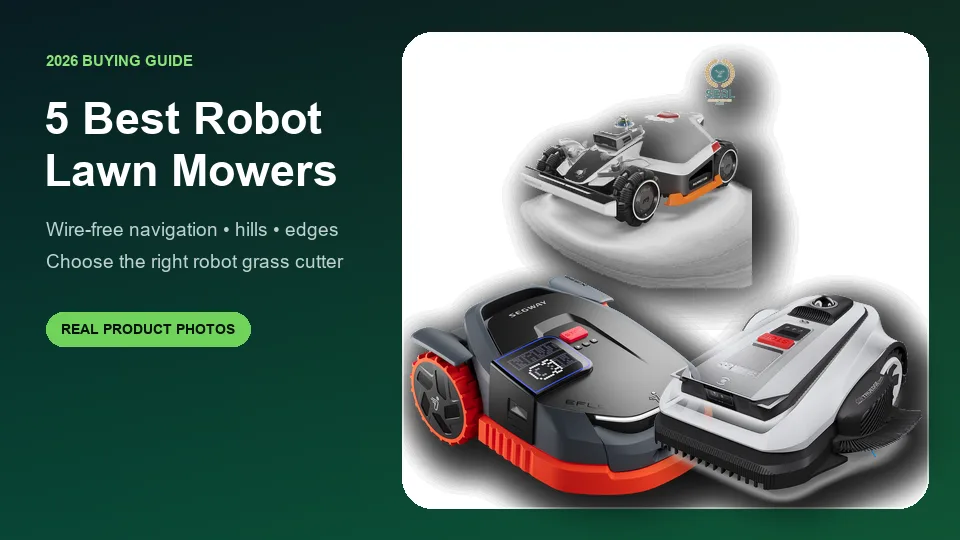

A good robot lawn mower should do more than move around the yard and trim grass. It needs to navigate reliably, stay inside the mowing area, avoid pets and garden furniture, handle the terrain, return to its charger, and leave a consistent finish without demanding daily attention.
The category has changed quickly. Many of the best robot lawn mowers in 2026 no longer require a buried perimeter wire. Instead, they combine satellite positioning, LiDAR, cameras, or several navigation systems at once. That makes setup easier, but it also makes choosing the right model more complicated. A mower that works beautifully on an open suburban lawn may struggle beneath dense trees, on soft ground, or along a steep bank.
This guide compares five leading models for different types of yards. Whether you call it a robotic mower, an autonomous mower, or a robot grass cutter, the best choice is the one that matches your lawn size, slope, obstacles, edge layout, and tolerance for setup.
The Best Robot Lawn Mowers at a Glance
- Best overall: Segway Navimow X330
- Best for steep or uneven lawns: Mammotion LUBA 3 AWD
- Best for close edge cutting: ECOVACS GOAT A3000 LiDAR PRO
- Best for established support and dealer access: Husqvarna Automower 410 iQ
- Best for simple setup without an RTK antenna: eufy E18
How We Evaluated the Best Robot Lawn Mowers
This is a documentation-led comparison rather than a claim that every mower was tested on the same lawn. We reviewed current manufacturer specifications, manuals, navigation systems, cutting hardware, app features, terrain limits, security functions, and maintenance requirements. We also considered how each design fits real-world yard conditions.
The most important criteria were:
- Navigation reliability: RTK, LiDAR, camera vision, virtual boundaries, and performance around trees or buildings.
- Lawn capacity: The recommended mowing area, not merely the largest map the app can store.
- Terrain handling: Maximum slope, traction, suspension, obstacle crossing, and behavior on soft turf.
- Cut quality: Cutting width, adjustable height, systematic patterns, and edge performance.
- Obstacle avoidance: The ability to recognize people, pets, toys, trees, furniture, and drop-offs.
- Setup: Whether the mower requires perimeter wire, an RTK reference station, manual mapping, or automatic mapping.
- App and smart features: Multi-zone control, schedules, no-go areas, remote status, theft protection, and firmware support.
- Ownership costs: Price class, replacement blades, trimmer line, connectivity, accessories, and professional installation.
Coverage and slope figures are manufacturer ratings under suitable conditions. Real performance can be lower when a yard has wet grass, narrow corridors, exposed roots, heavy shade, weak satellite visibility, or several disconnected mowing zones.
Best Robot Lawn Mowers Comparison
| Model | Best For | Navigation | Recommended Area | Maximum Slope | Boundary Wire |
|---|---|---|---|---|---|
| Segway Navimow X330 | Best overall | RTK, vision, multi-camera sensing | Up to 1 acre | Up to 50% | No |
| Mammotion LUBA 3 AWD | Steep and rough terrain | LiDAR, NetRTK, dual-camera vision | Model dependent; up to 1.25 acres in the range | Up to 80% | No |
| ECOVACS GOAT A3000 LiDAR PRO | Edges and antenna-free mapping | 360-degree LiDAR and AI camera | Up to 0.75 acre | Up to 50% | No |
| Husqvarna Automower 410 iQ | Support and mature ecosystem | EPOS virtual mapping | Up to 0.5 acre | Up to 45% | No for EPOS setup |
| eufy E18 | Simple vision-only setup | Camera-based V-FSD | Up to 0.3 acre | Up to 40% / 18 degrees | No |
1. Segway Navimow X330 — Best Overall Robot Lawn Mower
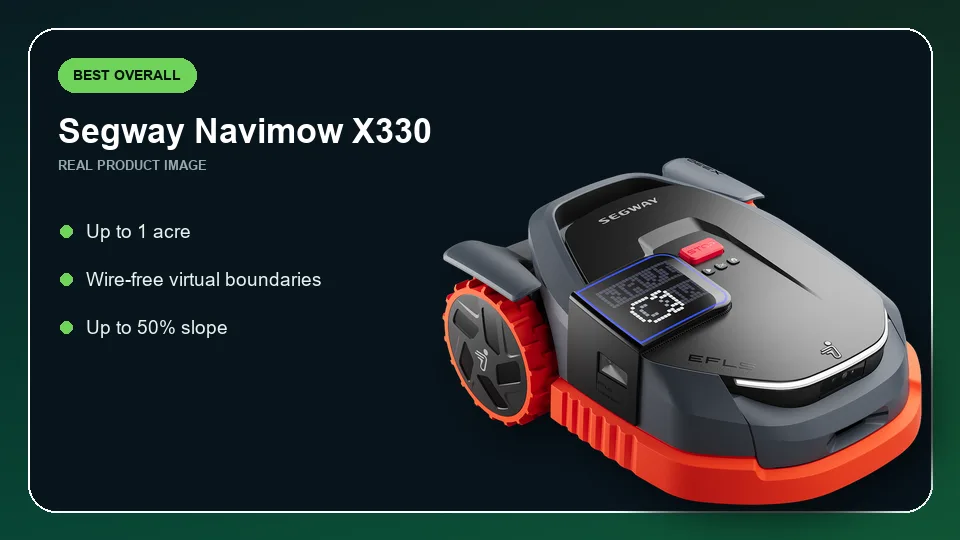
The Navimow X330 offers one of the most balanced combinations of coverage, speed, obstacle detection, and wire-free navigation. It is designed for lawns up to one acre, making it large enough for many suburban properties without pushing buyers into the highest-priced 1.5- or 2.5-acre models in the X3 range.
Its navigation system combines precise positioning with a wide field of view from multiple cameras and additional sensors. Virtual boundaries, mowing zones, and exclusion areas are managed through the app. Systematic mowing produces deliberate lines instead of the random movement associated with older robotic mowers.
Why We Picked It
The X330 is the strongest general recommendation because it does not specialize so heavily that it becomes impractical elsewhere. It covers a substantial area, handles moderate slopes, maps without buried wire, and offers a broad smart-control package. Buyers with a smaller lawn can step down to the X315, while larger properties can remain in the same product family.
Who It Is For
Choose the X330 for a medium-to-large lawn with several zones, landscaping features, or a mix of open and moderately obstructed areas. It is particularly appealing when fast, organized mowing matters more than extreme hill-climbing.
Pros
- Wire-free virtual boundaries
- One-acre recommended coverage
- Systematic cutting patterns and multi-zone control
- Strong obstacle-sensing hardware
- Several capacity options in the X3 family
Cons
- Premium purchase price
- Best results still depend on careful charging-station and antenna placement
- Not as capable on extreme slopes as a dedicated AWD mower
Key specifications: Up to 1 acre; up to 50% slope; virtual boundaries; app-controlled zones and schedules.
2. Mammotion LUBA 3 AWD — Best Robot Grass Cutter for Hills
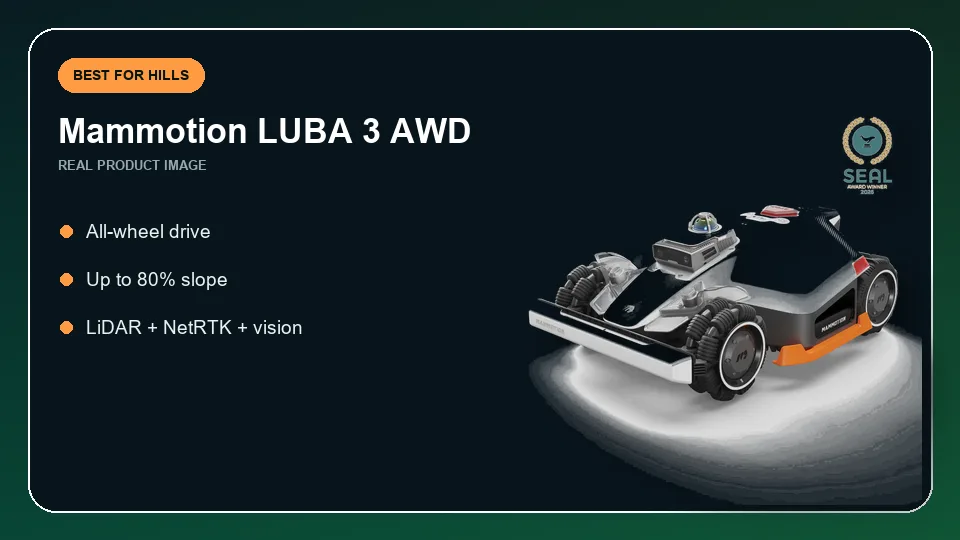
The Mammotion LUBA 3 AWD is built for lawns that expose the limits of conventional two-wheel-drive mowers. Its all-wheel-drive system is rated for slopes up to 80%, while its Tri-Fusion navigation combines 360-degree LiDAR, NetRTK positioning, and dual-camera AI vision.
The product family includes several coverage levels, so buyers can match the mower to the property rather than paying for unnecessary map capacity. Multi-zone mapping is useful for large or divided yards, and the wide dual-disc cutting system can cover open ground efficiently.
Why We Picked It
Traction is the reason to choose the LUBA 3. Where a light rear-wheel-drive mower may slip, stall, or damage the turf while trying to turn on a bank, the AWD chassis has more control. The combination of LiDAR, satellite positioning, and cameras also gives the mower several ways to understand its surroundings.
Who It Is For
This model suits large, uneven, or steep properties with multiple mowing zones. It is excessive for a small, flat rectangle, but compelling for lawns with banks, rough transitions, roots, or areas where satellite reception is inconsistent.
Pros
- All-wheel drive with excellent rated slope capability
- LiDAR, NetRTK, and camera navigation
- Wide cutting system
- Multi-zone mapping
- No buried perimeter wire or separate RTK installation required
Cons
- Large and expensive
- More mower than most flat suburban yards need
- Zero-turn behavior can disturb soft or wet turf if settings are too aggressive
Key specifications: Up to 80% slope; Tri-Fusion navigation; AWD; model-dependent coverage; up to 215 minutes of stated runtime on selected versions.
3. ECOVACS GOAT A3000 LiDAR PRO — Best for Edge Cutting
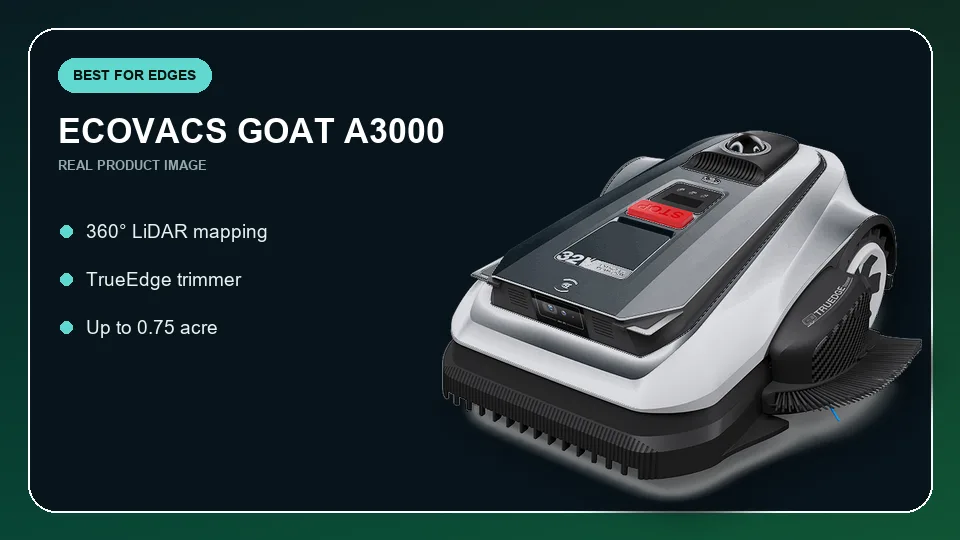
The GOAT A3000 LiDAR PRO is designed around two common complaints: complicated antenna placement and the strip of uncut grass left beside walls and borders. Its 360-degree LiDAR system can map without a perimeter wire or external RTK reference station, while the separate TrueEdge trimmer targets grass near boundaries.
The mower is rated for lawns up to three-quarters of an acre, uses a 13-inch main cutting width, and can work on slopes up to 50%. An AI camera supplements LiDAR for obstacle recognition.
Why We Picked It
Many robot mowers still leave enough grass at a fence or raised border that regular manual trimming is necessary. The GOAT’s dedicated edge-trimming hardware addresses that problem more directly than simply driving the cutting disc closer to the chassis edge.
Who It Is For
It is a good fit for medium-to-large lawns with walls, paths, borders, and complex shapes, especially where the homeowner wants automatic mapping without mounting an RTK antenna.
Pros
- 360-degree LiDAR mapping without an RTK station
- Dedicated edge-trimming system
- Strong 0.75-acre coverage
- Wide 13-inch main cutting path
- AI-assisted obstacle recognition
Cons
- Trimmer line adds another consumable
- Large chassis may be less suitable for tight passages
- Advanced hardware raises the price and maintenance complexity
Key specifications: Up to 0.75 acre; 50% slope; 13-inch cutting width; 1.2-to-3.6-inch cutting height; IPX6 mower body.
4. Husqvarna Automower 410 iQ — Best for Dealer Support
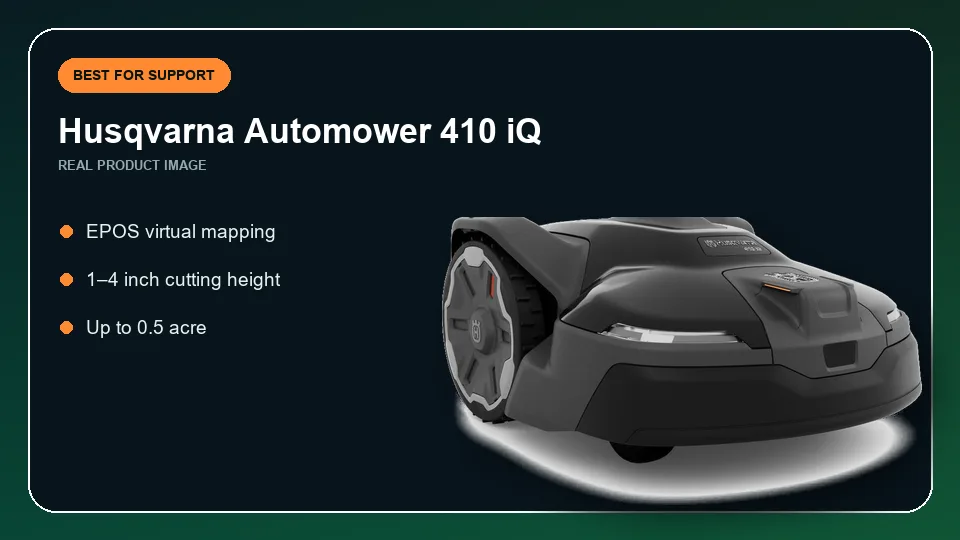
Husqvarna has been building robotic mowers for years, and the Automower 410 iQ combines that established ecosystem with modern virtual-boundary technology. EPOS mapping removes the need to bury a wire, and the Automower Connect app manages work areas, stay-out zones, schedules, and mowing patterns.
The 410 iQ is rated for lawns up to half an acre and slopes up to 45%. Its 1-to-4-inch cutting-height range is useful for homeowners who keep taller grass than many European-style robotic mowers allow. The included reference station and access to professional installation are also important for buyers who prefer support over do-it-yourself experimentation.
Why We Picked It
The 410 iQ is not the flashiest mower here, but ownership involves more than specifications. Replacement parts, dealer knowledge, installation help, documentation, and a mature app can be more valuable than one extra sensor.
Who It Is For
Choose it for a typical suburban property when you want wire-free mapping from an established lawn-equipment brand and value local service. It is also one of the better options for lawns maintained at a higher cutting height.
Pros
- Established mower brand and dealer network
- EPOS virtual boundaries
- Wide 1-to-4-inch cutting-height range
- App control and systematic mowing patterns
- Hose-washable mower body
Cons
- Expensive for half-acre coverage
- Reference-station placement still matters where cloud EPOS is unavailable
- Narrower cutting width than some large premium models
Key specifications: Up to 0.5 acre; up to 45% slope; 9.4-inch cutting width; 1-to-4-inch cutting height; IPX5.
5. eufy E18 — Best Robot Lawn Mower Without RTK
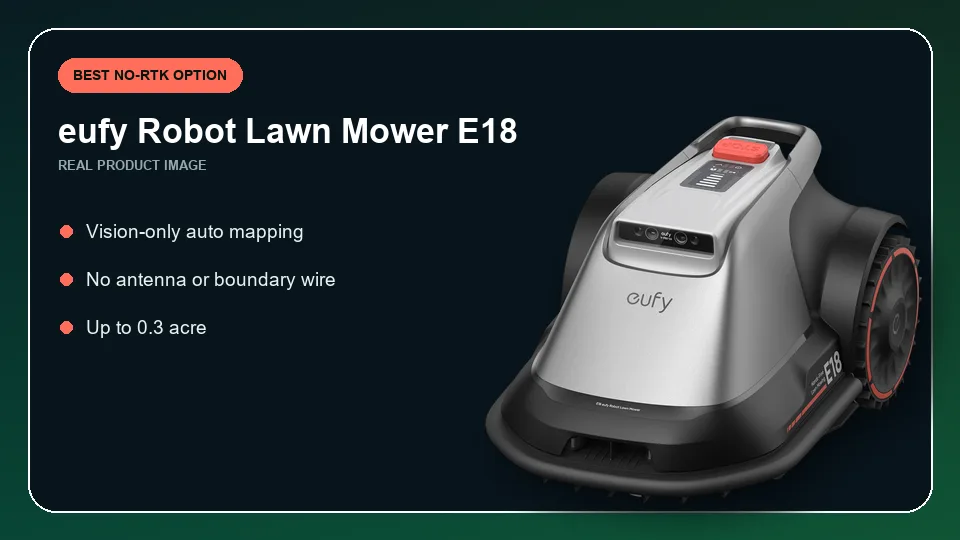
The eufy E18 takes a different approach from satellite-based mowers. Its V-FSD system uses cameras and visual algorithms to map the yard, identify boundaries, and avoid objects. It requires no buried wire and no RTK antenna, which can make initial setup simpler for a suitable lawn.
The tradeoff is that the E18 is intended for relatively flat, well-defined lawns. It covers up to 0.3 acre, handles slopes up to 18 degrees, and works best when grass and physical boundaries are visually clear. The 25-to-75mm cutting-height range, 56dB noise rating, multi-zone management, GPS tracking, and rain or low-light recall make it a practical small-yard option.
Why We Picked It
Some yards have poor satellite visibility or no convenient location for an RTK reference station. The E18 offers genuine automatic mapping without either requirement. For a flat lawn with clean boundaries, that simplicity is attractive.
Who It Is For
Choose the E18 for a small-to-medium, mostly flat lawn with obvious grass borders. Avoid it for steep banks, dense grass varieties the manufacturer excludes, large height changes, or poorly defined transitions between lawn and planting beds.
Pros
- No boundary wire or RTK station
- Automatic visual mapping
- Quiet 56dB operation
- Multi-zone control and GPS theft tracking
- Simple fit for well-defined small lawns
Cons
- Not intended for steep or rough terrain
- Smaller 0.3-acre coverage limit
- Visual navigation depends on suitable light and clear boundaries
- Manufacturer advises against some dense grass types
Key specifications: Up to 0.3 acre; 8-inch cutting width; 1-to-3-inch cutting height; 18-degree maximum slope; 56dB; IPX6.
How to Choose the Right Robot Grass Cutter
Measure the Actual Grass Area
Do not buy according to the total lot size. Measure only the grass the mower must maintain, then add reasonable headroom. A mower operating at its maximum published limit may need to work almost continuously during peak growing season.
Match the Navigation System to the Yard
RTK works well with a clear view of the sky but can be challenged by dense tree cover and tall structures. LiDAR performs well around physical features and does not need a satellite reference antenna. Vision-only systems are easy to install but rely on clear, recognizable boundaries and suitable lighting. Hybrid systems provide more redundancy, usually at a higher price.
Check Slopes, Not Just Lawn Size
Measure the steepest working area and the slope along boundaries. A mower may handle a steep section in the middle of the lawn but have a lower limit near a drop, wall, pond, or virtual edge. Wet grass and soft soil reduce usable traction.
Inspect Passages and Transitions
Record the narrowest gate, path, and corridor. Check whether the mower must cross paving, gravel, tree roots, curbs, or steps. Disconnected lawns may require a transport route, a second charging station, or manual carrying.
Be Realistic About Edge Cutting
A robot grass cutter rarely eliminates trimming everywhere. Flush paving allows some mowers to ride over the edge and cut closely. Walls and raised borders usually leave a strip. A dedicated side trimmer reduces that strip but introduces another consumable and safety consideration.
Budget for the Complete System
Include the mower, antenna or reference station, garage, installation, replacement blades, trimmer line, cellular service, batteries, winter storage, and possible repairs. The least expensive mower is not the best value if it needs frequent rescue or cannot maintain the entire yard.
Frequently Asked Questions
What is the best robot lawn mower in 2026?
The Segway Navimow X330 is the best all-around choice in this comparison because it balances one-acre coverage, wire-free mapping, systematic cutting, obstacle sensing, and app control. The best model for your yard may differ: LUBA 3 AWD is stronger on extreme slopes, while the eufy E18 is easier to install on a small, flat lawn without RTK.
Do robot lawn mowers need a boundary wire?
Many current models do not. They use RTK satellite positioning, LiDAR, cameras, or a combination of sensors to create virtual boundaries. Older and entry-level models may still use a buried wire, which can remain reliable but requires more installation work.
Can a robot grass cutter handle hills?
Yes, within its rated limit. Standard two-wheel-drive models often handle moderate slopes, while AWD products such as the Mammotion LUBA 3 are designed for much steeper terrain. Always check both the working-area slope and the lower slope limit that may apply near boundaries.
Will a robotic mower collect grass clippings?
Most do not. They cut small amounts frequently and leave fine clippings to decompose as mulch. This works best when the mower follows a regular schedule and does not have to reduce very tall grass in one session.
Are robot lawn mowers safe around pets and children?
Modern mowers use lift sensors, bumpers, cameras, radar, or other obstacle-detection systems, but they still contain moving blades. Schedule mowing when the lawn is clear, supervise children, remove small toys, and follow the manufacturer’s safety guidance.
How often should a robot mower run?
Frequency depends on grass growth, lawn size, weather, and mower capacity. Many owners schedule several sessions per week or short daily sessions during peak growth. Avoid mowing waterlogged ground, and reduce frequency during heat, drought, or slow growth.
Can robot mowers cut to the edge?
They can cut closely along flush paths, but raised borders and walls usually leave some grass. Models with offset cutting discs or a dedicated trimmer can reduce manual edging, though no design is perfect for every boundary.
How long do robot lawn mower blades last?
Blade life varies with mowing hours, grass type, soil, sticks, stones, and moisture. Small pivoting blades may need replacement several times per season. Inspect them regularly and replace the full set together to keep the cutting disc balanced.
Can a robot lawn mower work under trees?
It depends on the navigation system and canopy density. RTK-only models may lose precision beneath heavy cover. LiDAR and vision can help in those areas, which is why hybrid navigation is valuable for complex yards.
Is a robot lawn mower worth the cost?
It can be worthwhile when mowing consumes several hours each week and the lawn suits autonomous operation. The value is lower for tiny, irregular yards that still require extensive trimming or for properties where the mower must frequently be carried between disconnected areas.
Final Verdict
The best robot lawn mower is determined by the yard, not by the longest feature list. The Segway Navimow X330 is the most balanced choice for many medium-to-large lawns. The Mammotion LUBA 3 AWD is the specialist for steep, rough terrain. ECOVACS offers the most direct answer to edge trimming, Husqvarna provides a mature ownership ecosystem, and the eufy E18 simplifies installation for smaller lawns that suit vision-only navigation.
Before buying, measure the mowable area, slope, narrowest passage, tree cover, and boundary type. Then choose the navigation and drive system that solve those specific problems. That approach will save more time than buying the most powerful robot grass cutter and hoping the yard adapts to it.
Latest Reviews
Best Smart Glasses in 2026: 6 Top Picks for AI, AR and Sport

8 Best Smart Rings in 2026: Oura, Galaxy Ring & More
5 Best Birthday Card Makers for Creative Designs in 2026

YuE2-3B Review: Local AI Music, Suno Comparison & ComfyUI

5 Best Business Card Makers in 2026
Onepage.io Review 2026: Is This AI Website and Funnel Builder Worth It?