

In November 2025, the AI music platform Suno suffered a data breach that exposed the personal information of more than 55 million users. The incident included email addresses, phone numbers, physical addresses, and partial payment card details. The breach was not publicly disclosed until July 2026, eight months after it occurred, when the dataset appeared on Have I Been Pwned.
Most of those 55 million users had no idea their data was sitting in a criminal marketplace for the better part of a year.
Suno is not an isolated case. Between January 2025 and February 2026, researchers documented at least 20 separate security incidents across AI-powered applications, exposing the personal data of tens of millions of users. A single AI wrapper app (one of those tools that provides a unified interface to ChatGPT, Claude, and Gemini) left its entire database publicly readable due to a misconfigured security setting, exposing 406 million records including 18 million user profiles and hundreds of millions of message logs.
The pattern is consistent. AI platforms accumulate personal data quickly, grow fast, and do not always grow their security infrastructure at the same pace. For the people who use these platforms regularly, the early adopters, the tool reviewers, the technically curious, the exposure surface is wider than most realize.
How Identity Theft Changed When AI Entered the Picture
Identity theft used to be a relatively slow, manual, and opportunistic crime. Attackers harvested credential dumps, tested them against common platforms, and moved on to the next target. The process was limited by human bandwidth: there were only so many accounts an attacker could test, so many phishing emails a team could write convincingly, and so many fraud schemes a criminal network could run simultaneously.
AI removed those constraints almost entirely.
Phishing emails generated by large language models are now, according to multiple security researchers, nearly indistinguishable from legitimate communications. They reference real names, real employers, and recent activities pulled from public sources and data broker profiles. A 2026 report on generative AI threats documented a 148% surge in AI-generated impersonation scams year-over-year. The emails no longer have the grammatical errors and generic templates that trained users to spot them.
The impersonation problem extends beyond email. Deepfake-generated audio and video can now bypass voice biometric systems used by financial institutions. Deepfake usage in biometric fraud attempts surged 58% year-over-year according to the Entrust 2026 Identity Fraud Report, while injection attacks, where attackers bypass verification systems by feeding manipulated images or video directly into them, rose 40% in the same period. Synthetic identity fraud, in which criminals fabricate complete personas with no real-world counterpart, is projected to cost businesses between $20 billion and $40 billion globally each year.
The FBI took note. In its 2025 Internet Crime Complaint Center Annual Report, the first time in the IC3’s 26-year history that it introduced “AI-related” as a formal crime category. The agency logged over 22,000 AI-related complaints with nearly $900 million in attributed losses. Researchers broadly agree this is a significant undercount, because most victims of AI-powered phishing or voice clone fraud never identify AI as the mechanism of the attack.
Why AI Tool Users Face a Specific and Underappreciated Risk
The general population uses a handful of platforms with relatively stable privacy policies. People who actively evaluate, review, and adopt AI tools occupy a different position entirely.
A typical AI enthusiast might have active accounts across a dozen or more platforms: AI writing assistants, image generators, audio tools, video editors, coding companions, research tools, chatbot wrappers. Each signup is a data point: an email address, often a phone number, sometimes a payment method. Each platform has its own data retention policy, security posture, and breach history. Most users never check any of these.
In 2025, security researchers discovered over 225,000 OpenAI and ChatGPT credentials for sale on dark web markets, not because OpenAI was breached, but because infostealer malware on user devices harvested login credentials and sent them elsewhere. The platform was not the weak link. The aggregation of accounts was.
This is the specific vulnerability that active AI tool users carry: not a single exposure, but the cumulative effect of many accounts, many platforms, and many data points distributed across services with varying levels of security. Any one of those platforms being breached (and the Suno incident makes clear that breaches in this space can go undisclosed for months) means that personal information has been in criminal circulation long before its owner finds out.
The credentials from a breached AI tool account do not stay isolated. They get cross-referenced against other platforms, tested through automated credential stuffing tools, and added to data broker packages that build increasingly detailed profiles of individuals. The more tools someone actively uses, the more data points exist to cross-reference.
The Gap That Standard Security Tools Do Not Cover
The response most users have to general cybersecurity risk is reasonable: keep devices updated, use a password manager, enable two-factor authentication where possible, run antivirus software. These measures address the device and the login. They do not address what happens to personal data after it has left the device and landed on a third-party server.
A password manager does not tell users that their email address appeared in a breach three months ago. An antivirus program does not alert users that their phone number is being sold as part of a data broker package. Two-factor authentication protects against unauthorized login attempts but cannot undo the fact that credentials are already in circulation.
The missing layer is identity monitoring: continuous scanning of sources that ordinary browsing cannot reach: dark web forums, breach databases, credential dumps, data broker listings, with alerts generated when personal information surfaces in any of them. It is a category of tool designed specifically for the after-the-fact problem: not preventing data from leaving a platform, but knowing when it has and responding before someone else acts on it.
What PureVPN Identity Threat Protection Does
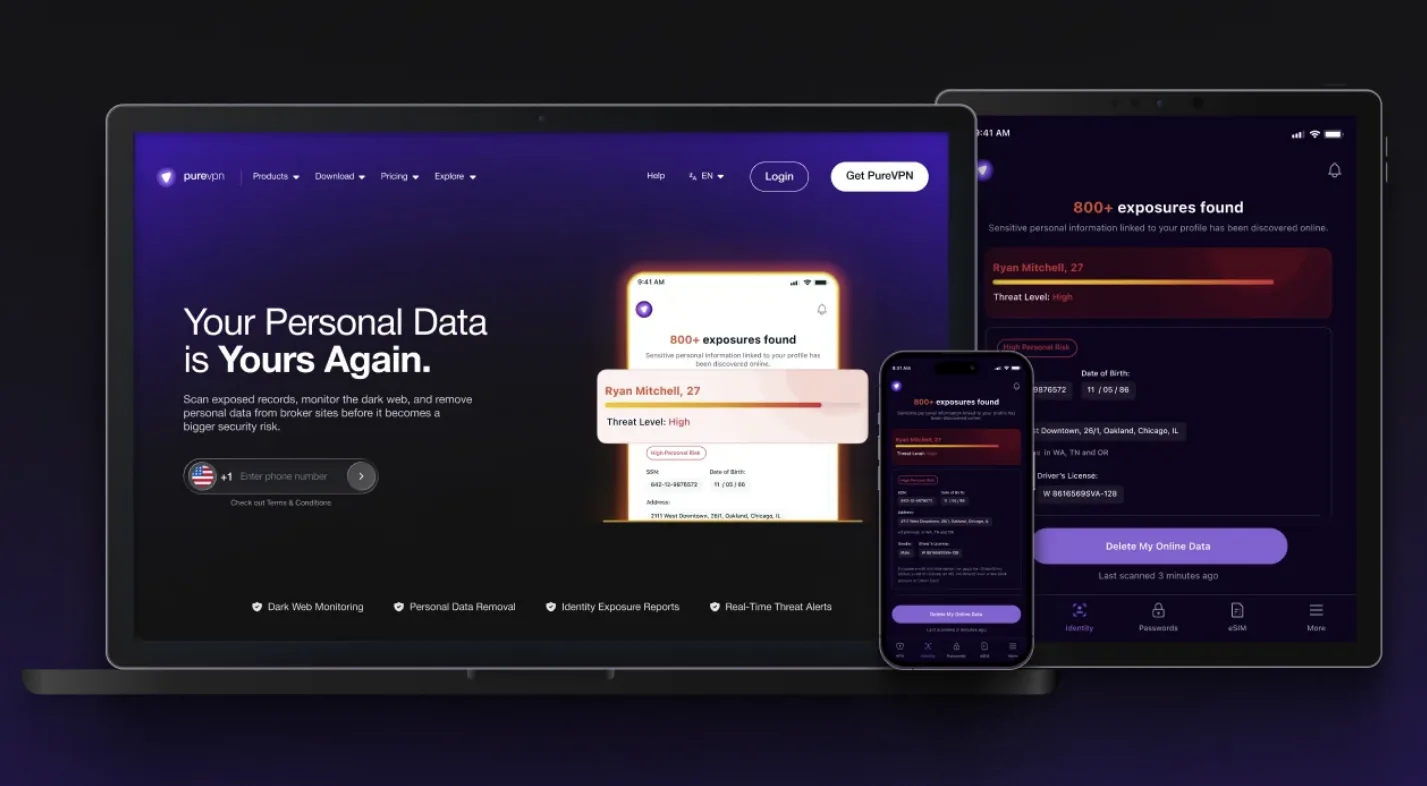
PureVPN Identity Threat Protection operates in this monitoring category. The service continuously scans breach databases, dark web sources, and data broker listings for personal identifiers, then generates alerts and provides guidance when exposure is detected. It monitors across five categories of personal identifiers: email addresses, phone numbers, credit card numbers, passport numbers, and national identification numbers. These are the same data points that appear most frequently in breach datasets and that carry the most downstream risk when compromised.
The service runs across Windows, Mac, iOS, Android, and major browsers, which means it covers the multi-device reality of how most active AI tool users actually operate. Alerts include context on what was found and where, along with recommended next steps rather than generic notifications.
For someone who has signed up for a significant number of AI platforms over the past two to three years, the first useful thing monitoring does is establish a baseline. It surfaces exposure that already exists: old credentials, email addresses in breach dumps, personal data in broker listings, that the user may have had no visibility into. From that baseline, ongoing monitoring adds alerting for new exposure as it appears.
Other services in this category include similar functionality, and the right choice depends on which identifiers a user most needs to monitor and which platforms they prioritize. What makes PureVPN relevant for active AI tool users specifically is the breadth of identifier coverage and the cross-device support, both of which match the distributed, multi-platform usage pattern that creates the exposure in the first place.
A Practical Note on Timing
Most people think about identity monitoring after something goes wrong. A breach notification arrives. A fraudulent charge appears. An account is locked out by someone else’s login attempt. At that point, the monitoring becomes reactive, useful for damage assessment but not for prevention.
The more effective intervention is establishing monitoring before a problem surfaces. Given that the Suno breach sat undisclosed for eight months, and that credential dumps often circulate for months or years before victims are notified, there is a meaningful window between when exposure occurs and when a user finds out. Continuous monitoring narrows that window, which is where most of its practical value lies.
For anyone who has been actively using AI tools since the generative AI wave began in 2022 and 2023, there is a reasonable probability that at least one of those platforms has had a security incident that went unreported or underreported. Running a check is a reasonable first step. Setting up ongoing monitoring is a reasonable second one.
The Larger Picture
AI has genuinely changed the identity threat landscape. The attacks are more convincing, the automation is faster, and the data being weaponized against people is more detailed than it has ever been. The specific vulnerability of active AI tool users, wider account footprints and more data points distributed across more platforms, is a structural feature of how these tools are adopted, not a fixable behavior.
The response does not need to be complicated. Standard security hygiene covers most of the device and login layer. Identity monitoring covers what happens to personal data after it has already left a platform. Together they address most of the practical risk surface that active AI tool users carry without requiring technical expertise or significant time investment.
The threat got smarter. The tools to manage it got more accessible at roughly the same time.
Related
The 8 Best Speech to Text AI Tools in 2026: Features, Reviews, and Real-World Use Cases

Best AI Image Extender and Outpainting Tools

AI Email Subject Line Generator: Best Tools to Write Better Email Hooks
Best AI Game Translation Tools for PC Games and Visual Novels
Best AI Avatar Generators to Create Profile Pictures, Videos, and Digital Humans
Best AI Diagram Generators for Workflows, Ideas, and Visual Planning