Reseña de ERNIE-Image: IA de imagen open source, LoRA, uso local y NSFW
ERNIE-Image es un modelo de generación de imágenes open source pensado para usuarios que necesitan control, texto visible, diseño comercial y despliegue local. No destaca…

ERNIE-Image es un modelo de generación de imágenes open source pensado para usuarios que necesitan control, texto visible, diseño comercial y despliegue local. No destaca solo por muestras bonitas, sino por tareas prácticas como carteles, composiciones con texto y diseños estructurados.
Si solo buscas el resultado online más cómodo, Qwen Image 3.0 o una herramienta comercial puede ser más directa. Pero si valoras licencia abierta, control local, ComfyUI, LoRA y versiones cuantizadas, ERNIE-Image merece una prueba seria.
Índice
Veredicto rápido
| Item | ERNIE-Image |
|---|---|
| Ideal para | Local image generation, posters, layouts, text-heavy visuals, commercial design drafts |
| Más débil en | A smaller LoRA ecosystem than FLUX, SDXL, Pony or Illustrious |
| Model | 8B Diffusion Transformer with Prompt Enhancer |
| License | Apache 2.0 |
| Turbo | ERNIE-Image-Turbo for faster 8-step generation |
| VRAM | 24GB VRAM is the comfortable target; GGUF/FP8/NVFP4 can reduce the entry point |
| NSFW | More flexible locally than many hosted services, but not an adult-specialized model |
Qué es el modelo
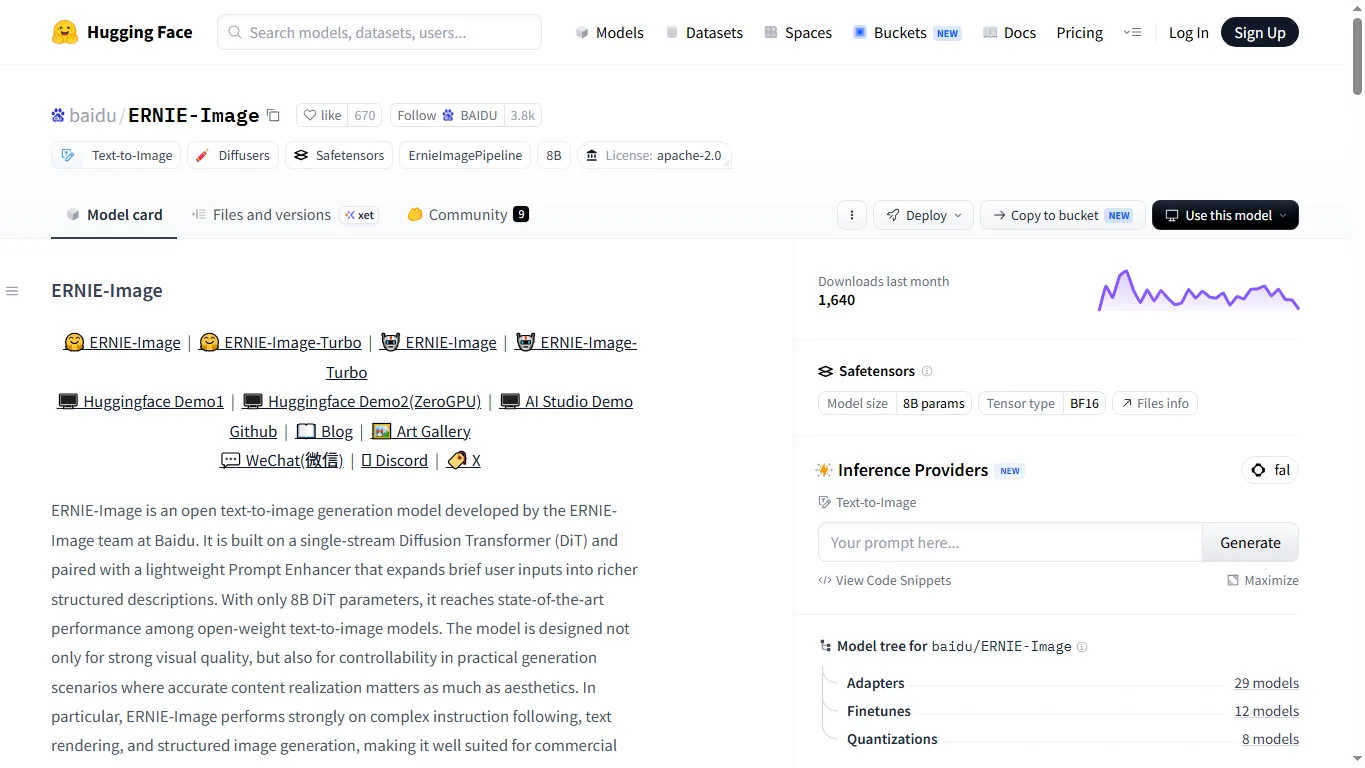
ERNIE-Image is published at baidu/ERNIE-Image and focuses on controllable text-to-image generation. Its official materials emphasize instruction following, text rendering, structured layouts and practical design use cases.
The model is especially interesting for people who need posters, menus, social media graphics, product mockups, comics-style panels or any image where text and layout matter. It is less mature if your main goal is to collect hundreds of character LoRAs.
Prueba online y descargas
You can start from the official download page ERNIE-Image, the faster ERNIE-Image-Turbo, the Baidu AI Studio demo, the GitHub repository and the Comfy-Org package.
| Resource | Link | Use |
|---|---|---|
| Base model | ERNIE-Image | Highest flexibility |
| Turbo model | ERNIE-Image-Turbo | Fast drafts |
| ComfyUI | Comfy-Org/ERNIE-Image | Node workflow |
| GGUF | Unsloth GGUF | Lower VRAM testing |
| Turbo GGUF | Turbo GGUF | Fast quantized experiments |
Instalación local y hardware
For the full local workflow, a 24GB VRAM GPU is the easiest baseline. On 16GB or 12GB GPUs, use quantized branches, lower resolution, CPU offload and memory-saving ComfyUI settings. On 8GB cards, online demos or hosted inference are usually less frustrating.
| Hardware | Expectativa realista |
|---|---|
| 24GB VRAM | Comfortable local testing |
| 16GB VRAM | Possible with optimized or quantized workflows |
| 12GB VRAM | Experimental; expect compromises |
| 8GB VRAM | Not recommended for full model workflows |
Diferencias entre versiones
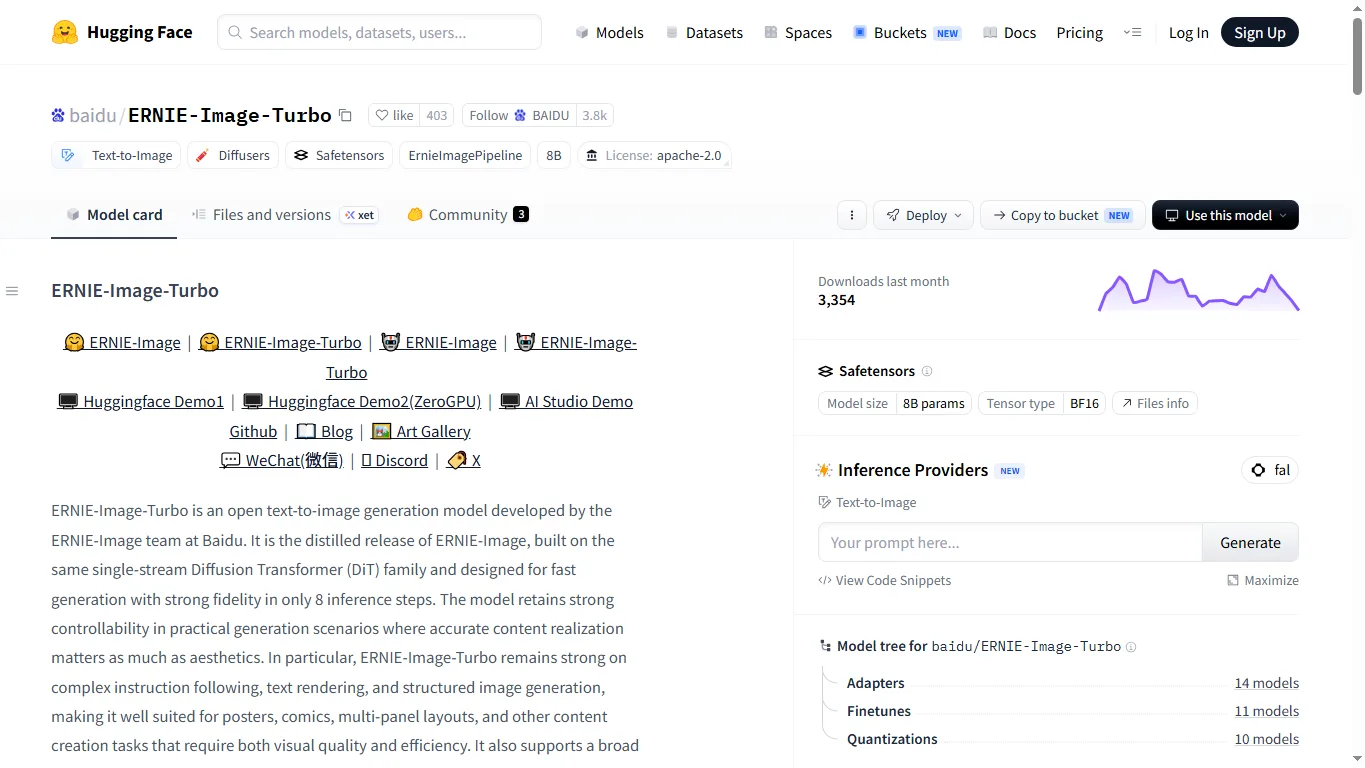
The base version is better for maximum quality and adaptation. The Turbo version is better when speed matters, especially for repeated prompt testing and draft generation. Start with Turbo to explore prompts, then move to the base model if the final image needs more detail.
LoRA, cuantización y comunidad
The ecosystem is still young, but useful deployment resources already exist: GGUF builds, Turbo GGUF builds and ComfyUI packages. For LoRA discovery, use Civitai's ERNIE Image search and always check the base model before downloading.
Compared with SDXL or Pony, ERNIE-Image has fewer character/style assets. Its current advantage is more about open deployment, text/layout tasks and a practical commercial design direction.
Comparación con otros modelos
| Model | Best at | Note |
|---|---|---|
| ERNIE-Image | Text/layout and open local design workflows | Apache 2.0, young ecosystem |
| Qwen Image | Dense layout and multilingual visual text | Qwen Image review |
| Nucleus Image | Sparse MoE efficiency | Nucleus Image review |
| Z-Image | Fast local generation and finetunes | Z-Image review |
| FLUX | Mature general image workflow | Large ecosystem |
Compatibilidad NSFW
Local ERNIE-Image workflows are more open than many hosted tools because you control the model and safety layer. Still, ERNIE-Image is not mainly an adult model, and online demos may filter mature content. Dedicated NSFW finetunes may be stronger for that specific use case.
Avoid illegal or abusive use, including underage sexual content, non-consensual real-person sexualization, harassment, impersonation and rights violations.
Preguntas frecuentes
Is ERNIE-Image open source?
Yes, the official model is published under Apache 2.0, but check derivative LoRA or quantized licenses separately.
Should I use the base or Turbo version?
Use Turbo for fast drafts and the base model for final quality or adaptation experiments.
Is it good for text in images?
Text and structured layout are among its key strengths, but exact typography still needs regeneration and checking.
Referencias
Conclusión
ERNIE-Image is most valuable for users who want an open, controllable local image model for practical visual design. It is not yet the richest LoRA ecosystem, but it has a clear place among current open image models.
Relacionados Reseñas
Los 6 mejores creadores de currículums con IA en 2026

Los 10 mejores convertidores de audio a texto en 2025 — Gratis y de pago

Los 8 mejores tutores de IA en 2026

Los 6 mejores generadores de códigos QR gratis en 2026
Best 5 Dubbing AI Tools Of 2026
6 Best AI Face Swap Tools for Video Face Swap Projects in 2026